An IT manager plans, coordinates and directs computer-related activities, setting the organization's technology goals before any system is chosen to serve them. The seat is leadership over goals, money, people and risk, not a senior version of the help desk.
That distinction explains a pattern most internal promotions get wrong. The strongest troubleshooter on a support team usually wins the manager job and then struggles, because the deliverable changed. Nobody grades a manager on the ticket closed at 4pm. They grade the manager on whether the project got funded, whether the new hire started on time, whether the vendor renewed at a defensible price, and whether the last outage produced a change that stuck.
Technical depth still matters. A manager who has never administered a system can't tell a real constraint from a lazy one, and gets sold whatever the vendor's sales engineer wants to sell. The knowledge just moves from the keyboard to the design review, the budget line and the risk register.
The practical test: if requests for money, headcount and risk ownership land on your desk, you're managing IT. If they land on someone else's desk and you're still taking tickets, you're not.
Table of Contents
- What an IT Manager Is Accountable For
- A Normal Week of IT Manager Work
- Pay and Job Growth for IT Managers
- Security Work as an Operating Capability
- Where the Role Sits and How People Reach It
- Decide Whether the Role Fits You
What an IT Manager Is Accountable For
The U.S. Bureau of Labor Statistics occupational outlook for computer and information systems managers describes the role as professionals who "plan, coordinate, and direct computer-related activities." It also puts the sequence in the right order: managers determine the organization's IT goals first, then implement systems that support those goals.
That ordering is worth taking seriously. Goal before system means every purchase, hire and upgrade answers to a business need someone can name out loud. In practice the role combines technical oversight with budgeting, staffing, vendor management and business planning, which is why a good job description reads more like an operations brief than a list of software.
Five areas carry most of the accountability. Each splits into a decision the manager owns and hands-on work somebody else performs:
| Responsibility | What the manager decides | Who does the hands-on work |
|---|---|---|
| Technology needs | Analyze requirements, recommend upgrades, justify funding | Systems analysts and project leads |
| Hardware and software operations | Direct installation, maintenance and upgrades | Support technicians and systems administrators |
| Cybersecurity | Set processes to detect, prevent and mitigate threats | Information security analysts |
| People and vendors | Set staffing, supervise specialists, manage suppliers | Developers, analysts and support staff |
| Business alignment | Turn goals into IT plans, budgets and risk controls | Department leads and finance partners |
Money decisions come before tool decisions
Managers assess the costs and benefits of proposed projects and justify funding before a purchase happens. The key test is almost never whether a tool is decent. It's whether the benefit this year outweighs the cost this year, and whether that money beats the sixteen other requests competing for the same budget. A manager who can't defend a spend in business terms loses the argument to a colleague who can.
Direction is not the same as doing
Directing the installation and maintenance of hardware and software is a supervisory act. The manager sets the standard, sequences the work, owns the outcome and answers for it when the upgrade breaks something at month end. Support technicians and systems administrators perform the work. To see how narrow the execution specialties become below the manager line, compare the split between systems administrator and network administrator roles: each is a full job with its own depth, and neither one carries budget authority.
The people side is just as concrete. Managers determine personnel requirements, supervise specialists such as systems analysts, software developers, information security analysts and support technicians, and manage the suppliers who provide everything from hardware to managed detection.
The scope varies more than the title suggests
Some managers oversee an entire IT department. Others lead one defined function, such as infrastructure, user support or cybersecurity, with a budget and a team sized for that slice alone. Titles differ by employer too: chief information officer, chief technology officer and management information systems director are comparable leadership roles, though the first two normally carry enterprise-wide scope rather than a department.
Read the table as a filter for any role you're evaluating. A duty in the left column belongs to the manager even when the manager can do the right-column work faster and better. A duty that appears only in the right column belongs to someone else's job, and a manager who keeps doing it is either covering a staffing gap or avoiding the work they were hired for.
A Normal Week of IT Manager Work
What does an IT manager do all week? Mostly, they make decisions with incomplete information before the first coffee. The compensation attached to that calendar is the reason the seat stays competitive:
Monday answers what broke
The week opens with triage that has consequences. What failed over the weekend, which failures are still open, which systems are degrading, and what can wait until Thursday without hurting anyone. The manager isn't diagnosing the fault. The manager decides who works on it, whether to pull people off planned work, and whether a customer or an executive needs to hear the news before they discover it themselves.
Midweek belongs to projects, vendors and people
An upgrade proposal lands: does the cost justify itself this quarter, what breaks if it slips, and what's the rollback. A supplier review follows: did the vendor hit the service level, and if not, what remedy does the contract provide. Deciding whether a request is worth doing at all takes more judgment than deciding how to do it.
Staff time is recurring, never leftover. One-to-ones, a hiring loop, a performance conversation that can't be postponed, and clearing a blocker for an analyst who's been waiting three days on a firewall change. Ticket trends count as a staffing signal, not noise: a category creeping up every month usually means a tool gap or a missing person, and the manager is the only one positioned to act on it.
A useful shape for the weekly numbers review: bring availability, open security items, project spend against budget, and ticket trends. Everything else is commentary.
Friday is for what changed
Platform changes, licensing terms, end-of-support dates and pricing shifts arrive whether or not anyone schedules time for them. The BLS definition puts a duty on managers to monitor changing technology so that purchasing, installation and upgrade decisions stay aligned with operational needs, and that happens in a standing slot, not in the gaps between meetings.
What the calendar doesn't show
Treat the split as orientation rather than a standard. Close to half the week goes to planning, vendors and meetings; the rest divides between people leadership and unplanned operational work. A major outage rearranges all of it, and a manager at a 60-person company still touches systems because there's nobody else to hand them to.
A good week leaves three things behind: funded work, a staffed queue, and fewer repeat incidents than the week before.
Pay and Job Growth for IT Managers
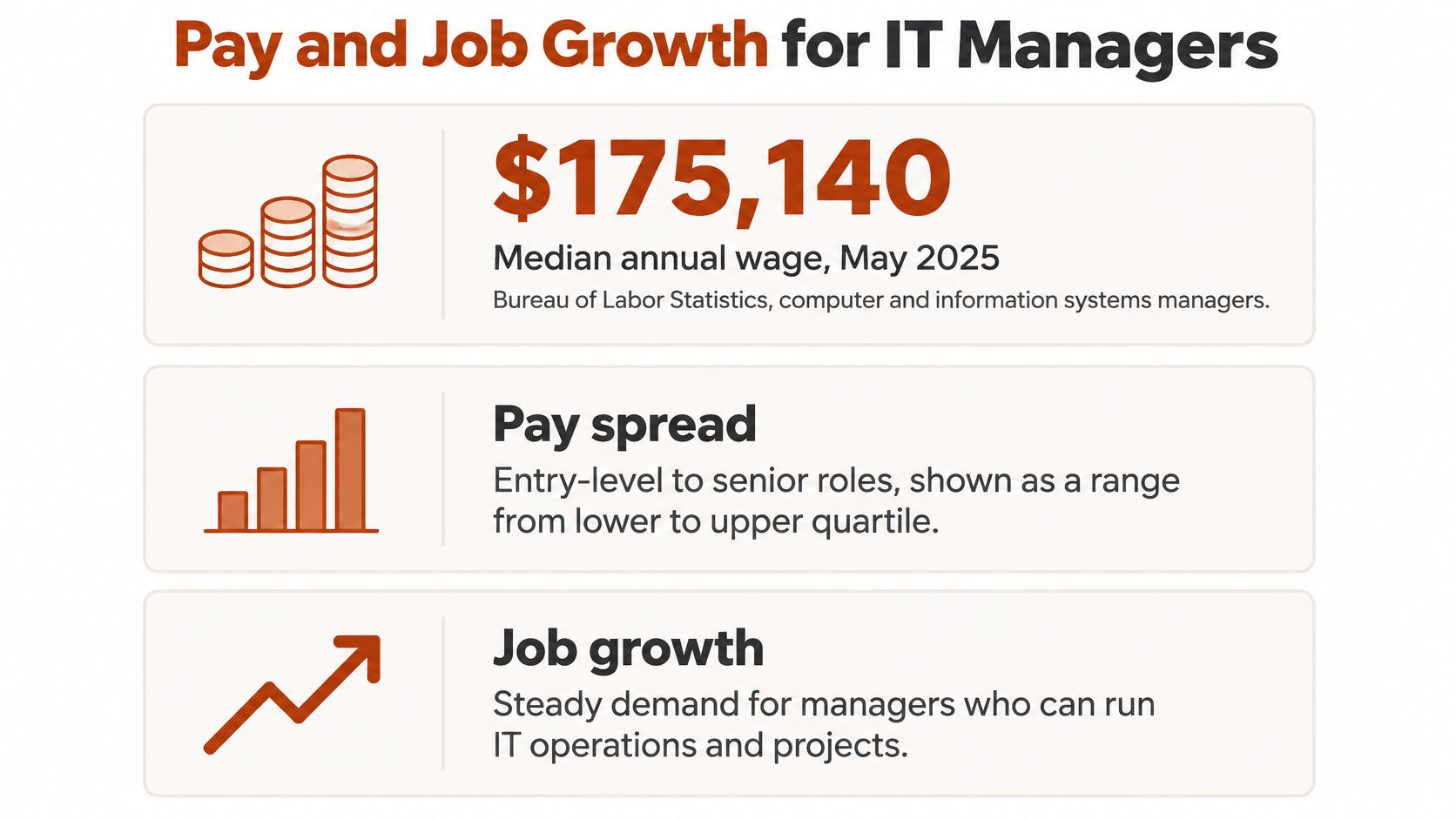
IT managers sit at the top of Mojolin's tracked tech roles for median annual pay: $175,140. The Bureau of Labor Statistics' outlook for management occupations reports this median for computer and information systems managers in May 2025.
The median is a midpoint, not a promised salary. The pay spread and employment outlook show how earnings vary across the occupation:
The May 2023 occupational estimates for computer and information systems managers report about 592,600 jobs, a mean annual wage of $180,720 ($86.88 an hour), and a median of $169,510. The 10th percentile was $101,590; the 90th was above $214,050. The median was $171,200 in 2024, and employment is projected to grow 15.2% from 2024 to 2034, considerably faster than the average for all occupations.
| Measure | Figure | Period |
|---|---|---|
| Median annual wage | $175,140 | May 2025 |
| Median annual wage | $171,200 | 2024 |
| Employment | 592,600 jobs | May 2023 |
| Mean annual wage | $180,720 ($86.88 an hour) | May 2023 |
| Median annual wage | $169,510 | May 2023 |
| 10th percentile annual wage | $101,590 | May 2023 |
| 90th percentile annual wage | Above $214,050 | May 2023 |
| Projected employment growth | 15.2 percent | 2024 to 2034 |
What the percentiles actually tell you
The median splits the occupation into two halves: one earns more, the other less. Percentiles show the range around that midpoint. The 10th percentile marks the lower end of the distribution; the 90th marks the threshold above which the highest-paid tenth earn.
Pay varies with industry, location, employer size, responsibility and experience. A manager accountable for a broad operation may earn differently from one leading a smaller team with a narrower remit. The title alone does not tell you which part of the distribution is relevant.
Read the median as a midpoint, not a target. A first manager role at a regional manufacturer and a director seat at a bank both sit within the occupation, but their scope and pay can differ substantially.
A short overview of the role puts the pay range in context:
Use $175,140 as a national midpoint for May 2025, not a quote for a particular city, industry or title. For a comparison across technology roles, Mojolin's information systems management salary breakdown places the figures side by side.
Security Work as an Operating Capability
An incident tests whether security responsibilities are clear before systems fail. The IT manager is accountable for readiness, decisions and communication; security specialists handle the technical investigation.
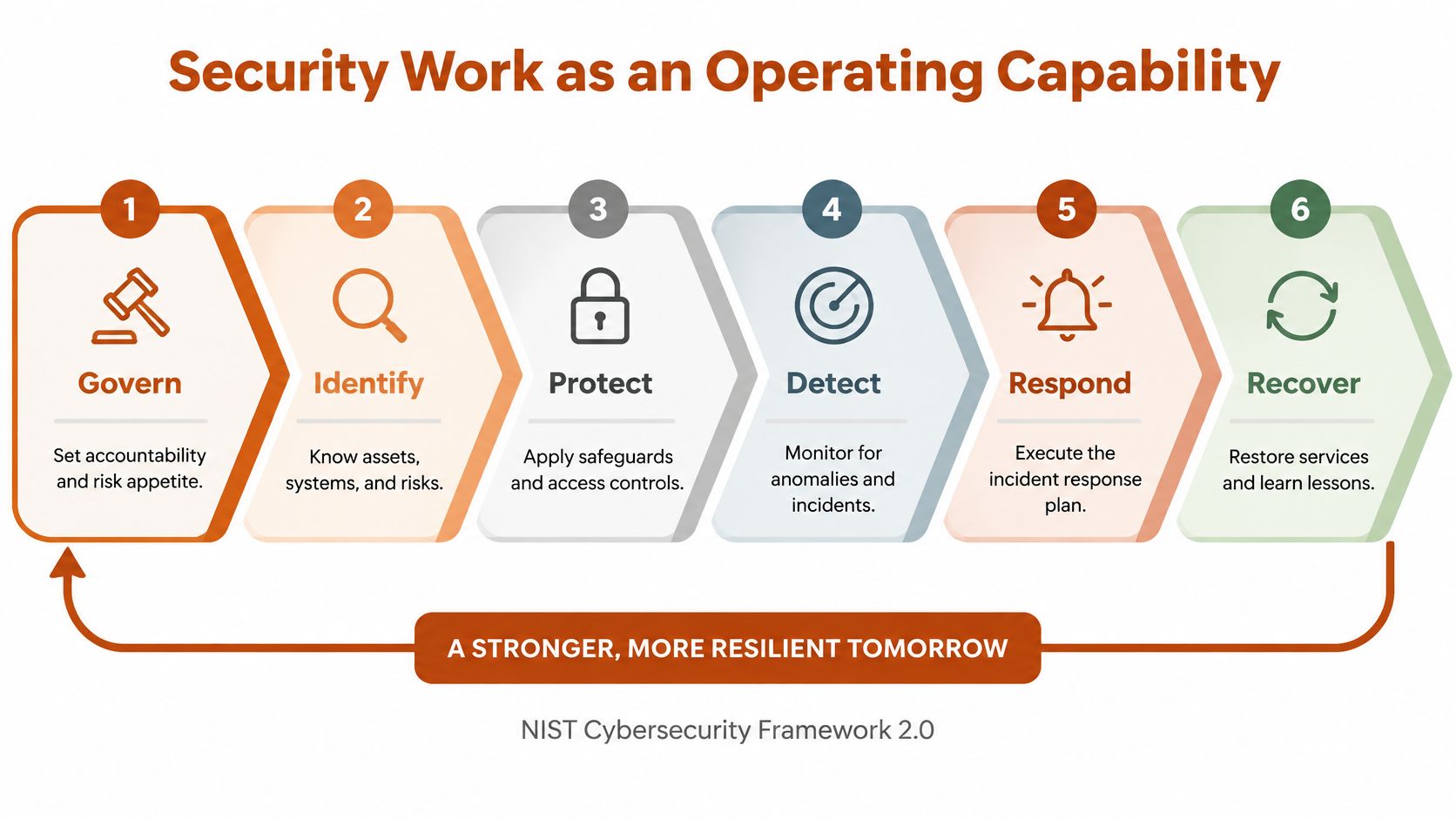
A mature response capability is maintained year-round, not assembled during an outage. NIST's Cybersecurity Framework 2.0 organizes cybersecurity work into six functions. The first three establish the conditions for the final three.
The six functions, in order
- Govern: Assign accountability and set how risk decisions are made when priorities conflict.
- Identify: Track the assets and systems the business depends on, along with the risks that could harm them.
- Protect: Reduce exposure, control access and prepare the people and resources a response will require.
- Detect: Monitor important systems and confirm that coverage works as intended.
- Respond: Prioritize, contain and eradicate threats, then coordinate reporting and communication with the right parties.
- Recover: Restore service and use a lessons-learned review to improve the response plan.
What the manager actually maintains
The manager maintains a tested response plan, clear escalation paths, monitoring coverage, recovery procedures and a review process that leads to changes. Specialists investigate the technical details. The manager sets priorities, assigns decision-making authority and coordinates communication, including decisions about when to notify customers.
These duties connect security preparation to business continuity. Buying a security product does not establish who declares an incident, who approves containment or how service will be restored. NIST places incident response within broader cybersecurity risk management, so preparation comes before detection in the framework: readiness helps limit impact, while coordinated response helps contain disruption and restore operations.
A quick test for any IT manager job description: if security appears only as a budget line for tools and licenses, ownership of the operating process is missing.
Where the Role Sits and How People Reach It
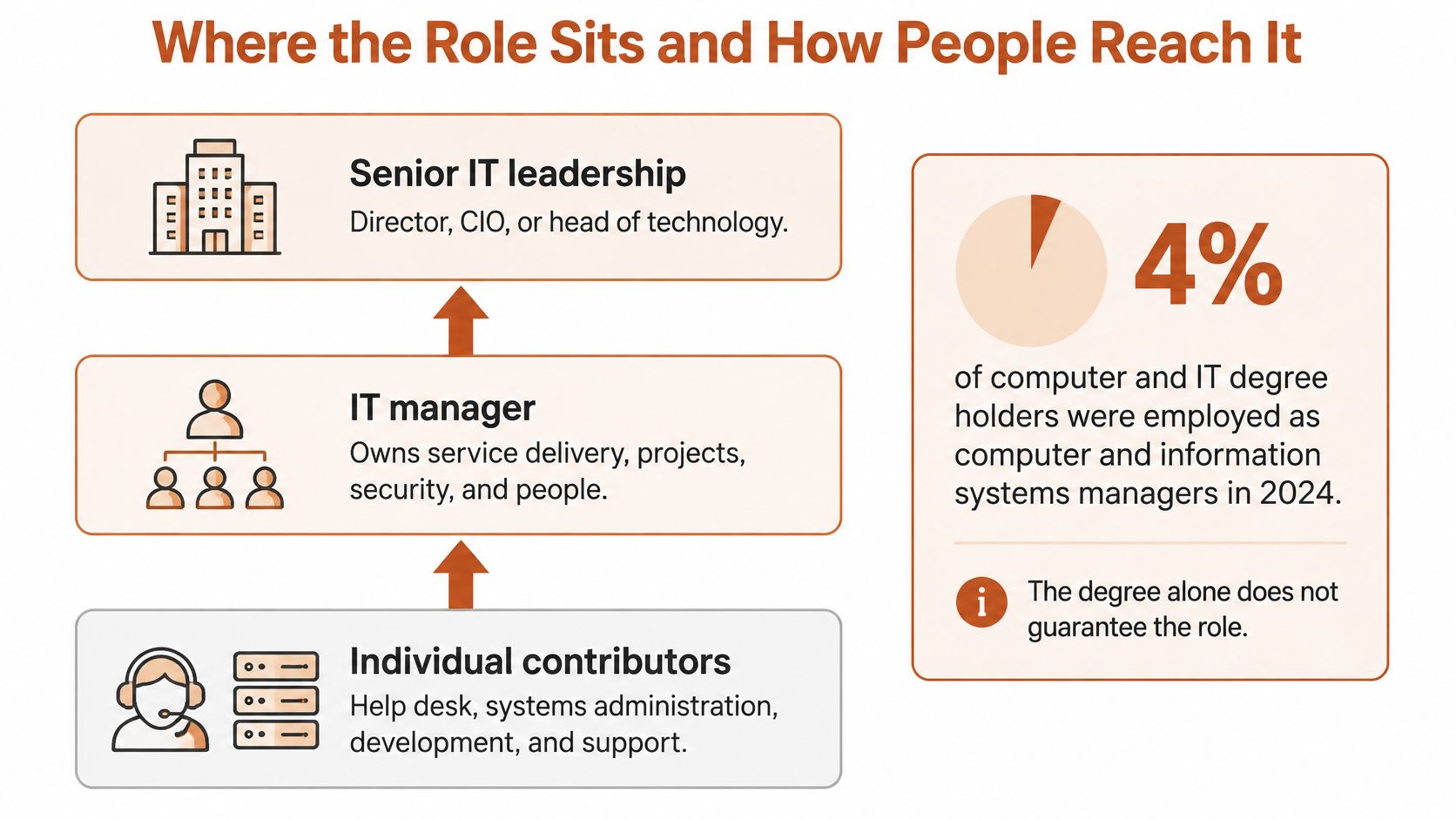
The degree alone doesn't place anyone in the seat. The Bureau of Labor Statistics field-of-degree data for computer and information technology reports that 4% of workers with a computer and information technology degree were employed as computer and information systems managers in 2024. Many people holding that credential were doing something else with it.
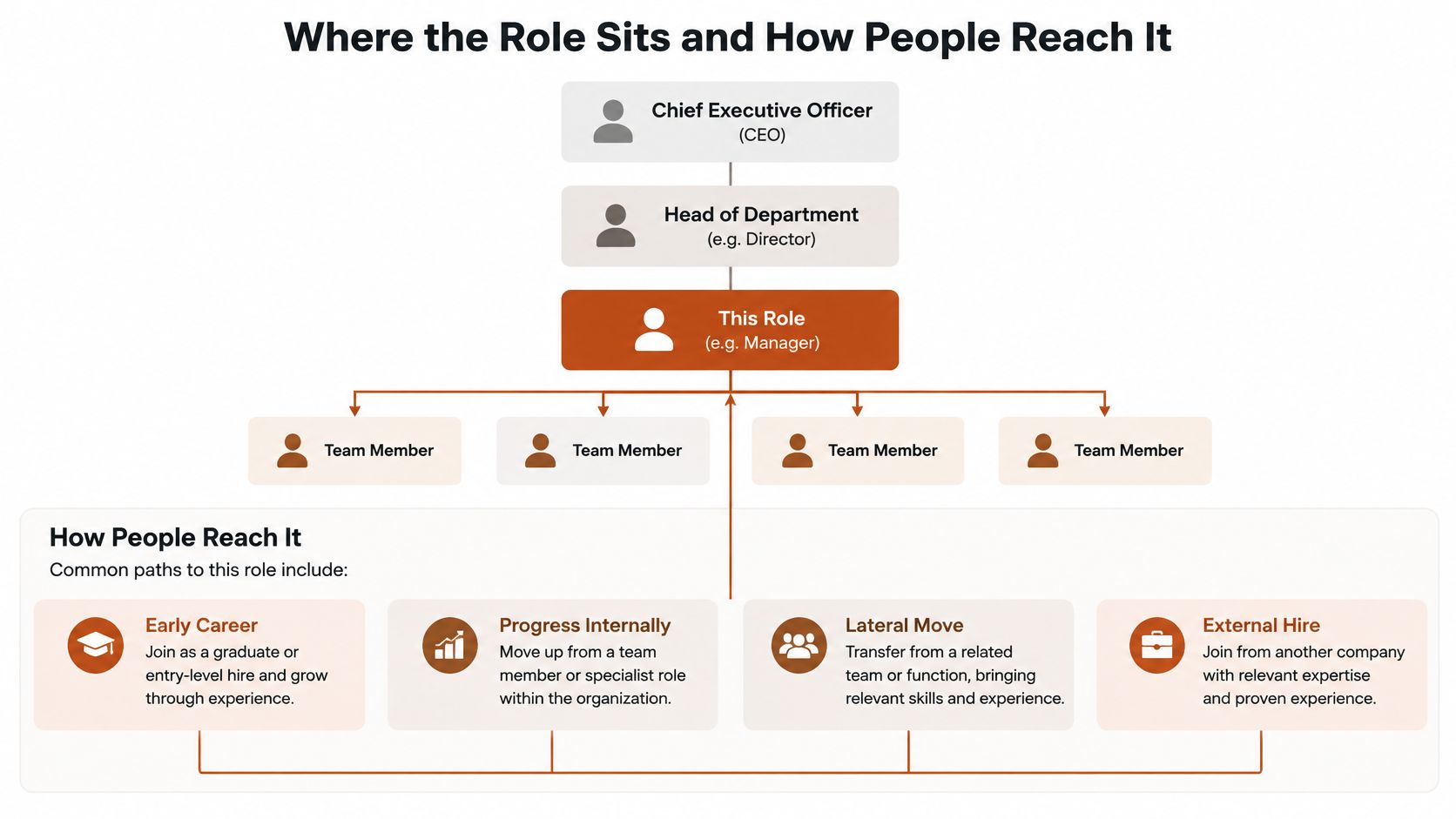
The reporting stack, top down
Executives such as a chief information officer or chief technology officer set enterprise direction and major investment choices. The IT manager turns that direction into operating plans for a department or a single function. Specialists build, secure and support the systems underneath.
A building superintendent is the closest analogy. The owner decides to renovate. The superintendent schedules the crews, holds the budget, books the inspections and answers when something fails code. The trades do the work. Nobody expects the superintendent to hang drywall personally, and nobody expects the owner to run the site.
Three scopes behind one title
The first is a department manager covering infrastructure, applications and support, usually with several team leads underneath. The second is a function manager who owns one slice, such as user support or cybersecurity, with its own budget, vendors and staffing. The third is the small-company case, where one person holds the title and still does some hands-on work. That last version is an edge case rather than the occupation the BLS describes, and candidates should check which one a posting means.
The route in, staged
Almost nobody is hired straight into the seat. The usual sequence runs through hands-on IT first, then leading a team or a function, then a manager role with budget and vendor accountability. Network architect work, for comparison, typically asks for a bachelor's degree and five or more years of experience, and hardly anyone starts there either: the path runs from help desk or network support to network administrator or engineer, then senior engineer, then architect.
The entry point is open. Mojolin's IT support specialist page notes that no prior experience is required to enter the role, and that moderate-term on-the-job training is typical once you're in it. For the sequence in more detail, this guide to how to become an IT manager maps the moves from first-line support to budget ownership.
Three wrong pictures worth correcting
- It isn't a promoted help-desk job. The measurement changes completely. Ticket volume stops being the scorecard and uptime, security posture and delivery replace it.
- It isn't a project manager or a software engineering manager. A project manager schedules a defined effort with a start and an end. An engineering manager leads developers on a product. The IT manager owns ongoing service, which never ships and is never finished.
- It isn't an entry role that certifications provide access to. A CompTIA A+ opens help desk work as the standard first certification. It doesn't open purchasing authority or a staffing budget.
A posting worth applying to shows supervision of specialists, a budget, vendor decisions and accountability for uptime or security outcomes. A posting that lists desktop builds and password resets has a bigger word in the title than the job behind it.
Decide Whether the Role Fits You
The role suits someone who wants accountability for other people's technical work, for spending and for risk, and who already understands how systems are built and how they fail at 2am. It's the wrong next step for someone who wants to stay hands-on most of the day, and it's not an answer to a first IT job search.
Three checks, in order:
- You've led people or a function, not only systems. Mentoring, owning a project end to end, or running a shift counts. Being the person everyone asks for help doesn't.
- You can explain a technology spend in business terms. Cost against benefit, the case for funding, and the cost of not doing it, in language a finance partner accepts.
- You accept being measured on uptime, security and delivery rather than your own ticket volume or your own commits.
The pay gap makes the trade-off concrete. IT support specialists have a median pay of $61,860, network architects sit at $134,050 in 2025 with the middle 80% between $79,900 and $202,680, and IT managers hold the highest median of the technology roles Mojolin tracks. Mojolin's role profiles collect 14 technology roles with BLS pay, job counts and ten-year outlook in one place, which is the fastest way to see where the manager rung sits against the specialties beneath it.
One action follows from all of it. Write down the decisions you already make against the responsibility table: funding, staffing, vendors and risk. If those columns come up empty, plan the next hands-on or team-lead step rather than applying for the manager title. If they're full, the title is already lagging behind the work.
Mojolin publishes sourced pay, employment and outlook data for 14 technology roles, including the IT support, systems administration and architecture jobs that feed into management, so the comparison above is one page rather than six browser tabs. It also covers the entry paths and certification decisions that come before a manager seat, from help desk training to exam costs and renewal rules. Start with the Mojolin careers data and check where the role you're aiming at sits.