You already run the thing. You're the person pulled onto the outage bridge at 11pm, the one who knows why the billing cluster falls over at quarter close, the one junior engineers copy on every question. Your manager spends her day in meetings, and half of what she does looks like work you could handle. So you start reading about how to become an IT manager.
Every guide you open hands you the same thing: a ranked list of certifications. That list is the least useful part of the answer. Panels don't hand out management titles for credentials. They hand them to people who can point at a budget they owned, a vendor decision they made and defended, an incident they ran, and a number that moved because of them. Titles follow evidence.
The reward for getting this right is real. IT managers have a median annual pay of $175,140, the highest of the technology roles Mojolin tracks.
Table of Contents
- Pick the Starting Track That Leads to IT Management
- Build the Technical Credibility Managers Need
- Lead Projects Before You Have the Title
- Add the Governance, Budget and Vendor Skills
- Interview Loops for IT Manager Roles
- Pick Your Track and Build Evidence This Quarter
Pick the Starting Track That Leads to IT Management
Almost nobody enters IT management from outside. The U.S. Bureau of Labor Statistics treats computer and information systems management as a role people grow into from a technical job. It lists a bachelor's degree, usually in computer science, information technology, engineering technology or management information systems, as the typical entry education, and 5 years or more of related work experience as the norm. No formal on-the-job training requirement attaches to the role. The degree is a filter. The five years is the gate.
The paper requirement is softer than the headline suggests. In the same occupational profile, O*NET respondents reported that 48% require a bachelor's degree for new hires, 26% require some college without a degree, and 14% require a master's degree. A strong technical record and a demonstrated ownership trail can outweigh a missing diploma, though the credential question returns the further up you go.
Find the row that matches your target team
Experience requirements are not generic. They're shaped by the team you want to run, which is why the specialization matters more than the job title on your future business card.
| Target manager role | Typical starting role | Experience to build first |
|---|---|---|
| Help desk or service desk manager | Computer support specialist | Ticket queue ownership, escalation handling, staff scheduling |
| IT security manager | Information security analyst | Incident response, risk assessments, audit evidence |
| Network or infrastructure manager | Network or systems administrator | Change management, capacity planning, on-call leadership |
| Cloud or platform manager | Cloud or DevOps engineer | Cost control, deployment pipelines, vendor contracts |
The pattern holds across all four rows. A help desk manager usually comes up through computer support, an IT security manager through information security analysis, an infrastructure manager through systems or network administration. Hiring managers reach for the candidate who has already survived the team's worst day, not the one with the widest certificate folder.
Two questions sharpen the plan faster than any salary survey. Match the track to the team you want to run, not to whichever title pays best this year. Then ask a current manager in that team which role they hired from last time, and what the successful candidate had done before. That answer is your syllabus.
The market and the ceiling
Field size isn't your constraint. The United States had an estimated 592,600 computer and information systems manager jobs in 2023, according to BLS occupational employment statistics, so the openings exist at every level of the ladder.
If you're not yet inside a technical role, the entry point is support work, which the Mojolin guide to entry-level IT jobs maps out, and Mojolin's IT support specialist page notes that no prior experience is required to enter the role. The climb from there is visible rather than mysterious. Almost nobody is hired straight into the network architect seat, because the usual path runs from help desk or network support to network administrator or engineer, then senior engineer, then architect.
One caution before you commit. IT director and chief technology officer roles need many more years of broad technical and leadership scope than a first-line manager job, so choose your track for the next role, not for the top of the ladder. Pick one track and one target team in your own organization now, and use that choice as the filter for everything below.
Build the Technical Credibility Managers Need
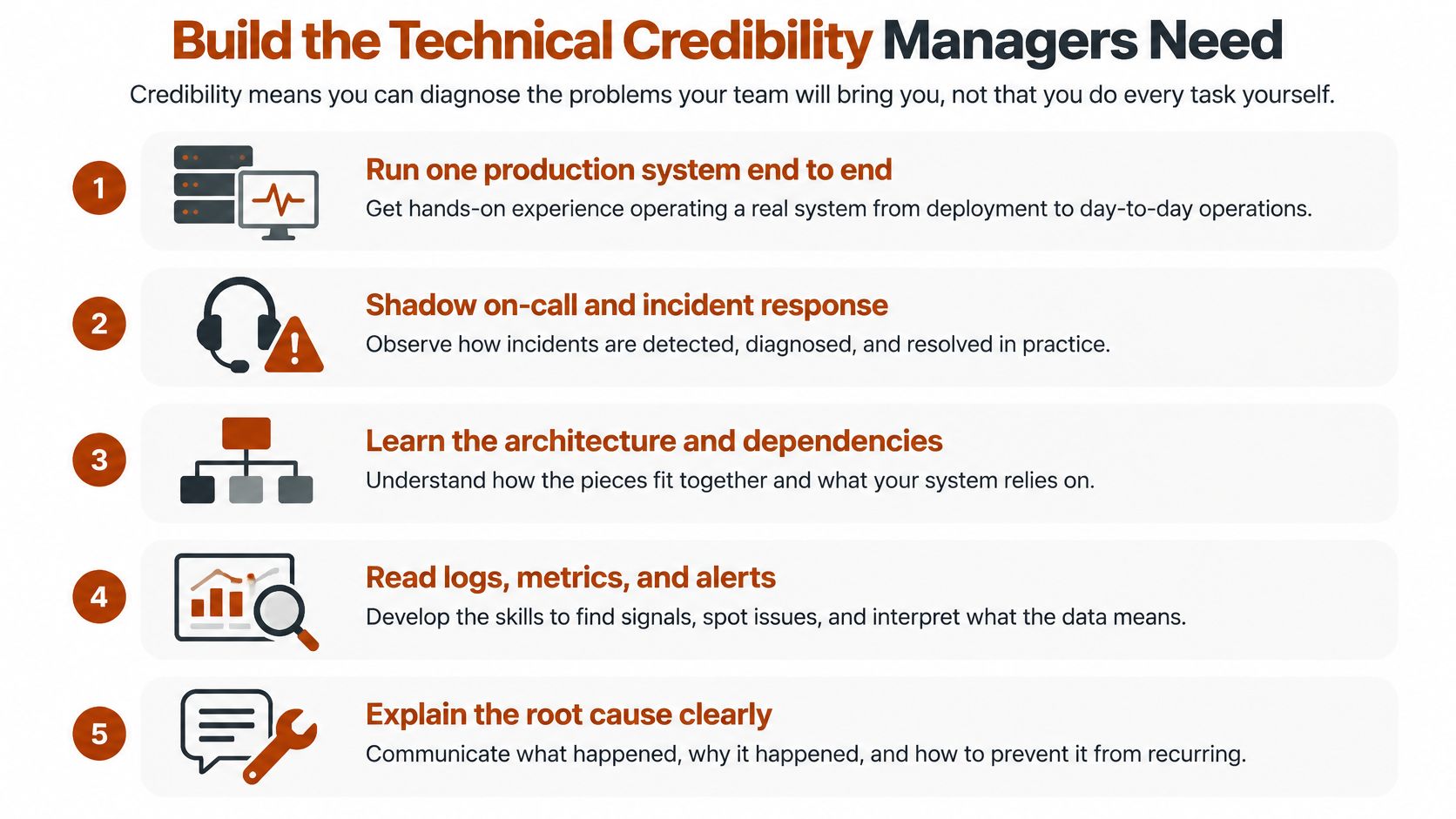
Credibility as a manager means you can diagnose the problems your team brings you. It does not mean you do every task yourself, and it certainly doesn't mean you win the argument about the config file. A manager who has never run a production system can't tell whether a request for more capacity is real, and the team learns to route around them within a quarter.
Run one production system end to end
Own the whole thing: patching, backups, monitoring, and a recovery test you have performed and documented. The common slip is reading about the system instead of operating it. Nobody is impressed that you understand the backup architecture if you've never restored from it while someone is watching the clock.
Learn one cloud platform properly
Most architect and manager roles now assume working knowledge of AWS, Azure or Google Cloud. Mojolin's network architect page notes that cloud networking knowledge from AWS, Azure or Google Cloud is now expected for most architect roles, which tells you where the baseline sits. Learn one platform's networking, identity and cost model. Not three of them badly.
Add the certification that matches your track
One credential, chosen against the track you picked, is enough at this stage. Mojolin's IT support specialist page identifies CompTIA A+ as the standard first certification for help desk work, and a Cisco CCNA is the common early milestone for networking roles. Collecting both plus four more proves only that you can pass exams. To compare what each one asks of you, Mojolin's comparison of IT certifications sets exam prices, exam lengths and renewal rules side by side.
Automate one recurring task and measure it
Take a job your team repeats every week, script it, and record the hours it frees. The number is the point, because it gives you an outcome to report rather than a hobby project to mention. Keep the script in version control with a README, so it survives your move to another team.
Write a runbook someone else can follow
Then dry-run it with a colleague who has never touched the system. Every place they stall is a gap in your documentation and a preview of the questions your team will bring you at 2am. This is also the artefact that most convincingly answers "have you ever handed work over" in an interview.
The five-minute test: Can you explain your team's architecture and its single biggest risk to a non-technical executive in five minutes, without drawing anything?
Lead Projects Before You Have the Title
Leadership without a title is proven through delivery, not through enthusiasm. The strongest candidates for a first management role can point to a change they drove across functions where nobody reported to them, and they can produce the numbers. Here is the sequence that works, in the order it should happen.
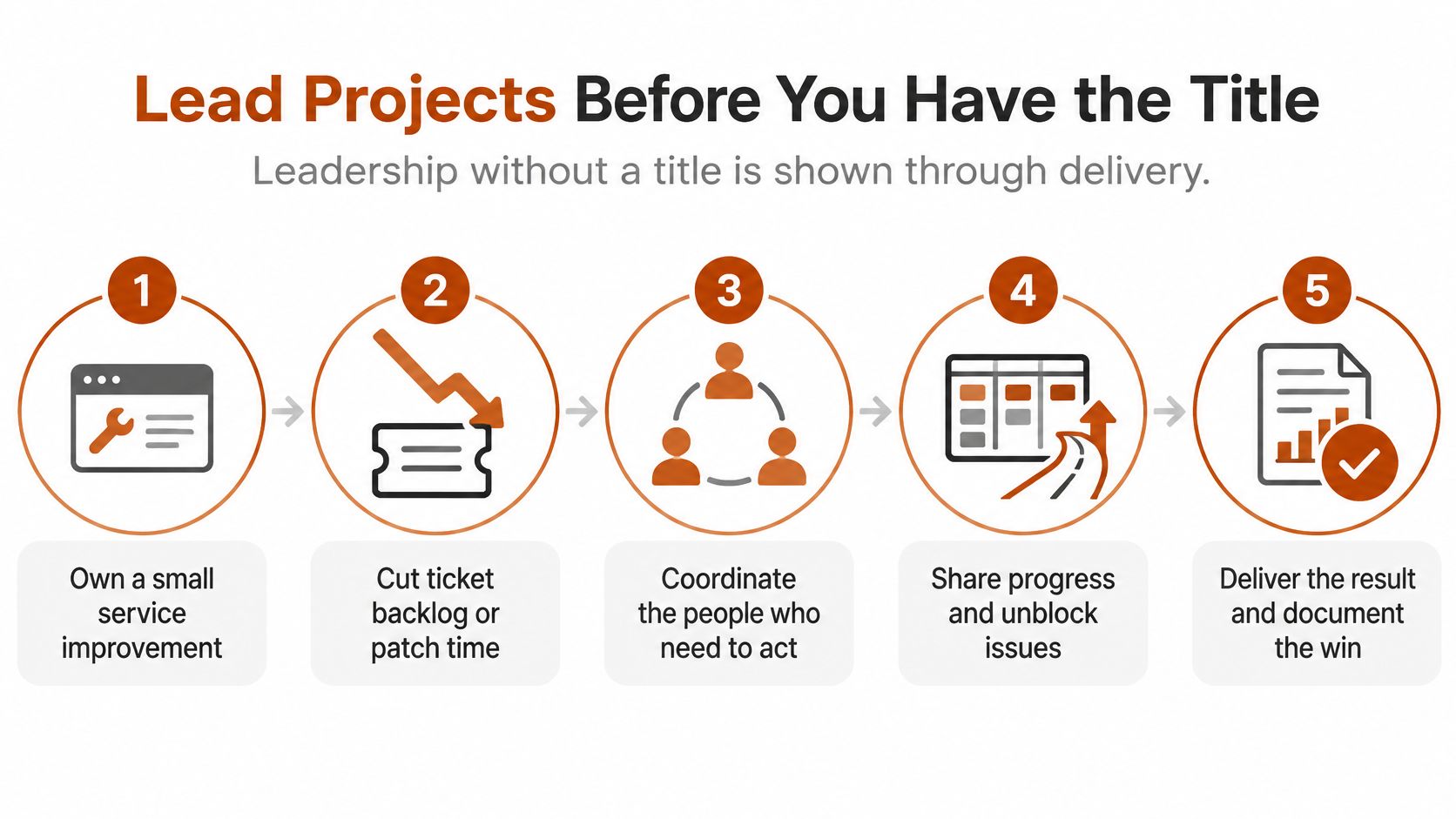
- Own a small service improvement. Shorten patch time, drain a ticket backlog, kill a noisy alert. Small enough that nobody else is competing for it, visible enough that people notice when it stops working.
- Record the baseline before you change anything. Ten minutes in a spreadsheet. Without a before number, every later claim about improvement is an opinion.
- Define scope, risks and who signs off. One page. Name the person who can veto it, because that's the person your future hiring manager will call for a reference.
- Run a documented delivery cadence. A three-line weekly note (what shipped, what's blocked, what you need) does more for a promotion case than a heroic fortnight. Reliability is what people remember when a role opens.
- Report the benefit after launch using the measured change. "Backlog down from 240 to 60 tickets in nine weeks" survives a follow-up question. "Led a backlog initiative" doesn't.
- Scale to work involving vendors, budgets or several teams. One project proves you can deliver. A second that crosses a contract or a cost line proves you can be trusted with a department.
A hiring manager can test a before-and-after number. A list of activities can't be tested, which is why senior engineers with eight years of solid work lose roles to colleagues with four years and two documented outcomes.
The salary association explains why certification gets so much attention. PMI's 2025 survey reports that PMP-certified respondents in the United States had a median salary of $135,000 against $109,157 for non-certified respondents, roughly a 24% difference. That's an association in survey data, not proof the credential causes the gap. The people who sit the exam are usually the people already running projects.
Earn the credential after the work, not instead of it
The PMP validates structured project knowledge, and it should follow real delivery rather than substitute for it. Map your experience against scope, schedule, cost, risk, stakeholders and benefits first, then close the gaps with supervised project ownership and study. Three pitfalls sink otherwise strong applications: treating a credential as a promotion guarantee, reporting activity instead of outcomes, and never quantifying the trade-offs you chose. Mojolin's guide to project management certifications is a reasonable place to check what each one requires before you spend the money.
When you write the story up, track three outcomes and nothing else: cycle time, production incidents and adoption. Those three cover most of what a panel wants to hear, and each one has a number attached.
Add the Governance, Budget and Vendor Skills
Senior engineers often stall at this point. Someone can be the best troubleshooter on the floor and still lose a management interview to a candidate who has never racked a switch but has run a renewal negotiation and can explain a cost variance to a finance partner without flinching.

Own a number and defend it
Forecasting renewals and tracking cost per service are learnable in a quarter. The skill under test is explaining variance: what moved, why, what you did about it, and what happens next quarter. Finance doesn't want an apology for an overspend. They want the driver and the correction.
Score vendors instead of preferring them
Build a one-page scorecard and score two or three proposals on the same sheet: total cost across the contract term, service levels with penalties attached, exit terms if you leave, and the security review outcome. Most vendor decisions go wrong in the exit terms, not the headline price, and the manager who catches that is the one who looks ready for a budget.
Set the rules rather than only following them
Data stewardship, access policy, a risk register with owners and dates, a change board that meets on a fixed day. These are unglamorous artefacts that prove you can govern rather than administer. They also produce the interview answer every panel asks for and few candidates have ready.
Judge AI claims instead of collecting AI certificates
The instinct to bolt on an AI credential misses what the evidence says the job now needs. The 2025 AI Workforce Consortium report found that 78% of ICT roles included AI-related technical skills, while human capabilities such as communication, collaboration, leadership and problem-solving were increasingly prioritized for responsible adoption. The same release points to OECD analysis that fewer than 1% of workers need advanced AI skills, while most need broader digital, data-interpretation, managerial and human skills.
The implication for a candidate is narrow and useful. You don't need to become an AI engineer. You need enough fluency to judge vendor claims and deployment risk, then evidence of governance: an AI-use policy for your team's tooling, a risk assessment of one proposed tool, a data-classification exercise, or an adoption business case with a cost and a stop condition. Those four pieces are portfolio evidence. A certificate that proves you attended a course is not.
The people evidence sits beside the money evidence
Budget and vendor artefacts show you can handle resources. People management is the other half, and it's the part panels probe hardest because it's easiest to fake on paper. Four concrete actions generate the proof:
- Run one hiring loop. Write the scorecard, sit the interviews, and record why you advanced or rejected each candidate.
- Hold a monthly 1:1 with a junior colleague and keep notes on their goals and blockers, then follow up on both.
- Own on-call fairness, the rota and the escalation rule, including what happens when someone is asleep and the pager goes off twice.
- Give one piece of written performance feedback tied to a measured outcome rather than a personality comment.
Put those next to the vendor scorecard and the AI-use note and you have a packet that answers the only question that matters in a management loop: can this person be trusted with money, risk and other people's careers?
Interview Loops for IT Manager Roles
A panel is testing whether you can run a team with a capped budget and fewer people than the work needs. Technical depth gets you through the door and stops being the differentiator after round two. Before you rehearse anything, list the four to six capabilities that separate someone who would do well in the role from someone who would struggle. Scope control, incident judgement, budget trade-offs, stakeholder communication, people decisions and measured results cover most first-line manager roles.
| Stage | What it tests | How to prepare |
|---|---|---|
| Recruiter or manager screen (about 30 minutes) | Fit, scope and salary range | A two-sentence summary of your last project, team size and budget |
| Technical round | Depth in your chosen track | One outage you diagnosed, with the steps and the root cause |
| Leadership or case round | Decisions under budget and staffing limits | One trade-off story with numbers and the result |
| Panel or executive round | Communication and judgement | A 90-day plan for the role, written in one page |
| Offer and negotiation | Pay expectations and scope of authority | A pay range tied to headcount, budget and the decisions you will own |
The screen is short and mostly about fit and money, so have both ready in plain language. Nothing wastes a screen like a candidate who can't summarise their current scope in two sentences or who names a salary without knowing what authority comes with it.
Use one answer shape everywhere
Situation, decision, trade-off, measured result. A workable trade-off story: a migration you deliberately delayed to protect an audit date, what the delay cost, and what you told the stakeholders who wanted it sooner. That single story demonstrates judgement, financial awareness and communication at once, which is why it scores better than three separate anecdotes about being helpful.
Practical rule: One story per capability, each under three minutes, each with a number in the final sentence.
Skip two kinds of answer. Any answer that lists team activity without a result reads as filler. Any answer that claims a title you didn't hold collapses the moment a reference check happens, and IT is a small market.
The round most candidates flounder is the leadership case, because it asks for a decision rather than a fact. Prepare one genuine example of choosing between two imperfect options with a real cost attached, and rehearse it out loud until the trade-off lands in under a minute. Then rehearse the 90-day plan, because executives will ask what you'd do first and they can tell within thirty seconds whether you've thought about their environment or just yours.
Pick Your Track and Build Evidence This Quarter
Turn all of the above into a dated plan scoped to one quarter. Not a career plan, just the next ninety days.
- Week 1. Name one target manager role and one team from the starting-track table, and say the choice out loud to your manager. Ambition that nobody hears about doesn't get funded.
- Weeks 1 and 2. Pick the single technical gap that blocks that role. A documented recovery test, one cloud fundamental, or one script that removes a manual task are all valid choices. Block the hours on your calendar, because this step dies without them.
- By day 30. Baseline one service metric you intend to move (ticket backlog, patch time, incident count), then write the scope, the risks and who signs off.
- Days 30 to 60. Send the short weekly status note and keep a running log of decisions, cost figures and results. The log becomes your interview notes later.
- By day 60. Ask for one stretch assignment that touches a budget line, a vendor scorecard or a junior colleague's goals. One is enough, and asking early leaves time to recover if it's refused.
- By day 90. Close the project with the before-and-after number, draft two stories in the situation-decision-trade-off-result shape, and finish one governance artefact, whether that's an AI-use note or a single risk-register row.
Day-90 success looks like that packet, not another certificate. The pattern repeats every quarter: a metric moved, a decision recorded, a piece of governance written, a story sharpened. Three quarters of that and the conversation with your manager changes from "I'd like to move into management someday" to a specific discussion about which team and when. Mojolin's guides on getting hired and choosing a career path cover the adjacent ground, from salary negotiation to how fair hiring loops are run.
Mojolin publishes sourced statistics and independent careers data on technology roles, including pay, job counts and ten-year outlooks drawn from U.S. Bureau of Labor Statistics figures, plus certification comparisons that show exam prices, exam lengths and renewal rules before you spend anything. If you're building the evidence packet described here, its guide to entry-level IT jobs and its certification comparisons are the two pages to read next. Visit Mojolin to check the numbers for your chosen track.