Computer and information systems managers had a U.S. median wage of $175,140 a year ($84.20 an hour) in May 2025, with the 10th percentile at $107,550 and the 90th percentile at $297,510. That spread makes an information system management salary a question of job scope and career stage, not just job title.
A newcomer supervising departmental operations and an executive directing enterprise technology can fall within the same occupational category. The useful question is which responsibilities, authority and comparable offers support a particular position within that broad pay distribution.
Table of Contents
- Pay Benchmarks for Information Systems Managers at a Glance
- What the BLS Occupation Category Covers
- How Job Scope Moves Pay Within the Range
- Starting Pay for Entry Routes Into Management
- Whether AI Skills Earn a Pay Premium
- Demand Behind the Pay Range
- Build and Check a Defensible Salary Range
- Turn the Range into a Negotiation Plan
Pay Benchmarks for Information Systems Managers at a Glance
BLS pay benchmarks for computer and information systems managers, May 2025
| Benchmark | Annual pay | Data year |
|---|---|---|
| 10th percentile, computer and information systems managers | $107,550 | 2025 |
| Median, computer and information systems managers | $175,140 | 2025 |
| 90th percentile, computer and information systems managers | $297,510 | 2025 |
| Median, management occupations | $126,520 | 2025 |
| Median, all U.S. occupations | $50,980 | 2025 |
These are United States occupational benchmarks, not employer salary bands. The hourly equivalent is available for the occupation's median, but no hourly values should be inferred for the other rows without checking their underlying wage measures.
The 10th percentile marks the level below which one in ten workers earns, while the median is the midpoint, with half earning more and half earning less. The 90th percentile marks the level exceeded by one in ten workers.
What each benchmark helps establish
- Lower occupational boundary: The lower percentile identifies a lower-paid part of the occupation, not a designated entry-level management grade.
- Central reference: The occupational median provides a starting point for comparison when a posting describes computer and information systems management.
- Upper occupational boundary: The upper percentile indicates higher-paid work within the category, without identifying which specific responsibilities produced that pay.
- Management comparison: The management-wide median helps distinguish technology management from management work considered as a whole.
- Economy-wide comparison: The all-occupation median provides context for the occupation's position across the broader workforce.
Mojolin's pay chart shows the middle 80% of earners, from the 10th to the 90th percentile, with the median marked. A comparison of technology salaries by role can help a career changer compare management with adjacent technical paths without treating different occupations as interchangeable.
A distribution isn't an offer
The table answers a descriptive question: how wages are distributed across an occupational group. It doesn't answer what a particular employer should offer a particular candidate.
A candidate should select the occupational row that best matches the work before choosing a reference point within its distribution. The management-wide and economy-wide rows are context, not alternative estimates for the same job.
Benchmarking rule: A percentile is a position in a wage distribution, not a promise attached to a title.
The appropriate result is a working comparison range. A defensible offer estimate still needs the actual job description, employer context and evidence from comparable opportunities.
What the BLS Occupation Category Covers
The BLS category covers professionals who plan, coordinate and direct an organization's computer-related activities. In its Occupational Outlook Handbook, the BLS reports a May 2025 U.S. median of $175,140 annually, or $84.20 hourly, compared with $126,520 for management occupations and $50,980 for all occupations.
That comparison places information systems management among higher-paid mainstream management paths. It reflects a category with responsibility for technology infrastructure, cybersecurity, enterprise applications, data systems and digital operations, rather than a single narrowly defined managerial task.
Occupational membership versus employer titles
Titles grouped within this category include IT manager, information systems director and technology manager. The broader grouping also accommodates substantially different leadership profiles, including infrastructure leaders, security managers and technology executives.
An employer's title therefore isn't enough to establish comparability. A technology manager responsible for a departmental application shouldn't automatically be priced like an information systems director accountable for the organization's entire technology environment.
The role typically requires a bachelor's degree, while employers may also value industry experience, technical credentials and management responsibility. A credential helps describe preparation, but it doesn't establish the scale of the job being priced.
Scope and geography matter
Mojolin's pay, employment and outlook figures come from the U.S. Bureau of Labor Statistics Occupational Outlook Handbook, using its 2025 pay and 2025 to 2035 projection edition. Its role-page pay and job figures cover the United States.
Location, industry, organization size, seniority and the scale of the technology environment all matter when interpreting the occupational benchmark. The national figure doesn't isolate any particular combination of those characteristics.
A practical posting review should ask:
- Decision authority: Does the employee direct technology activity or mainly execute assigned technical work?
- Organizational reach: Does responsibility cover a department, several business units or the enterprise?
- Accountability: Does the employee own staffing, budgets, service delivery or security decisions?
The strongest category match comes from the duties, not from the word “manager” appearing in a title.
How Job Scope Moves Pay Within the Range
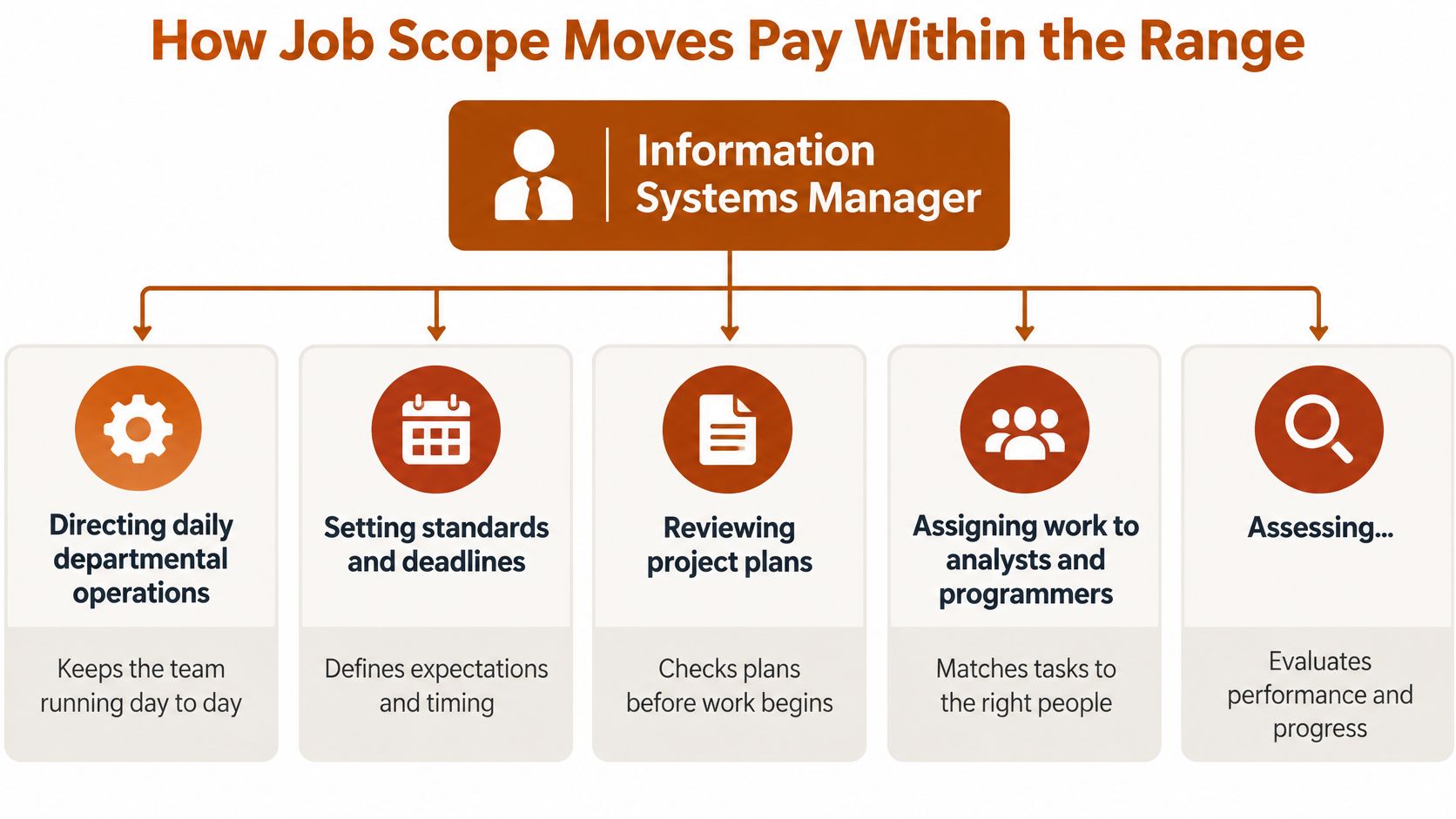
The occupation includes directing daily departmental operations, setting standards and deadlines, reviewing project plans, assigning work to analysts and programmers, and assessing system requirements with business stakeholders. It also includes managing security and backup systems, controlling budgets, purchasing equipment, and recruiting or supervising staff.
The O*NET occupational profile connects these responsibilities to computer and information systems management and reports the same 2025 U.S. median wage of $84.20 hourly or $175,140 annually. Its task descriptions provide a more useful comparison framework than title matching alone.
The responsibility hierarchy helps separate daily execution from broader management ownership.
Scope signals and the direction they push pay
| Scope factor | Pay tends to rise when | Pay tends to sit lower when |
|---|---|---|
| Budget authority | The role owns and approves a large technology budget | The role executes a budget set by others |
| Direct reports | The manager leads several teams of analysts and programmers | The role has few or no direct reports |
| Business criticality | Systems support revenue operations or regulated services | Systems support internal tools with low impact |
| Security accountability | The role owns security and backup systems | Security is handled by a separate team |
| Strategy ownership | The role sets enterprise-wide technology strategy | The role runs day-to-day departmental operations |
Budget authority distinguishes approval responsibility from spending administration. Direct reports distinguish responsibility for several teams from coordination of a small operational group.
Business criticality concerns the consequences of failure, not merely the number of applications supported. Security accountability adds responsibility for protection and recovery, while strategy ownership adds decisions about enterprise priorities and investment.
Reading the profile as a whole
These factors indicate direction, not dollar adjustments. Neither the task list nor the wage median quantifies the premium for an additional team, a larger budget or enterprise security ownership.
Say a manager schedules application support, administers an approved budget and escalates security decisions. Another manager approves infrastructure investment, leads several teams and determines recovery priorities for revenue-critical services.
The second profile supports a stronger argument for higher compensation, but the task comparison alone doesn't establish a precise percentile. Before comparing offers, the candidate should document what the role owns, what it approves and what it merely supports.
Starting Pay for Entry Routes Into Management
The lower end of the occupation isn't a starting-salary schedule. In the BLS wage distribution for computer and information systems managers, the lowest 10% earned below $107,550 and the highest 10% earned above $297,510 in 2025, but those groups aren't classified by management-entry route.
Career progression can begin from several technical and business backgrounds.
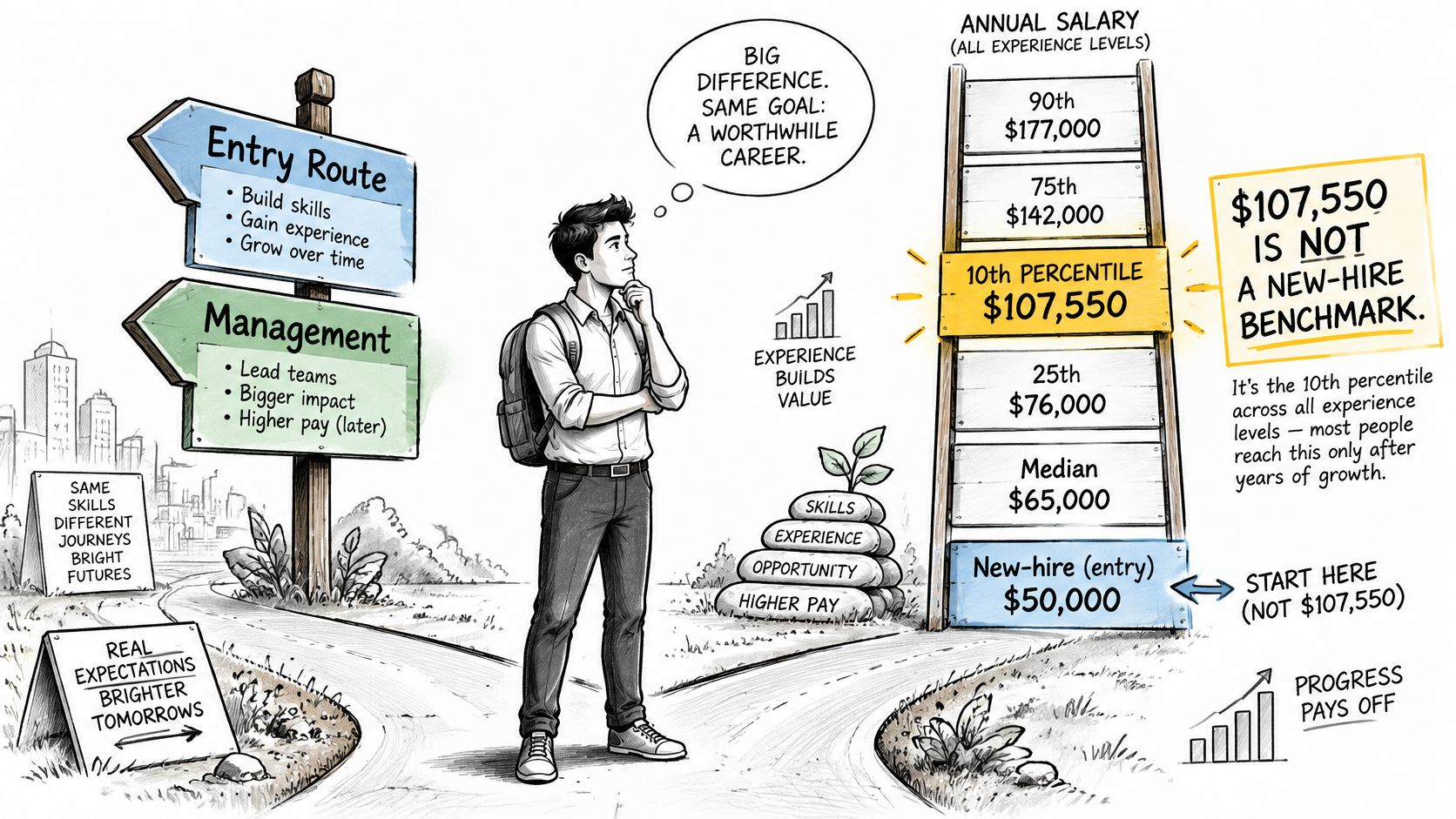
A first-time manager may bring substantial technical experience without having held budget or staffing authority. Conversely, a person newly hired by an employer may already have extensive management experience, so “new hire” and “new manager” aren't interchangeable.
What each entry route needs to demonstrate
- Systems administration: The comparison should distinguish hands-on infrastructure expertise from ownership of service delivery, staffing and investment decisions.
- Business analysis: Relevant evidence includes translating stakeholder requirements into priorities, resolving competing demands and accepting delivery accountability.
- Cybersecurity: The key distinction is between performing security work and owning security decisions, recovery responsibilities and team resources.
- Software development: Technical leadership should be separated from hiring, performance management, budget control and organizational planning.
- An MIS degree: Academic preparation should be paired with evidence of operational or leadership responsibility rather than treated as proof of management-level scope.
For someone still building relevant experience, an entry-level IT career guide can help distinguish the first technical job from the later transition into management. The occupational wage distribution doesn't price every stage between them.
Career-path guidance can support that distinction, but it can't replace comparable offer evidence.
Evidence that can support an entry estimate
A useful comparison file should contain:
- Comparable first-time management offers: Prefer roles with similar authority rather than merely similar titles.
- Different employer sizes: Compare how staffing, support resources and organizational complexity change the job.
- Documented team and budget ownership: Record whether authority is immediate, shared or only anticipated.
- Operational versus strategic work: Identify whether the manager executes a plan or determines it.
A newcomer needs evidence about the job being entered, not an assumption that the occupation's lowest-paid workers are all beginners.
Without entry-route wage splits, a precise starting estimate remains a candidate-specific judgment supported by comparable opportunities.
Whether AI Skills Earn a Pay Premium
Professionals designing, developing or implementing AI solutions earned 17.7% more than peers not involved in AI work, according to the 2025 Dice tech salary findings. That finding concerns technology professionals engaged in AI work, not a guaranteed premium for every information systems manager using AI tools.
The distinction matters because association isn't proof of a standalone skill premium. Higher compensation may reflect scarce technical expertise, greater seniority, industry concentration or responsibility for valuable AI programs.
Adoption versus accountable ownership
Using a copilot to draft documentation is different from approving enterprise deployment of an AI-enabled service. The latter may involve decisions about access, data handling, vendor dependence, security and operational responsibility.
A compensation case should distinguish:
- Routine adoption: Using copilots or automation within an existing job.
- AI governance: Defining approval, oversight and acceptable-use responsibilities.
- Data-platform ownership: Accepting responsibility for the systems that supply and control organizational data.
- Model-risk management: Establishing evaluation, escalation and monitoring arrangements.
- Enterprise implementation: Owning rollout, integration, support and security across business functions.
These responsibilities aren't equally valuable in every market or function. A candidate shouldn't combine them under a broad AI-skills label and assume that employers price them identically.
The better compensation argument
A manager seeking recognition for AI work should document what changed in the job. Relevant evidence includes newly assigned decision rights, additional staff, implementation budgets and responsibility for failures or misuse.
A hypothetical manager who introduces an approved writing assistant has a different case from one who takes ownership of an enterprise AI platform. The difference is accountable scope, not just familiarity with the technology.
The available finding doesn't establish how much of the management wage distribution is attributable to AI. The useful test is whether each AI responsibility changes budget, team ownership, business exposure or strategic authority, followed by a comparison with employers hiring for that same work.
Demand Behind the Pay Range
National employment and projected openings provide context for a job search, but they don't establish the price of a particular vacancy. A large occupational workforce and recurring recruitment needs can coexist with selective hiring at a candidate's preferred location and seniority.
Projected openings combine employment growth with replacement needs when workers leave the occupation. Employers can therefore recruit managers even where an organization isn't expanding its management structure.
Hiring activity isn't bargaining power by itself
A candidate's negotiating position depends on the relevant vacancies, not every opening within the national occupational category. Infrastructure operations, security management and enterprise technology leadership require different evidence of readiness.
A career changer should examine where existing experience matches the duties employers need filled:
- Infrastructure background: Look for operational leadership roles with explicit service and staffing responsibility.
- Security background: Examine whether vacancies require technical supervision, organizational risk ownership or both.
- Development background: Separate software delivery management from broader enterprise systems leadership.
- Business systems background: Identify positions combining stakeholder requirements, application ownership and resource decisions.
This approach uses demand as a search-planning signal. It doesn't treat hiring activity as an automatic reason for an employer to increase an offer.
Test the relevant market
A useful vacancy review records the employer, work location, stated compensation range, reporting relationship and actual authority. Remote eligibility should also be checked rather than assumed from the occupation.
For senior candidates, the important comparison is whether advertised positions offer the same breadth of ownership. A vacancy with an impressive title but limited decision rights may be a weaker comparison than a differently titled role with equivalent enterprise responsibility.
Search implication: National opportunity matters only after a candidate identifies employers hiring for the right scope in the right market.
A candidate should check live postings for the intended management level before setting compensation expectations. National demand doesn't reveal local competition, the availability of qualified applicants or an employer's approved budget.
Build and Check a Defensible Salary Range
A defensible range should connect the person, the job and the compensation measure. It should also preserve uncertainty rather than hide it behind an exact-looking estimate.
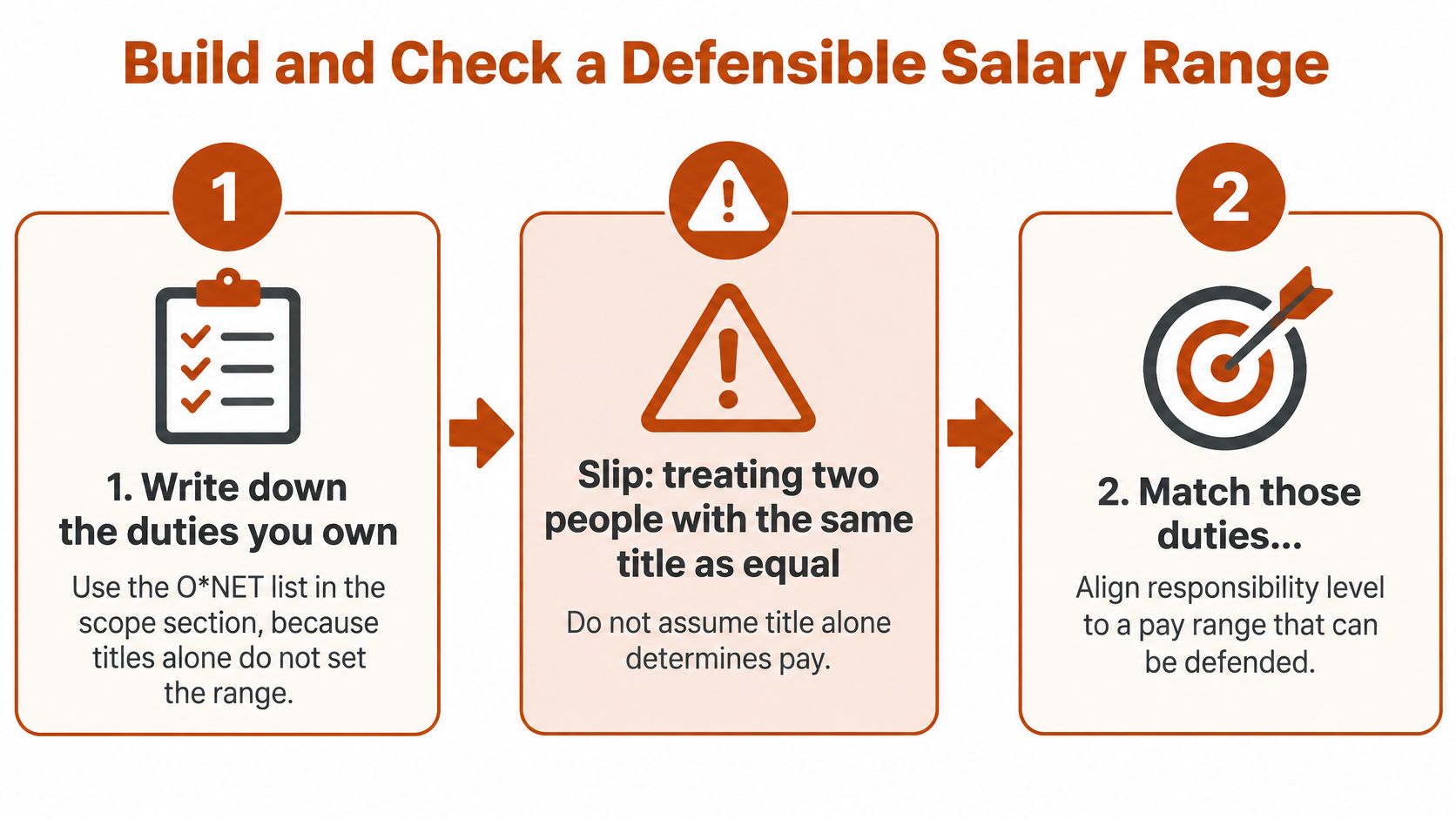
The process begins with documented responsibilities and ends with an employer-specific comparison.
Establish the comparison
Write down the duties owned. Use the occupational task list to record decisions, approvals, staffing responsibilities and operational accountability, because titles alone don't establish comparable work. Common slip: Treating employees with the same title as equivalent despite different authority.
Match the work to the occupational category. Confirm that the position involves directing computer-related activity before using the management distribution as its benchmark. The median is a midpoint, not an arithmetic average that high earnings can pull upward. Common slip: Applying one central figure to every level of management.
Form a scope hypothesis. Broader budget and strategy ownership supports investigating higher-paid comparators, while a narrower operational remit supports investigating lower-paid ones. This is a hypothesis to test, not proof that a role belongs above or below the median. Common slip: Assigning a percentile from duties alone or treating the lower percentile as a hiring floor.
The scope hypothesis should be written in plain language. For example, a role may warrant a senior comparison because it approves investment and directs several functions, while still lacking evidence to justify an executive comparison.
Make the comparison usable
Check employer and market context. Compare location, industry, organization size, seniority and technology scale so that the benchmark reflects the work environment. An employer-specific range may sit outside the central occupational band. Common slip: Presenting a national distribution as a guaranteed local offer.
Separate compensation components. Record salary, equity, signing payments and benefits on separate lines, then identify any conditions attached to them. BLS wages on Mojolin are national figures that exclude equity, signing bonuses and benefits, and combine junior and senior workers under one title. Common slip: Comparing a wage benchmark directly with an offer described as total compensation.
Build an entry-route comparison separately. For a first management move, prioritize evidence from comparable transitions and distinguish technical experience from management authority. A long individual-contributor career may support readiness without proving equivalent managerial scope. Common slip: Substituting an all-experience median for an entry estimate.
Keep an audit trail. Record the source, its pay-data year, the date checked and the assumptions behind each comparison so that the estimate can be explained or revised. Common slip: Quoting an attractive figure without preserving what it measures.
A compact worksheet can capture the outcome:
| Record | What belongs in it |
|---|---|
| Job match | Duties, authority and reporting relationship |
| Comparator quality | Similarities and material differences |
| Compensation basis | Wage or salary versus other components |
| Uncertainty | Missing information and assumptions |
| Negotiation position | Supported range and conditions for changing it |
The range should narrow as relevant evidence improves. Unsupported precision shouldn't substitute for a documented explanation of why a candidate belongs near a particular set of comparators.
Turn the Range into a Negotiation Plan
The strongest negotiation position isn't the highest national figure a candidate can find. It's a proposed range supported by the responsibilities the employer intends to assign.
A candidate can prepare a concise evidence sheet containing the occupational benchmark, its source and data year, the role's scope profile and relevant offer comparisons. For a first management appointment, the sheet should identify the transition explicitly rather than imply established management experience.
Prepare the case around decisions
The discussion should focus on the authority attached to the position. Budget approval, staffing ownership, service accountability and enterprise planning provide more useful negotiating substance than a title alone.
AI responsibilities belong in the case only when they materially change the work. Before including them, the candidate should determine whether the employer expects additional implementation ownership, governance decisions, security accountability or team leadership.
A technology salary negotiation guide can help organize the conversation around that evidence. The request should remain tied to the job rather than to an unsupported percentage increase.
Resolve uncertainty before naming a target
Several details can change the comparison:
- Authority: Is the manager accountable for decisions or responsible only for recommendations?
- Resources: Are staffing and budget commitments approved or merely planned?
- Offer composition: Which components are recurring, conditional or paid only once?
- Role expansion: Would additional enterprise responsibilities trigger a compensation review?
The candidate should label the result a working range, with clear assumptions and conditions. An employer can then respond to a specific job valuation rather than a personal aspiration.
Before any negotiation, the candidate should confirm the range that can be defended, not just the single salary hoped for. The conversation is stronger when its boundaries follow from comparable work and its target follows from documented responsibility.
Mojolin provides sourced U.S. technology pay, employment and outlook information, with role pages that compare each occupation's median against the other 13 roles it tracks. Visit Mojolin to compare information systems management with adjacent careers, then bring a documented scope profile and a defensible salary range to the next offer discussion.