A senior security credential can cost US$1,154 in exam and maintenance charges over three years, even before preparation or a retake, according to ISC2's CISSP cost and maintenance information. That's a more useful starting point than an exam advertisement: the registration fee buys an attempt, while maintaining the credential creates a separate financial commitment.
A defensible security exam cost comparison separates confirmed charges from estimates and missing information. It also distinguishes a provider's published fee from a third-party price report, especially when those reports disagree.
Table of Contents
- Security Exam Costs at a Glance
- What the Exam Fee Covers and What It Leaves Out
- Entry-Level Exams Like CC, SSCP and Security+
- Senior Credentials and Three-Year Totals
- Specialist Exams Like CEH and Certified Security Manager
- Where Published Prices Conflict or Are Out of Date
- Retake Costs and Worked Failure Scenarios
- Pick Your Exam and Confirm the Fee Before You Pay
Security Exam Costs at a Glance
| Certification | Level | Exam fee | Price source |
|---|---|---|---|
| CompTIA Security+ (SY0-701) | Entry to mid-level | US$439 voucher | Published voucher price reported by GRC Engineering Club |
| ISC2 Certified in Cybersecurity (CC) | Entry level | US$199 | ISC2 published regional pricing |
| ISC2 Systems Security Certified Practitioner (SSCP) | Practitioner | US$249 | ISC2 published regional pricing |
| ISC2 Certified Information Systems Security Professional (CISSP) | Senior | US$749 | ISC2 published regional pricing |
| ISACA Certified Information Security Manager (CISM) | Manager | US$575 member or US$760 non-member, plus US$50 application processing | ISACA published pricing |
| EC-Council Certified Ethical Hacker (CEH) | Specialist | Approximately US$950 to US$1,199 | Cybersecurity Guide's compiled public pricing |
| CorpSecurity Certified Security Manager | Manager | US$450 | CorpSecurity's official fee schedule |
These are registration or voucher charges, not complete certification budgets. The CISM row identifies an additional application charge because leaving it out would understate the first payment required. A shortlist based only on the headline fee can also mislead, since some credentials require renewal spending while others carry separate application or preparation costs.
For the ISC2 rows, ISC2's published exam pricing lists CC at US$199, SSCP at US$249, and CISSP at US$749 in the Americas and other regions not separately listed. The same schedule lists United Kingdom prices of £161.19, £201.69, and £606.69, respectively. That spread matters for anyone comparing a three-year cash cost across providers, because the local fee, not the converted fee, is what appears at checkout.
Regional prices aren't currency conversions
The local registration price should anchor the budget. Converting an American price into pounds doesn't establish what a candidate will pay in the United Kingdom. A candidate budgeting from the wrong currency can understate the first payment and misjudge later renewal costs.
The price-source column matters just as much as the fee column. A compiled public price, an official fee schedule, and a regional price list don't provide the same assurance that a figure remains available at checkout. Treat each figure as a starting point for the credential's initial cash outlay, then check what the quote includes. A voucher may cover one attempt, while application charges, membership categories, and maintenance sit outside that line.
Budgeting rule: An exam price is a known line item, not evidence that every other certification expense is zero.
Mojolin's certification prices, exam formats, and renewal rules come from each certification vendor's official pages. Its comparison helps narrow a shortlist by putting fees, exam length, and renewal rules beside one another. The applicable regional checkout price still needs to be confirmed before funds are committed.
The cheapest row isn't automatically the best purchase. Candidates should match the credential to the target work, then establish what the quoted fee excludes before comparing affordability. That order produces a more useful three-year budget than ranking credentials by sticker price alone.
What the Exam Fee Covers and What It Leaves Out
Registration, certification, and maintenance are different purchases. A voucher generally covers the examination attempt described in the product listing. It shouldn't be treated as an all-inclusive package of training, application processing, and future renewal.
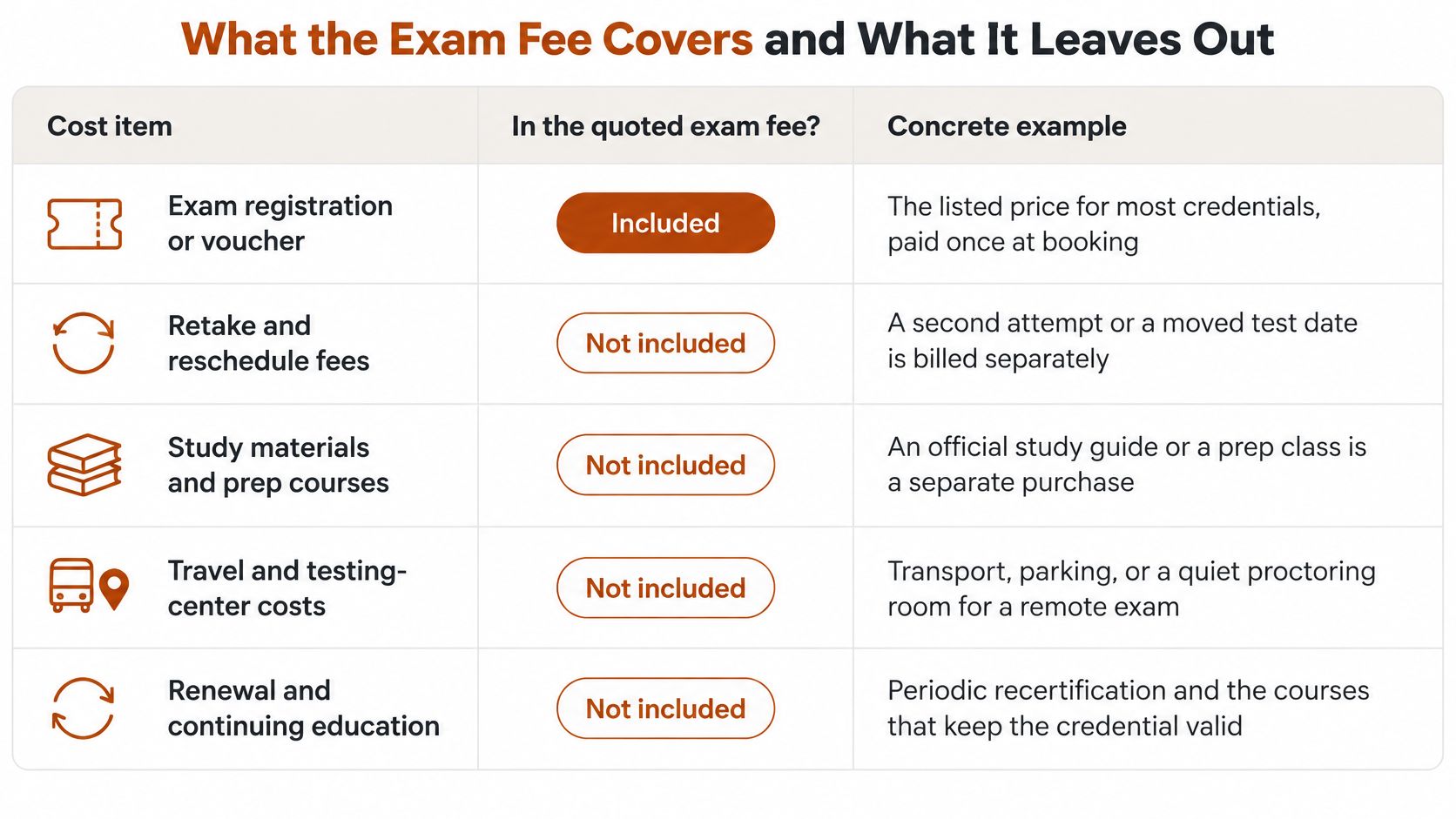
| Cost item | In the quoted exam fee? | Example |
|---|---|---|
| Exam registration or voucher | Yes, for the product listed | CC registration or a separately purchased Security+ voucher |
| Application processing | No, when separately charged | CISM application processing |
| Membership pricing | Changes the registration price | CISM member and non-member registration categories |
| Retake | Not in a standard first-attempt price | Another Security+ voucher unless the purchase includes a retake |
| Preparation, courses, and practice tests | Not in an exam-only purchase | Study guides, practice questions, or instructor-led training; no verified preparation price established |
| Travel, time off, and rescheduling | Not included in the exam-only budget | Transport, missed work, or a booking change; no verified amount established |
| Annual or three-year maintenance | No | CISSP and CISM annual maintenance, or Security+ continuing-education fees |
| Regional currency pricing | Set by the testing region | ISC2 publishes separate American and United Kingdom prices |
Missing costs need a category, not a guessed amount
A preparation budget should distinguish required purchases from optional study support. An official course shouldn't automatically be added to every candidate's total, but neither should a candidate assume that free materials will meet every preparation need.
The same distinction applies to continuing education. A credential can require learning activity without requiring every activity to be purchased. The cash budget and the time budget therefore need separate columns.
For employer-funded candidates, reimbursement terms also affect affordability. An organization might approve registration while leaving study resources, travel, or ongoing maintenance to the employee.
- Cash paid before the exam: Registration, separately charged application processing, selected preparation products, and travel arrangements.
- Conditional spending: Another attempt, a booking change, or replacement preparation materials.
- Ongoing obligations: Maintenance charges and qualifying learning activities needed to retain the credential.
A useful comparison adds the same categories for every shortlisted credential. Treating an omitted price as not established, rather than free, prevents a seemingly inexpensive option from winning through incomplete accounting.
Entry-Level Exams Like CC, SSCP and Security+
CC, SSCP, and Security+ give candidates different starting points, but their prices shouldn't substitute for a career decision. A lower-fee examination can suit a constrained learning budget; a named requirement in a target job posting can justify paying more for a different credential.
For Security+, GRC Engineering Club's cost guide reports a US$439 SY0-701 voucher, a US$150 continuing-education fee over three years, and 50 continuing-education units during that cycle. On that fee-based renewal route, the reported voucher and maintenance charges produce a US$589 cash baseline, excluding preparation, taxes, travel, and retakes.
That baseline is more informative than the voucher alone. It recognizes that passing the examination begins a maintenance commitment rather than ending the candidate's spending decisions.
The Security+ price conflict matters
A different figure appears in Crucial Exams' reporting, which identifies US$425 as the direct-from-CompTIA voucher price in 2025. That conflicts with the higher published voucher figure, so neither report should be presented as an independently confirmed current checkout quote.
The correct response isn't to average the reports. Candidates should identify the current exam product, sales region, and purchase terms, then use the amount offered by CompTIA.
| Candidate's situation | More useful decision criterion |
|---|---|
| Exploring cybersecurity with a limited budget | Whether the credential supports an affordable, relevant learning plan |
| Applying for a role that names Security+ | Whether the specified credential is required or preferred |
| Already performing security-related work | Whether the exam objectives match existing responsibilities and the next intended role |
| Depending on employer reimbursement | Whether approval covers the selected credential and purchasing channel |
A cybersecurity analyst career path can help connect certification selection to the work the candidate intends to pursue. The decision should begin with duties and hiring criteria, not the assumption that a more expensive exam necessarily creates a better entry route.
Retake exposure deserves attention before purchase, particularly when the exam-only price already stretches the budget. A voucher with a retake included and a standard voucher are different products, so comparing their labels without comparing their terms can produce a misleading saving.
The practical choice is the credential that meets the candidate's immediate objective at a manageable total cost. A cheaper credential that doesn't address the target employer's requirement may be an additional expense rather than a substitute.
Senior Credentials and Three-Year Totals
For senior credentials, recurring fees and learning obligations materially change the comparison. CISSP's exam-and-maintenance baseline, identified in the opening, isn't a complete personal budget: preparation, travel, additional attempts, and any unestablished charge remain outside it.
CISM introduces another distinction. ISACA's CISM information lists registration at US$575 for members or US$760 for non-members, a US$50 application-processing fee, and annual maintenance of US$45 for members or US$85 for non-members. ISACA also requires at least 20 CPE hours annually and 120 CPE hours during each three-year reporting period.
Compare documented cash baselines
| Credential | Application fee | Maintenance over three years | Three-year mandatory total |
|---|---|---|---|
| CompTIA Security+ | No separate application charge established | US$150 CE fee, with 50 CEUs | US$589 including the US$439 voucher |
| ISC2 CISSP | Separate application charge not established | US$405, based on US$135 annually, with 120 CPE credits | US$1,154 including the US$749 exam |
| ISACA CISM, member | US$50 | US$135, based on US$45 annually, with 120 CPE hours | US$760 including the US$575 exam, excluding membership dues |
| ISACA CISM, non-member | US$50 | US$255, based on US$85 annually, with 120 CPE hours | US$1,065 including the US$760 exam |
The CISM totals are arithmetic from ISACA's listed charges. The Security+ baseline uses the reported voucher and fee-based continuing-education route; the CISSP baseline uses ISC2's stated examination and annual maintenance charges.
Not established doesn't mean no charge. In particular, an unverified application-fee field shouldn't be converted into an asserted zero. These totals are documented cash floors under the stated assumptions, not guarantees of an all-inclusive certification price.
A member-price comparison is incomplete until membership dues are included.
The CISM member baseline is lower, but membership isn't costless merely because its price isn't established here. Candidates should compare the complete member route against the complete non-member route, including any applicable dues, before treating member pricing as a saving.
Learning time belongs in the employer's budget
CPE requirements create scheduling obligations even when qualifying activities carry no cash fee. Employers need to decide whether employees can complete relevant learning during paid working time and how that activity will be documented.
A senior credential is easier to justify when a target role explicitly values it or an employer funds it for an agreed responsibility. It shouldn't be justified by assuming that the credential alone guarantees higher earnings; a cybersecurity pay comparison provides career context, not proof of certification-driven salary gains.
A reimbursement request should therefore separate registration, application processing, maintenance, membership, study resources, and learning time. That gives the employer a concrete approval decision rather than an undefined promise to cover certification.
Specialist Exams Like CEH and Certified Security Manager
Specialist certifications shouldn't be forced into a simple entry-level-to-senior price ladder. Candidates need to compare the credential's purpose with the work they intend to perform, rather than treating a larger fee as evidence of broader relevance.
For CEH, Cybersecurity Guide's compilation of publicly available pricing gives an approximate examination cost of US$950 to US$1,199 in 2025. That is a dated range, not a current quote for a clearly identified purchase.
A range creates an important verification task. The candidate needs to identify the exact examination product, region, delivery arrangement, and any bundled materials before deciding which amount applies.
A fee without renewal terms isn't a lifecycle total
CorpSecurity's official fee schedule listed its Certified Security Manager examination at US$450 in 2024. The source year should remain attached to that figure because an older official price isn't automatically a current price.
| Credential | Evidence available | Missing information needed for a three-year budget |
|---|---|---|
| CEH | Dated compiled examination-price range | Applicable current product price and renewal charges |
| CorpSecurity Certified Security Manager | Dated official examination fee | Current registration price and renewal rule |
Neither credential has a defensible three-year cash total from the available fee evidence. Publishing a total anyway would imply that maintenance is free or unnecessary, neither of which has been established.
Candidates should also keep CorpSecurity Certified Security Manager distinct from ISACA CISM. Similar management-oriented names don't make their fees, requirements, or career purposes interchangeable.
Before committing, a candidate should obtain written confirmation of the applicable examination charge and the renewal obligations from the certifying organization. The confirmation should identify what the payment includes and which future charges remain separate.
That missing information is a decision issue, not a minor footnote. A credential with an attractive registration fee can still be impossible to compare fairly when its retention costs haven't been established.
Where Published Prices Conflict or Are Out of Date
A published fee has two separate qualities: authority and freshness. An official schedule establishes what the organization published, while its age determines whether a candidate should rely on it without further confirmation.
A third-party guide may be useful for discovering a price discrepancy, but it doesn't settle the amount due at checkout. An undated page also shouldn't be described as current merely because it lacks a visible publication year.
Different problems need different checks
- Conflicting voucher reports: For Security+, the candidate should reconcile the competing reports against the exact product currently offered, not choose whichever figure fits the budget.
- Compiled price ranges: For CEH, the range should trigger a product-level comparison. It doesn't prove that every candidate can buy at the lower end.
- Older official schedules: The CorpSecurity figure needs confirmation because the dated schedule doesn't establish continued availability.
- Regional schedules: ISC2 candidates should select the relevant local fee rather than convert another region's price.
- Incomplete membership comparisons: CISM member pricing needs applicable dues added before the member route can be called cheaper overall.
Verification standard: A conflicting, ranged, or older price should remain provisional until the applicable purchase terms are confirmed.
Candidates should retain a copy of the quote or checkout summary with the credential name, region, currency, included products, and payment conditions. That record is especially useful when an employer approves reimbursement before the purchase occurs.
There's no basis for describing every undated price as recently checked, or for assigning a publication year that the source doesn't establish. The honest distinction is dated historical price, published price without an established date, or current confirmed quote.
The final budget should use the last category wherever payment is imminent.
Retake Costs and Worked Failure Scenarios
A failed attempt usually means paying again, so the retake question belongs in the budget before the first sitting, not after the result. The reliable method is to build a conditional scenario from the credential's own published fees, then replace the assumption with the provider's actual retake terms once they are confirmed at purchase.
A Security+ failure scenario
Security+ carries a $439 exam price, and the certification stays valid for three years with a $150 continuing-education fee across that period. A candidate who passes on the first attempt pays $589 in total. A candidate who fails once and buys a replacement voucher at the same $439 pays $1,028: two exam fees plus the same maintenance charge. The single failed sitting adds $439, raising the three-year cash cost by roughly three-quarters.
That calculation assumes the replacement voucher costs the same as the original and that no retake entitlement was purchased. Some Security+ purchase options bundle a retake, so a candidate who rates their first-attempt risk as high should price the bundle against the $878 two-voucher scenario before choosing.
| Credential | Retake terms published | Budget treatment |
|---|---|---|
| Security+ | Some purchase options include a retake; no standalone retake price | Compare the bundle with a replacement-voucher scenario |
| CISSP | No separate retake fee published | Keep the retake allowance provisional |
| CISM | No separate retake fee published | Obtain the applicable retake charge before final approval |
A bundle reduces exposure only when its terms match the candidate's circumstances. Price, redemption conditions, and the included entitlement all need checking, because a product sold as a bundle does not always include another attempt.
- Set the baseline: Use the selected credential's documented exam, application, and maintenance charges.
- Add a failure allowance: Model a replacement attempt at the full exam fee, kept separate from confirmed costs, as in the Security+ example above.
- Check eligibility conditions: Confirm the vendor's waiting period between attempts, any cap on attempts, and the deadline attached to a retake entitlement.
- Preserve preparation funds: Keep study money intact, since spending it on a contingency leaves less for the preparation that reduces the chance of needing it.
Pick Your Exam and Confirm the Fee Before You Pay
The best purchase is a credential that meets a defined career requirement and remains affordable to maintain over the period you expect to use it. A low registration fee doesn't compensate for choosing an exam the target employer doesn't value, while a senior credential shouldn't be bought only because it appears more prestigious.
Mojolin compares IT certifications by exam price, exam length, and renewal rules. Its cybersecurity certification comparison can support a shortlist, while the certifying body's purchase terms establish the final commitment.
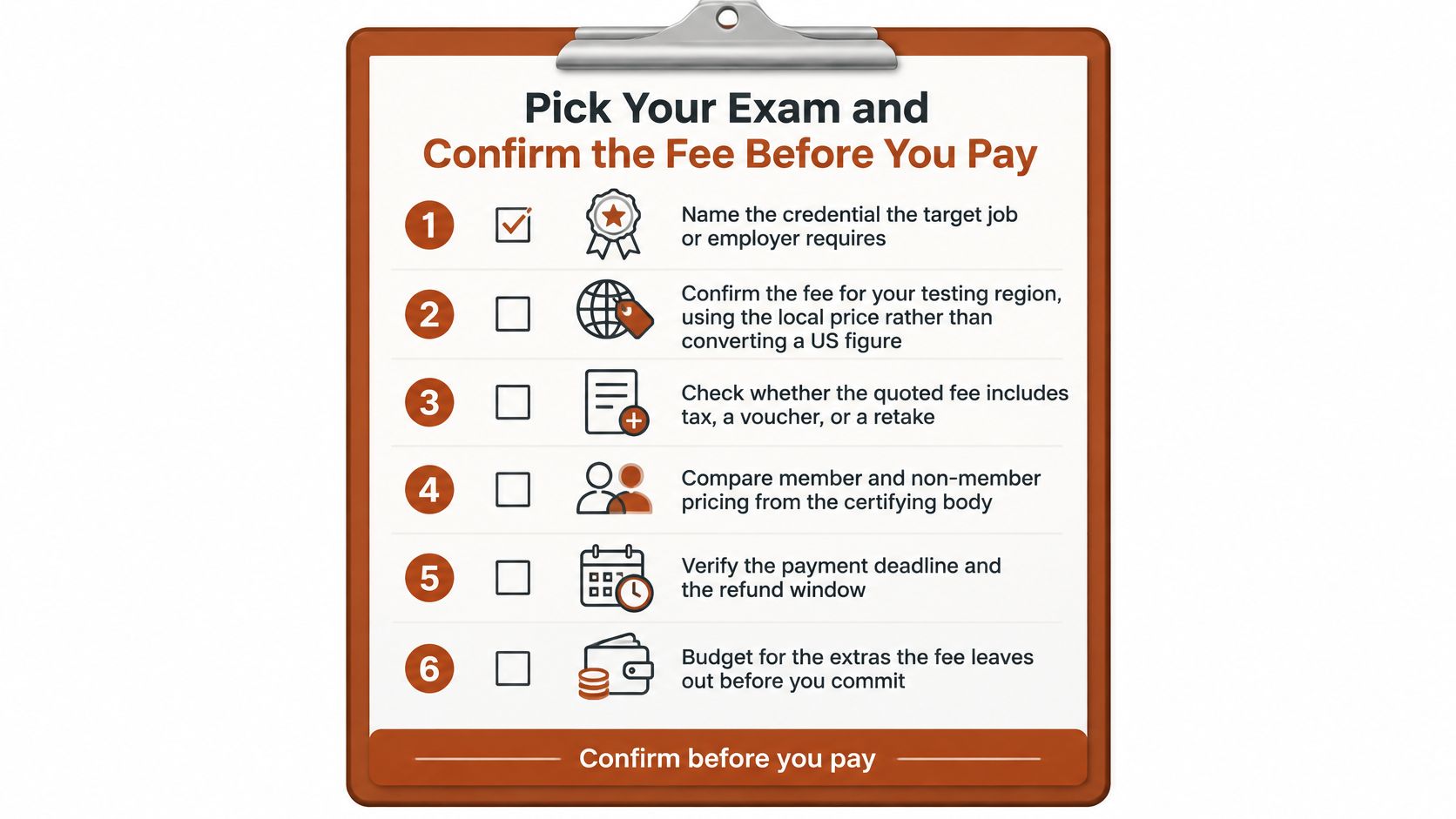
A payment-ready checklist
- Identify the job requirement. Record the exact credential named by the target employer, distinguishing a requirement from a preference.
- Confirm the testing region. Use the local currency price and applicable purchase channel, rather than a converted overseas figure.
- Define the purchase. Establish whether the quoted amount buys registration only, a voucher, preparation materials, or a retake entitlement. Check tax treatment, refund conditions, and payment deadlines.
- Add separate charges. Include application processing and any membership dues needed to access member pricing.
- Budget for an unsuccessful attempt. Use confirmed retake terms where available and label any fallback assumption clearly.
- Account for maintenance and time. Separate recurring cash fees from continuing-education activity and time away from work.
- Secure reimbursement approval. Ask the employer to specify which categories it covers and whether payment occurs upfront or after a successful result.
- Compare like-for-like totals. Keep preparation, travel, retakes, and membership consistently included or explicitly excluded across the shortlist.
Treat this checklist as a payment gate. Each step reduces the risk of comparing a bare exam fee with a quote that includes materials, membership, or another attempt. It also keeps the three-year cash view consistent, so renewal rules and maintenance effort sit beside the initial charge rather than arriving later as a surprise.
A candidate is ready to book when the credential fits the intended role, the maintenance commitment is understood, and the current applicable fee has been confirmed in writing. Until then, the budget is a planning estimate rather than a payment-ready total.