90% of security managers would consider entry-level candidates with prior IT experience, according to ISC2's cybersecurity hiring trends study. That finding reframes the cybersecurity analyst career path: the first useful move may be a job supporting systems, not a job with security in its title. Candidates need to show they can investigate how technology behaves, not just recognize security terminology.
Table of Contents
- Where a Cybersecurity Analyst Career Really Starts
- Cybersecurity Analyst Career Stages at a Glance
- How to Build an Entry Route Into Security
- Credentials That Carry Weight at Each Stage
- Specialization Tracks and Where Skills Demand Sits
- Choose Your First Move Before Applying
Where a Cybersecurity Analyst Career Really Starts
Information security analysts held 192,900 jobs in 2025, and the U.S. Bureau of Labor Statistics projects employment to increase by 40,600 jobs, or 21%, from 2025 to 2035. Those figures establish a substantial occupation with projected expansion. They don't establish that employers will hire beginners without practical preparation.
The safer planning assumption is that analyst is a destination reached through foundational work, rather than an automatic first job. Help desk, systems administration and networking expose candidates to the accounts, devices, services and administrative changes they'll eventually investigate. Someone who has resolved access failures can approach an authentication alert with useful questions about permissions, recent changes and expected behavior.
Direct entry remains possible through internships, relevant academic projects or security-adjacent responsibilities. The distinction isn't degree versus no degree. It's whether the candidate can show enough operational understanding to make a defensible judgment about an unfamiliar event.
Demand doesn't guarantee beginner seats
The 2024 ISC2 Cybersecurity Workforce Study estimated approximately 5.5 million active cybersecurity professionals globally and a workforce gap of about 4.8 million, while 31% of surveyed organizations said their security teams had no entry-level professionals. The gap estimates unmet organizational need, not advertised vacancies.
An employer can need more security capability without having the supervision, budget or training arrangements needed for a beginner. A small team might need someone who can independently investigate an identity compromise, even while struggling to cover routine monitoring.
Planning principle: A shortage of security capability isn't the same thing as a surplus of beginner-friendly jobs.
That distinction changes how candidates should evaluate opportunities. A support position with access to identity administration, endpoint troubleshooting and incident escalation can provide more relevant preparation than a security-titled position limited to forwarding notifications.
Progression means expanding responsibility
A practical route has distinct stages:
- Foundation: Understand normal system behavior through troubleshooting and administration.
- Entry analyst: Gather evidence, assess alerts and escalate with clear reasoning.
- Mid-level analyst: Own investigations and improve the team's detection or response processes.
- Senior or specialist: Design controls, resolve cross-domain problems and explain business risk.
Security operations offers a direct connection between troubleshooting and investigation, but it isn't the only route. Cloud operations, software development and audit can also provide useful starting evidence for different security specialties.
Cybersecurity Analyst Career Stages at a Glance
| Stage | Typical roles | Evidence employers check | Next move |
|---|---|---|---|
| Foundation | Help desk, IT support, junior systems or network admin | Hands-on troubleshooting, OS and networking basics, a starter certification | Security monitoring or junior analyst |
| Entry analyst | Junior security analyst, SOC tier 1 analyst | Log analysis, alert triage, documented lab investigations | Incident response or security analysis |
| Mid-level analyst | Security analyst, incident responder, detection analyst | Investigation write-ups, SIEM use, scripting for enrichment | Specialize in cloud, detection engineering or risk |
| Senior or specialist | Senior analyst, security engineer, cloud security, GRC lead | Cross-domain skills, risk communication, cloud and AI security | Architecture, engineering leadership or risk leadership |
The useful column is evidence employers check, not the job title. Titles aren't standardized across employers, and the boundaries overlap. An analyst in a small company might maintain controls and coordinate incidents, while someone with the same title elsewhere handles a narrowly defined monitoring queue.
Candidates should match their current work record or portfolio to the evidence column. The next move becomes credible when they can explain the work, reproduce relevant techniques and describe the limits of their conclusions. Completing a course isn't equivalent to demonstrating those abilities.
What changes between stages
The foundation stage asks whether a candidate can identify and resolve a technical problem. Entry analysis adds a different obligation: deciding whether an event warrants security attention and preserving enough context for another person to continue the investigation.
Mid-level work adds ownership. Instead of stopping at escalation, the analyst connects evidence across systems, coordinates containment and identifies why an existing control didn't prevent or detect the activity.
Senior work adds responsibility for decisions affecting other teams. A proposed control must account for operational disruption, implementation effort and the consequences of leaving a risk untreated.
Advancement is better demonstrated by a larger scope of sound decisions than by a longer list of tools.
Pay is an occupational benchmark
The BLS occupational profile reports a median annual wage of $124,910 for information security analysts in May 2024. That figure covers the occupation as a whole, not an entry-level salary or a guaranteed outcome at any stage.
A cybersecurity pay guide can support compensation research, but candidates should compare vacancies with similar responsibilities, locations and experience requirements. Someone without an IT background should start with the foundation row, where the immediate objective is credible technical work rather than an analyst-level salary.
How to Build an Entry Route Into Security
The experience paradox is visible in the occupational requirements. The BLS information security analyst profile lists a bachelor's degree as typical entry-level education, less than five years of related work experience, and no formal on-the-job training as its occupational classifications. These aren't universal hiring rules, but they make a certification-only plan difficult to justify.
The entry route combines workplace exposure, baseline knowledge and demonstrable practice.
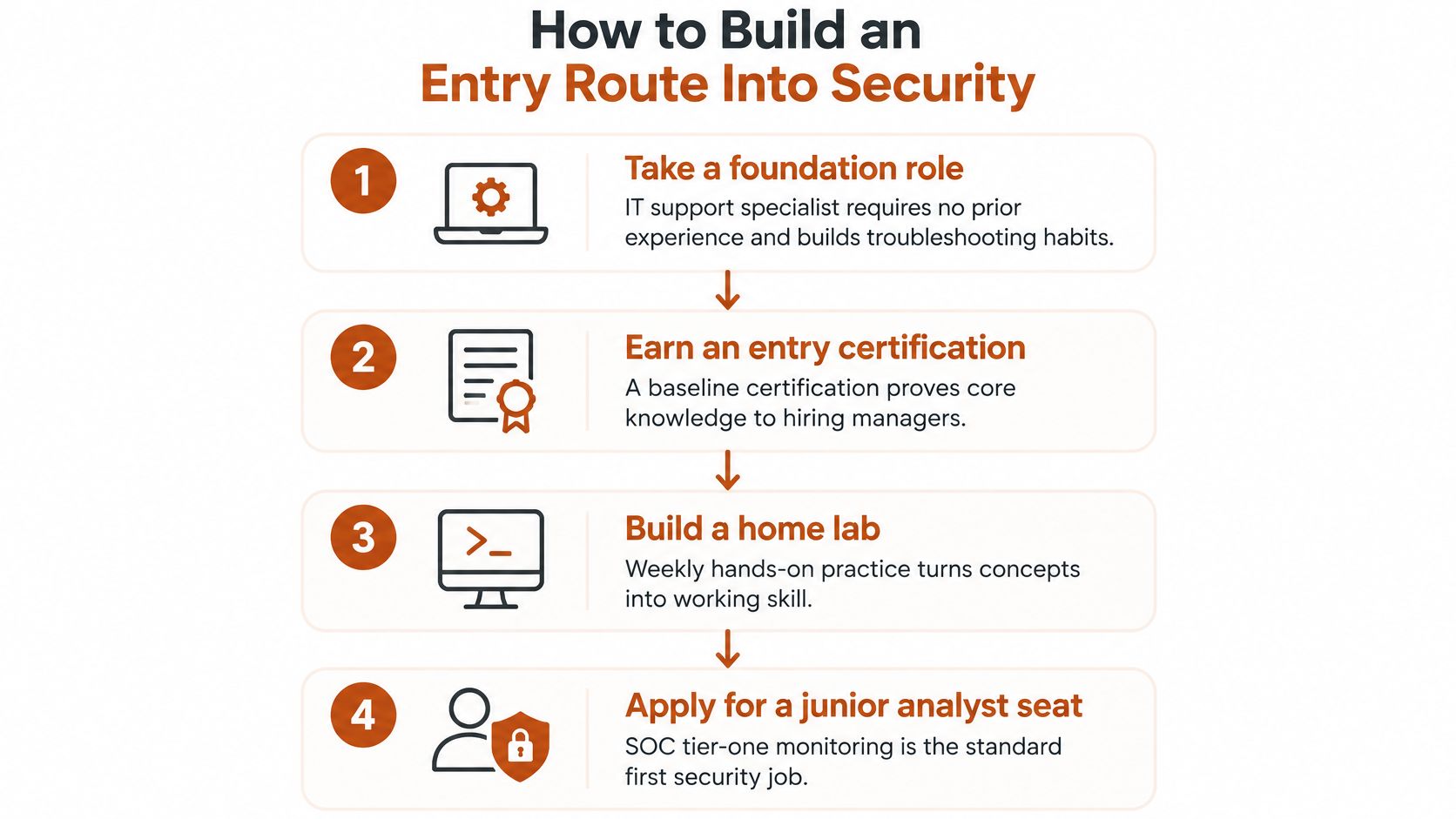
Build capability in a workable sequence
Take a foundation role. Mojolin's IT support specialist page says no prior experience is required to enter the role and that moderate-term on-the-job training is typical. Candidates should favor opportunities involving account administration, endpoint support, networking tickets and documented escalation because those activities expose normal operational behavior.
Learn how systems communicate. Practice TCP/IP, DNS, HTTP, authentication protocols, and Windows and Linux logging. An analyst needs to understand what a successful connection or legitimate login looks like before judging whether a failed or unusual attempt is suspicious.
Practice with a SIEM. In an isolated home lab, send sample authentication and endpoint logs into a security information and event management platform such as Splunk or Microsoft Sentinel. Search for related events, compare timestamps and identify missing context rather than merely capturing dashboard screenshots.
Turn an investigation into evidence. Record the timeline, relevant indicators, detection logic, proposed containment and recommendations. A useful write-up distinguishes observed facts from assumptions and explains what additional evidence could change the conclusion.
Add a foundational credential. Choose a credential aligned with the intended vacancy rather than studying for several overlapping exams. Its purpose is to support demonstrated capability, not stand in for it.
Practice concise communication. Write an incident summary that names the affected asset, observed activity, potential impact and recommended action. Then remove unexplained jargon so a manager outside IT can understand the decision being requested.
Apply across relevant entry routes. Consider junior analyst and SOC positions alongside cloud operations, audit and other security-adjacent work. Comparing entry-level cybersecurity job titles helps candidates search by actual responsibilities instead of relying on a single title.
Test reasoning, not tool familiarity
Say a lab contains failed sign-ins followed by a successful login. A credible investigation checks whether the events involve the same account, whether the source is expected and whether subsequent activity supports a compromise hypothesis. A weak investigation labels the pattern malicious without testing alternatives.
The accompanying video provides another learning format alongside hands-on exercises.
A practical self-test is whether the candidate can explain the log trail to someone outside IT without losing the distinction between evidence, inference and uncertainty. If the explanation depends entirely on a tool's severity label, the investigation needs more work.
Credentials That Carry Weight at Each Stage
Choose a credential when it supports the next role, not because it appears on a roadmap. A useful decision rule is to select a credential for the current transition, apply the learning and reassess against actual vacancies before paying for another exam.
Compare credentials by the work they support
| Credential | What it validates | Best-fit stage | Note |
|---|---|---|---|
| CompTIA A+ | Hardware, operating systems and troubleshooting | Foundation, help desk | Standard first certification for help desk work |
| CompTIA Security+ | Security terminology, controls and risk basics | Entry analyst | Pairs with lab evidence; does not replace it |
| ISC2 Certified in Cybersecurity | Entry-level security concepts | Entry analyst | Validates terms; strongest alongside IT experience |
| AWS Certified Solutions Architect – Associate | Cloud architecture on AWS | Mid-level, cloud track | Renewal needs the latest exam or the Professional-level certification |
Mojolin's IT support specialist page identifies CompTIA A+ as the standard first certification for help desk work. It makes sense for a candidate who needs structured preparation in operating systems, hardware and troubleshooting. Someone already performing that work should assess whether the exam closes a genuine gap or merely repeats existing evidence.
CompTIA Security+ and ISC2 Certified in Cybersecurity serve a different purpose. They help candidates establish a shared vocabulary for threats, controls and security responsibilities. Choosing between them should involve the intended employer's requirements, the candidate's existing knowledge and the current exam objectives.
Neither credential shows how a candidate handles an ambiguous investigation. A stronger application pairs the credential with a relevant artifact, such as a reasoned analysis of authentication activity or a documented assessment of endpoint events.
Cloud architecture isn't analyst readiness
AWS Certified Solutions Architect – Associate supports the cloud track by validating architectural knowledge. It doesn't directly establish readiness to monitor security alerts, preserve incident evidence or manage an investigation.
Hands-on design work makes the credential more useful. A candidate should be able to explain identity boundaries, logging choices and the operational consequences of a design, rather than identify an AWS service from an exam description.
Renewal requires passing the latest version of the exam or earning AWS Certified Solutions Architect – Professional. That requirement belongs in the decision alongside the initial study commitment.
Credential filter: The strongest choice addresses a requirement in the next job and produces knowledge the candidate can immediately apply.
A comparison of cybersecurity certifications can help narrow the options. Before booking, candidates should check the issuing body's current objectives and map each unfamiliar topic to an exercise, not just a revision note.
Specialization Tracks and Where Skills Demand Sits
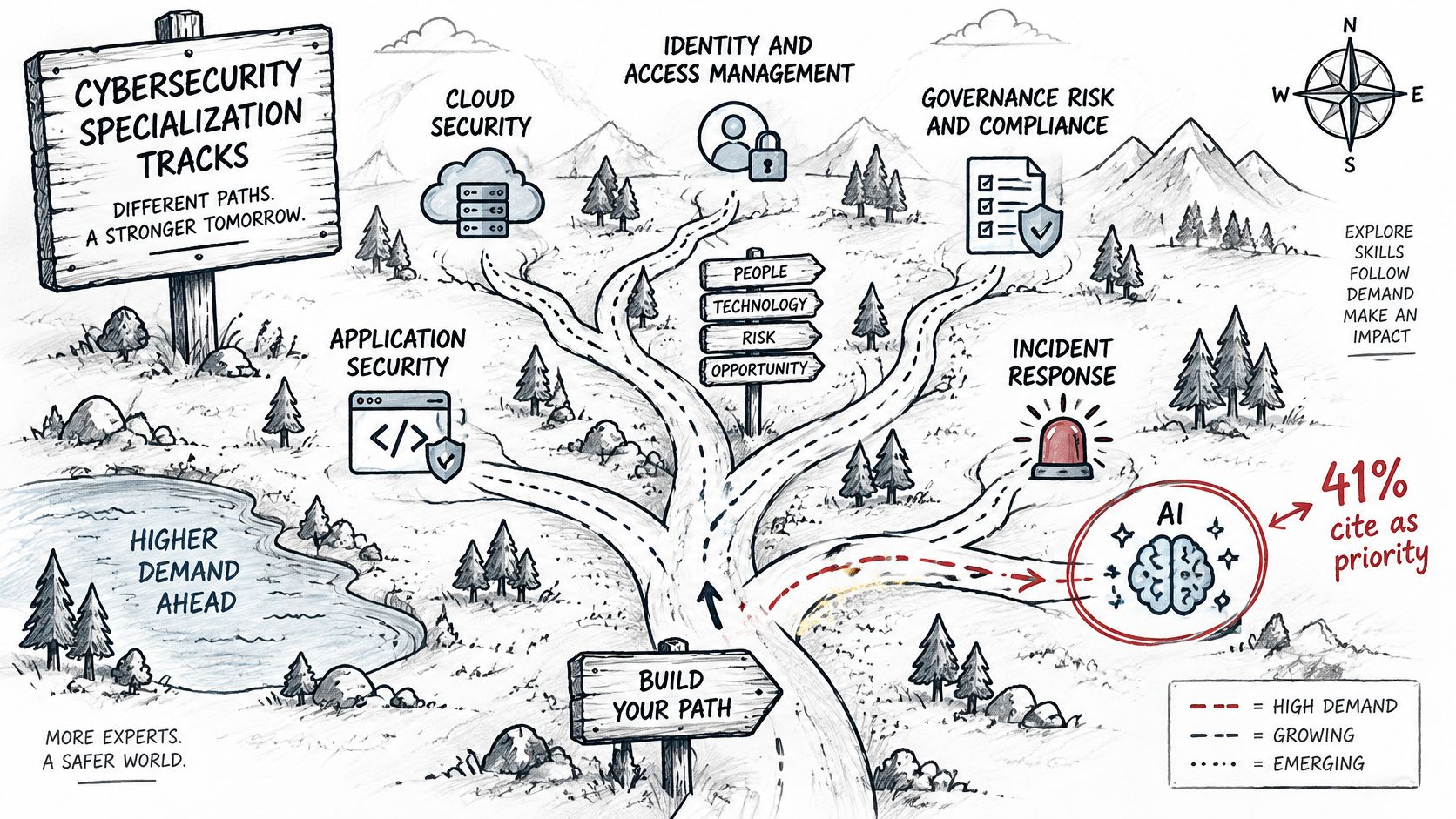
Specialization should address a capability an organization needs, not merely supply a more impressive title. In the 2025 ISC2 Cybersecurity Workforce Study, 59% of organizations reported critical or significant skills needs, up from 44% in 2024; the skill-priority shares reported in the table were 41% for AI, 36% for cloud security, 29% for risk assessment, 28% for application security, and 27% each for security engineering and GRC.
Those figures describe skill priorities, not each track's share of vacancies or its likelihood of hiring beginners. They support choosing a complementary capability rather than assuming every analyst should pursue the same destination.
Compare work and proof of readiness
| Track | Day-to-day work | Skill priority (ISC2 2025) | Entry evidence |
|---|---|---|---|
| AI security | Securing AI systems and using AI in detection | 41%, top priority | AI tool fluency and labs |
| Cloud security | Cloud identity, control planes and infrastructure-as-code | 36% | Cloud labs with identity controls |
| Risk assessment | Attack paths, risk scoring and business impact | 29% | Threat model write-ups |
| Application security | Secure code review and work with developers | 28% | Secure coding projects |
| Security engineering | Building and tuning controls and detections | 27% | Scripts and detection-as-code examples |
| GRC | Policy, audit and regulatory interpretation | 27% | Audit or compliance projects |
| Security operations | Monitoring, alert triage and incident response | No comparable figure reported | Log analysis and investigation write-ups |
The roadmap illustrates branching destinations rather than a mandatory sequence.
Use work style as the tiebreaker
Cloud security suits people who enjoy architecture, configuration and controlled experiments. A useful project tests identity permissions, records administrative activity and explains how an overly broad permission could expose a workload.
Application security suits candidates who like collaborating with developers. Evidence should include a code-level issue, an explanation of the abuse case and a fix that preserves the application's intended behavior.
For GRC, strong work connects policy requirements to verifiable evidence. A candidate who prefers interviews, documentation and careful interpretation can demonstrate value through a control assessment rather than a malware lab.
Security engineering favors people who like building and maintaining controls. Python or PowerShell scripts, tested detection logic and clear handling of false positives provide more useful evidence than a screenshot showing an alert fired.
Risk assessment and AI security also require disciplined judgment. A risk assessor must explain business consequences; an AI-focused practitioner must test system behavior and verify tool-generated conclusions rather than accepting fluent output as proof.
There's no mandatory tenure before choosing a track. Candidates should specialize after enough practical exposure to recognize which tasks they can perform well and want to deepen. When several tracks look viable, preferred daily work is a better tiebreaker than the largest percentage.
Choose Your First Move Before Applying
A workable plan starts with the candidate's present access, available time and preferred work. Aspirations matter, but an application becomes stronger when it connects those preferences to something completed and explainable.
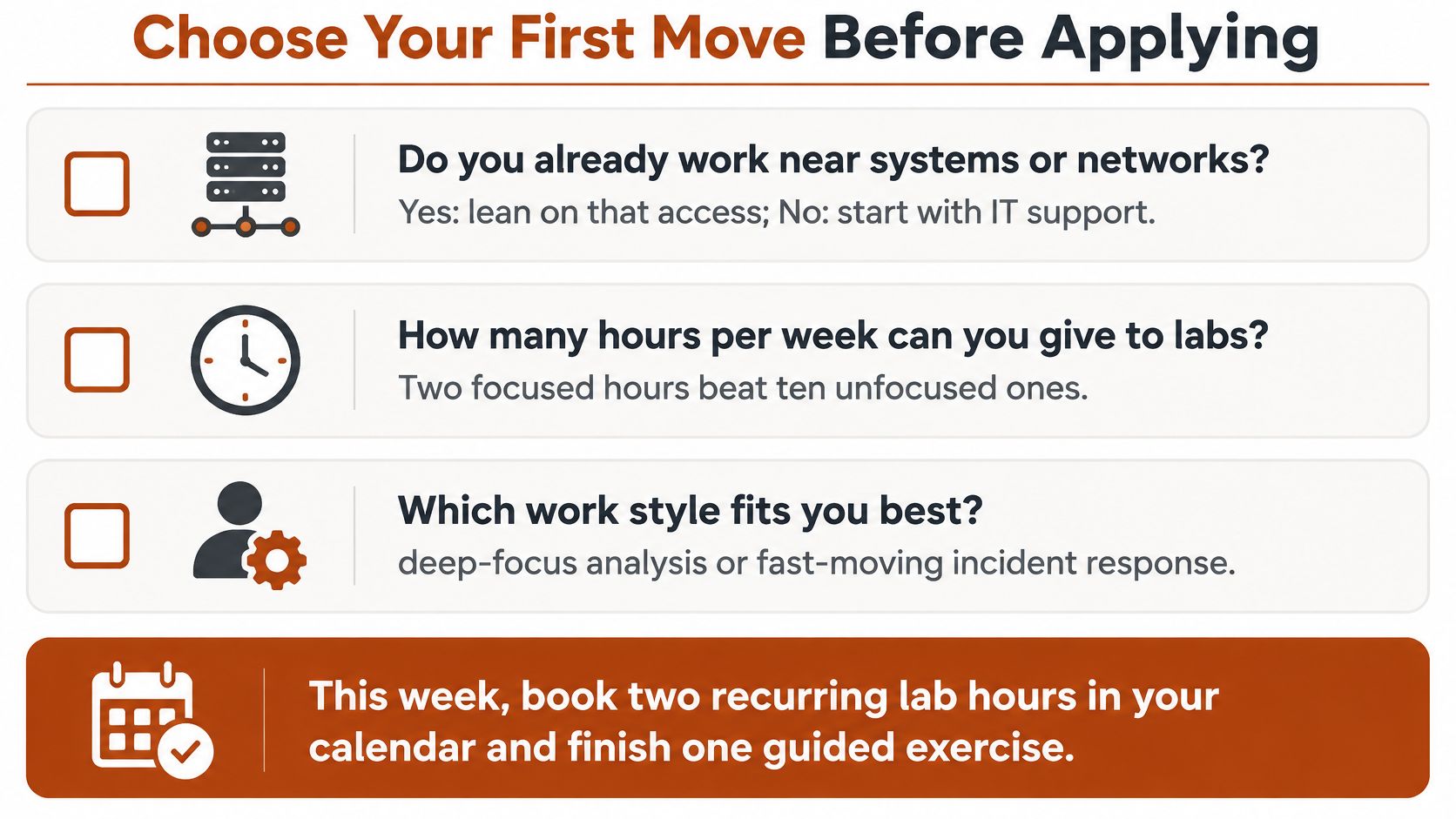
The checklist turns that decision into a concrete starting point.
A practical self-check
- Current access: Does the candidate already work near systems or networks? Someone handling support tickets can seek approved involvement in access reviews, endpoint investigations or escalation documentation; someone outside IT should prioritize a foundation opportunity.
- Available practice time: How much recurring time can the candidate realistically give to labs? The schedule should support completing and documenting a small exercise, rather than repeatedly starting new courses.
- Preferred work style: Does the candidate prefer investigating alerts, building controls, writing policy or working with developers? The answer should shape the project selected, not become an irreversible career commitment.
These answers establish the appropriate starting stage and a plausible direction. Someone without operational exposure shouldn't disguise that gap with advanced terminology. Someone already administering systems shouldn't discard relevant experience merely because the current title lacks the word security.
Make the next action observable
The next action should be a small, documented practice cycle: set up a lab, generate or import relevant logs, investigate a defined question and write the result. A suitable question might concern whether a sign-in pattern warrants escalation or whether an administrative change exceeded the intended permissions.
The written entry should include the question, environment, observations, conclusion and limitations. If the evidence doesn't establish malicious activity, that is a valid result. Resisting an unsupported conclusion demonstrates better judgment than forcing every exercise into a breach narrative.
Candidates seeking a foundation role can use the same exercise to support applications while explaining their troubleshooting approach. Any workplace examples should omit confidential information and appear in a portfolio only with appropriate authorization.
A useful initial milestone is a functioning lab with searchable logs, a completed investigation and a submitted application aligned with the candidate's demonstrated stage. That outcome isn't a hiring promise. It's evidence of forward movement that can be reviewed and improved.
Mojolin publishes sourced career and pay information alongside guides such as Entry-Level IT Jobs: Starting in Help Desk and Moving Up and Are IT certifications worth it? When they help and when not. Readers can visit Mojolin to compare entry routes and credential choices, then select a role and a practical project that match their current experience.