US information security analysts sit high on the national pay scale, yet that midpoint covers a wide market and should not be read as a typical starting offer.
The useful question about cyber security pay is which comparison matches the work. An advertised number can describe wages, self-reported survey responses or compensation attached to one vacancy, and each measures a different market; specialty, employer sector, location and AI skill can move an offer further than the national label suggests.
Table of Contents
- The Short Answer on Cyber Security Pay
- Pay Ranges Across the Full Market
- Security Job Families and How They Differ
- Certifications and Their Reported Salary Medians
- How AI Skills Change the Pay Picture
- Location, Sector and Benchmarking Your Pay
The Short Answer on Cyber Security Pay
Median pay means the midpoint, not the amount an employer should offer every qualified applicant. Half of the workers fall on either side of it, so a small group of exceptionally high earners doesn't pull the median upward the way it can pull an average.
That makes the median a useful reference, but an incomplete negotiating target. It doesn't identify the pay of a new entrant, distinguish operational work from architecture, or establish what a particular employer can afford.
The comparison must match the worker
A useful salary comparison starts with the work and then narrows the market:
- Specialty: Monitoring alerts, building cloud controls and approving security designs involve different responsibilities.
- Seniority: Time in a role matters alongside the independence and consequences of the decisions someone makes.
- Location and employer sector: A national occupation includes employers recruiting under different conditions and budgets.
- Credentials: A certification needs to be interpreted alongside the role it supports, rather than treated as a separate entitlement to higher pay.
These distinctions matter before a candidate decides whether an offer is strong or weak. An impressive title can describe narrowly supervised work, while an ordinary analyst title can include substantial control ownership.
National wages aren't worldwide career promises
The analyst benchmark is a US occupational measure. Mojolin's role-page pay and job figures are also US figures, so readers comparing opportunities elsewhere need a country-specific benchmark rather than a currency conversion.
Credential-holder surveys answer a different question: what participating professionals report earning. They can inform career choices without functioning as an official wage census or a reliable estimate of starting pay.
Practical rule: A salary benchmark is useful only when its occupation, geography and measure resemble the offer being assessed.
A candidate's working checklist should therefore be concrete: identify the relevant wage band, classify the job by its actual responsibilities, and record the factors that support a position within that band. That produces a defensible expectation rather than a demand built around a headline number.
Pay Ranges Across the Full Market
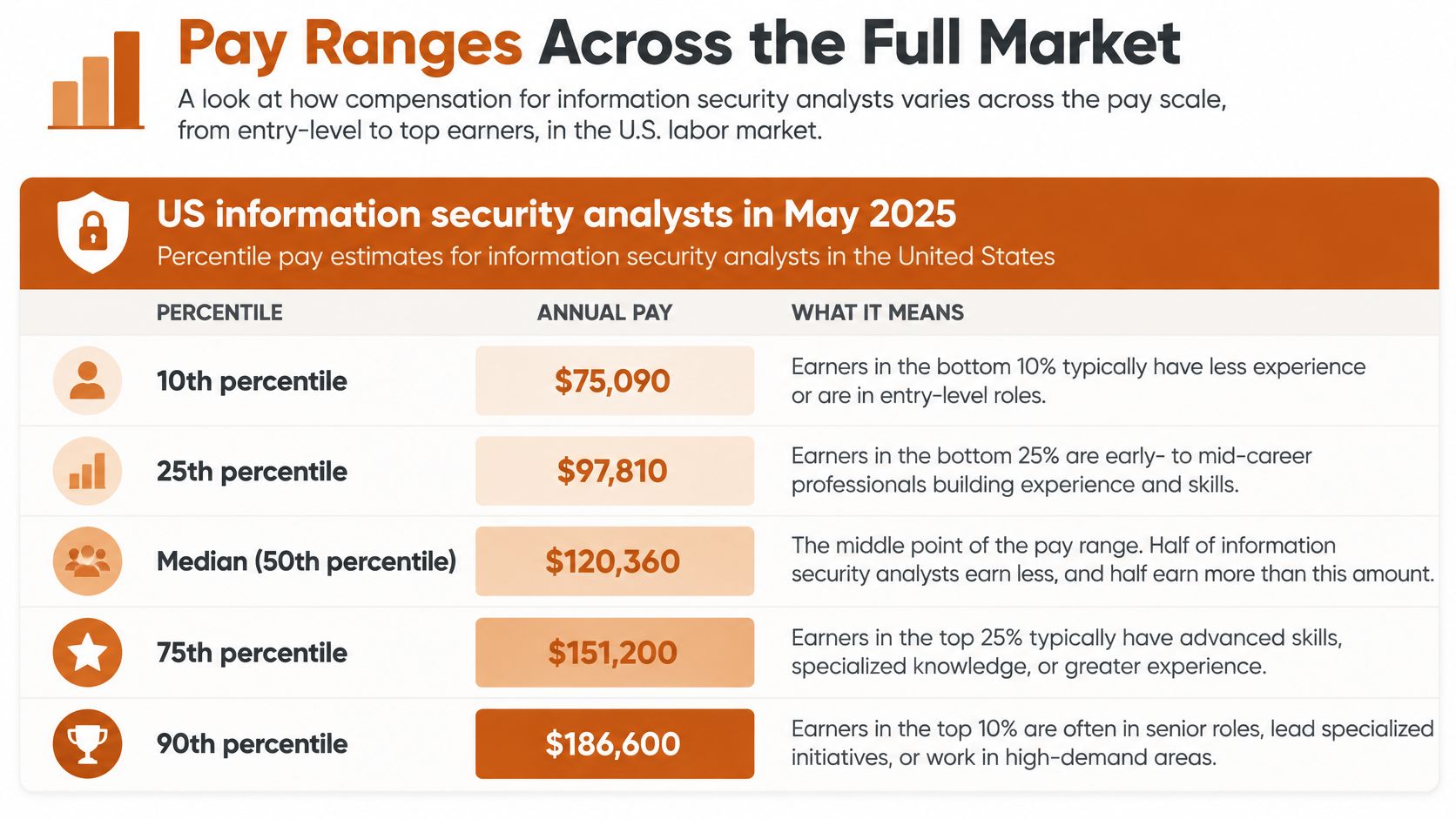
US information security analyst pay by percentile, May 2025
| Percentile | Annual wage (USD) | How to read it |
|---|---|---|
| 10th percentile | $75,090 | The lowest-paid tenth earn at or below this |
| 25th percentile | $97,810 | The bottom quarter earn below this |
| Median (50th percentile) | $129,180 | Half earn more, half earn less |
| 75th percentile | $163,500 | The top quarter earn above this |
| 90th percentile | $199,850 | The highest-paid tenth earn at least this |
A single national figure hides how widely cyber security pay spreads. The Bureau of Labor Statistics Occupational Outlook Handbook reports these May 2025 US wage points for information security analysts: the middle 50% earn between $97,810 and $163,500, and the highest-paid tenth earns at least $199,850. The bottom and top tenths sit more than $124,000 apart.
The chart provides a visual reference for the distribution.
Percentiles aren't career stages
The lower reference point identifies a wage position rather than a guaranteed entry-level salary. Likewise, the upper reference points don't establish what every experienced analyst or manager earns.
The lower quartile separates the bottom quarter from the rest of the occupation. The median marks the center, while the upper quartile identifies the boundary above which the highest-paid quarter sits.
Those distinctions prevent a common mistake: relabeling the distribution as junior, mid-career and senior pay. The published figures don't provide separate bands by years of experience. Percentile wages describe where pay falls across the whole occupation, nothing more.
That makes the spread itself the finding. The same occupation contains analysts near the 10th percentile and analysts near the 90th, and the distance between them reflects role scope, employer sector, location and specialization rather than a simple seniority ladder.
For a candidate whose duties match the analyst occupation, the central band is a more useful starting comparison than the top tail. It gives room to assess experience and responsibility without assuming that an unusually high wage is normal for the next offer.
Demand doesn't determine an individual offer
Employment projections describe the direction of an occupation; they say little about the bargaining power attached to a particular vacancy. New positions and replacement openings also represent different hiring needs, so an opening shouldn't automatically be interpreted as a newly created job.
The practical question remains whether an employer needs the candidate's particular capabilities. Someone who independently investigates incidents, improves detection rules and documents defensible decisions has a different case from someone who performs closely supervised triage, even when both hold an analyst title.
A video overview offers another way to approach the career discussion.
Turn the distribution into a target
A candidate can place an existing salary or offer against the table, then write down the evidence supporting that position. Relevant evidence includes hands-on investigations, ownership of production controls, escalation authority and accountability for remediation.
An employer should perform the same exercise from the other direction. If the advertised responsibilities require independent judgment but the offer sits toward the lower end, the hiring team needs to explain the mismatch or reconsider the scope.
The outcome should be a target band supported by responsibilities rather than a percentile chosen because it sounds ambitious. Years of experience help establish context, but the decisions someone can handle without supervision make the comparison more informative.
Security Job Families and How They Differ
A building needs someone guarding its entrance, someone installing its locks and someone deciding how the whole security design should work. Cybersecurity roles differ in much the same way: operating a control, building it and approving its design aren't interchangeable responsibilities.
The families below describe decision scope, not a rigid promotion ladder. Incident response, architecture and governance can each involve senior responsibility through different kinds of work.
| Job family | Main question | Decision it typically carries |
|---|---|---|
| SOC analyst | Does this activity need investigation? | Triage alerts, gather evidence and escalate suspicious behavior |
| Incident responder | How should the organization contain and recover from an incident? | Recommend containment, coordinate investigation and sequence recovery |
| Penetration tester | How could an authorized attacker compromise the system? | Choose tests within scope, validate weaknesses and explain remediation priorities |
| Security engineer | Which controls should run, and how should they operate? | Implement and maintain identity, network and endpoint protections |
| Cloud security engineer | How should cloud accounts and deployments remain secure? | Configure permissions, guardrails and deployment controls |
| Security architect | Does the proposed design manage the relevant risks? | Set security patterns, assess trade-offs and provide design approval |
| GRC analyst | Can the organization demonstrate that its controls meet requirements? | Translate obligations into policy, testing and audit evidence |
| CISO | Which security risks should leadership address and fund? | Set priorities, own the security budget and communicate risk to the board |
Accountability matters more than a tool list
An analyst who uses Microsoft Sentinel isn't automatically comparable with an engineer who designs its logging architecture and detection deployment process. The product name may match while the authority, maintenance burden and consequences of error differ substantially.
Similarly, a penetration tester's ability to find a weakness differs from an architect's responsibility to approve a design that prevents it. Formal acceptance of business risk may sit with a designated business owner rather than the architect, so candidates should clarify the actual approval chain.
A useful pay comparison follows decision ownership, not the number of tools listed on a résumé. Architecture credentials and senior leadership measures can help illuminate that distinction, but they don't establish a universal salary ranking across these families.
Read the verbs before the title
Descriptions built around monitor, investigate, build, design, approve or fund reveal more than an inflated title. Candidates exploring initial roles can use the guide to entry-level cybersecurity job titles to distinguish plausible entry responsibilities from positions that expect established ownership.
Some jobs carrying these titles can fall within a broad analyst classification, but title alone doesn't establish occupational fit. This comparison supplies no dedicated salary bands for SOC analysts, incident responders, penetration testers, security engineers, cloud specialists, architects or GRC analysts.
The analyst median isn't a proxy for every security specialty. A CISO compensation-growth finding is also not a published executive salary band, so it can't fill that gap.
Certifications and Their Reported Salary Medians
Reported median salary by cybersecurity credential, 2025
| Credential | Reported median salary (USD) | Scope it signals |
|---|---|---|
| Systems Security Certified Practitioner (SSCP) | $95,200 | Hands-on practitioner operations |
| Certified Cloud Security Professional (CCSP) | $118,840 | Cloud security design and control |
| Certified Information Systems Security Professional (CISSP) | $127,000 | Broad management across security domains |
| Information Systems Security Architecture Professional (ISSAP) | $140,620 | Advanced security architecture and design authority |
ISC2's career growth and earning potential analysis reports these self-reported global medians from its 2025 workforce data, including $95,200 for SSCP holders and $140,620 for ISSAP holders.
What the ordering suggests
The distinction between practitioner operations and architecture is useful. An operational credential supports the ability to carry out security work, while an architecture credential relates to decisions about how systems should be designed and controlled.
ISSAP's position is consistent with senior technical responsibility and design authority. It isn't proof that obtaining the credential independently produces the salary difference.
CCSP points toward cloud-specific knowledge, while CISSP covers broad security domains and management concerns. Neither label establishes whether the holder leads a team, owns production systems or works under someone else's approval.
What the figures can't prove
These are credential-holder medians, not certification bonuses. Respondents may already have held senior roles before gaining a credential, and their region, experience and specialty can affect the reported result.
The figures also aren't directly interchangeable with US occupational wages. A worldwide self-reported sample and a national wage measure describe different populations through different collection methods.
A certificate can support evidence of capability. It can't substitute for evidence that the holder can perform the target job.
A candidate considering an exam should therefore start with job requirements, not the highest figure in the table. The relevant question is whether the credential supports work the candidate can credibly demonstrate through projects, operational experience or design decisions.
- Match the domain: Cloud control ownership calls for different preparation from audit coordination or security operations.
- Check the responsibility: A role requiring architecture approval needs more than familiarity with architectural terminology.
- Assess the full commitment: Preparation, exam requirements and renewal obligations belong in the decision alongside potential career relevance.
The cybersecurity certification comparison can help candidates examine those practical differences. The salary interpretation should remain disciplined: identify the credential a target job names, confirm that experience supports its intended scope, and assess the employer's compensation for that work.
A pay gap between credential groups may also be a responsibility gap. Treating it only as an exam-selection problem misses the career progression that can sit behind the result.
How AI Skills Change the Pay Picture
Average enterprise pay and equity by role family
| Role family | Average enterprise pay (USD) | Equity offered |
|---|---|---|
| Cybersecurity | $152,700 | 4% of postings |
| IT security | $160,800 | Not reported in this comparison |
| Observability | $165,400 | Not reported in this comparison |
Help Net Security's coverage of cybersecurity job-ad research reports these enterprise-role averages and finds that 28.5% of G7 cybersecurity postings required AI skills from October 2025 through March 2026, compared with 14.2% during the same period a year earlier; US postings requiring AI skills carried median advertised pay 14.9% above cybersecurity postings overall.
Those findings don't establish that adding an AI keyword to a résumé causes an equivalent raise. Advertised compensation can reflect a different mix of seniority, employers and responsibilities, and an advertised figure isn't a record of accepted offers.
The career question is which AI-related work the candidate will own.

AI familiarity isn't the same as AI responsibility
AI engineering can involve building and evaluating systems, securing integrations and testing how model behavior affects application security. A candidate should distinguish implementing a controlled production system from merely using an assistant during daily work.
AI governance concerns acceptable use, approval processes, evidence and accountability. Its value depends on whether the employee can make requirements operational, rather than write a policy that no team follows.
Detection-and-response automation involves another set of consequences. An automated workflow that gathers incident evidence differs materially from one allowed to disable accounts or isolate endpoints.
Ordinary security roles may list AI familiarity without assigning any of those responsibilities. The growth in AI requirements is a reason to examine that distinction closely, not proof that basic familiarity has already become a universal baseline.
Apply an ownership, evidence and compensation test
A durable case for higher pay is more defensible when the employer needs a demonstrated capability tied to consequential work. The published comparison doesn't establish which AI specialty will retain a premium.
- Ownership: Identify the system, control or approval the employee will own. Ask whether automation can take action and who authorizes exceptions.
- Evidence: Determine how capability will be assessed. A tested workflow with evaluation criteria provides more substance than a list of AI products.
- Compensation and progression: Separate base salary from bonus, equity, benefits and the route to broader responsibility.
The enterprise averages also shouldn't be treated as a clean ranking of identical jobs. Cybersecurity, IT security and observability labels can capture different employers and job mixes.
Likewise, an unreported equity figure doesn't mean no equity exists. It means the comparison doesn't support a conclusion.
Higher cash pay can accompany greater operational exposure without better long-term progression. A candidate assessing an AI-heavy vacancy should ask who validates outputs, who handles failures and whether the employer provides the authority and resources needed to carry that responsibility.
Location, Sector and Benchmarking Your Pay
Increased demand doesn't necessarily create an economy-wide shortage. Georgetown's Center for Security and Emerging Technology finds that hiring difficulties cluster by occupation, region and industry, with geographically dispersed manufacturing demand and retail hiring challenges associated with relatively low compensation despite high demand.
That changes the interpretation of an employer's shortage claim. Difficulty recruiting can reflect the location, compensation or requirements of a vacancy rather than an absolute absence of qualified professionals.
A security analyst in a lower-paying sector may therefore face a different opportunity set from a similarly skilled peer elsewhere. Remote work doesn't automatically resolve the difference: a candidate still needs to establish whether the employer uses location-based pay, a national range or another compensation policy.
Compare the employer's actual hiring market
The comparison should identify local demand, sector budget, specialty, experience, credential relevance and responsibility. A broad national benchmark can frame the discussion, but it can't reveal the employer's approved range or whether the role has been scoped realistically.
Senior compensation provides another distinct signal. The IANS and Artico Search 2025 CISO Compensation Benchmark Report found an average 6.7% compensation increase among 566 CISOs in the United States and Canada in 2025.
That is a one-year average for the surveyed leadership group, not a raise entitlement, salary level or target for security professionals generally. Comparing it directly with analyst wages would confuse a change in compensation with a wage amount.
Negotiation checkpoint: A hiring team's difficulty filling a role is relevant only after the candidate understands the responsibilities, approved range and conditions attached to the offer.
Build a written target before the call
Establish occupational fit. Select a reference band only after confirming that the work resembles the occupation being measured. For another security specialty, comparable vacancies may provide a better starting point than forcing the analyst distribution onto it.
Document adjustments. Record the location policy, employer sector, relevant credentials and independent responsibilities. Support an upward expectation with specific work, such as owning identity controls, leading incident recovery or approving security designs.
Separate the opening request from the minimum. Choose an opening figure supported by the matched evidence. Establish a walk-away point using financial needs, alternatives and role conditions, not an automatic national-percentile floor.
A qualified analyst can use the lower quartile as a reason to examine an offer carefully. It isn't a universally appropriate minimum for every country, specialty or career transition.
The pay range should be shared on the first call with the candidate. A useful first-call question asks for the approved base range, geographic pay policy and any variable compensation before extensive interviews or assessments begin.
Candidates can organize that discussion with the salary negotiation guide. The written preparation should end with a target, the evidence supporting it and the unanswered question most likely to change the decision.
Mojolin publishes sourced career pay figures, occupational outlooks and certification comparisons for evaluating technology careers. Visit Mojolin to compare a target role with related occupations and prepare a salary expectation grounded in the work being offered.