
It's a new analyst's first Monday. A queue of security alerts is already waiting, a ticket asks for a firewall rule change, and a manager wants to know which item matters first. That confusion is normal, because entry level cybersecurity job titles rarely describe the same work from one employer to the next.
One junior analyst spends the day triaging alerts. Another reviews user access, tracks patches, or collects audit evidence. The title alone doesn't tell candidates which tools they'll touch, whether the shift runs overnight, or whether the work is technical, procedural, or both.
The eight titles below are grouped by what the first 90 days involve, which tools the job assumes on day one, and the realistic next move after the first role. Each entry names a practical starting point, so readers can match a title to help desk experience, systems administration, audit work, or cloud skills they already have. Readers who want the broad market context should also keep one caution in mind. National occupation figures cover workers at every experience level, so they aren't a promise of what a first offer will look like.
Table of Contents
- 1. SOC Analyst (Tier 1)
- 2. Junior Information Security Analyst
- 3. IT Security Specialist (Cybersecurity Technician)
- 4. Vulnerability Management Analyst
- 5. Junior Penetration Tester
- 6. Junior Incident Response Analyst
- 7. Junior GRC (Governance, Risk, and Compliance) Analyst
- 8. Associate Cloud Security Analyst
- Entry-level cybersecurity roles at a glance
- Pick Your First Role and Plan the Next Two Moves
1. SOC Analyst (Tier 1)
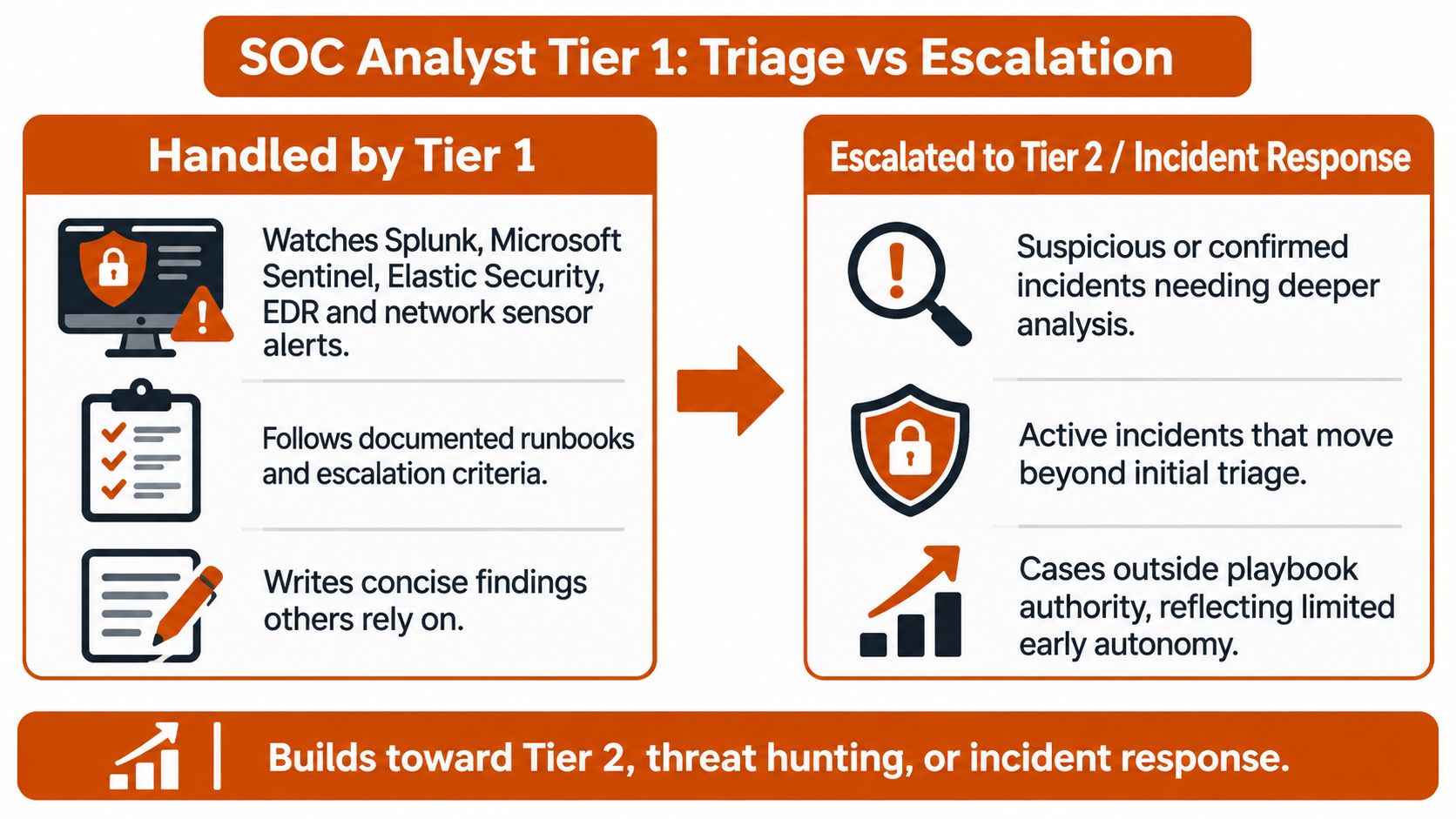
A SOC Analyst Tier 1 works the front of the queue. The analyst monitors alerts from a SIEM platform, endpoint detection tools, and network sensors, then decides whether each event is benign, suspicious, or a confirmed incident. In the United States, the U.S. Bureau of Labor Statistics information security analysts profile describes the broader occupation with a typical entry-level education of a bachelor's degree and 21% projected employment growth from 2025 to 2035, from 192,900 to 233,400 jobs.
The trade-off is structure versus repetition. Enterprise SOCs and managed security service providers (MSSPs) give Tier 1 analysts runbooks and clear escalation paths, which makes learning faster. The same structure can mean night shifts, high alert volume, and little authority to investigate beyond the first checks.
What the first 90 days test
- Alert triage: Identify the source, affected asset, severity, and supporting evidence before escalating.
- Log reading: Work through Windows event logs, Sysmon output, and basic packet captures in Wireshark.
- Clean handoffs: Write notes that let Tier 2 continue without re-asking basic questions.
Practical rule: A triage note that doesn't state what was checked, what was found, and why it matters isn't finished.
Candidates preparing for this track often start with the baseline covered by CompTIA Security+ certification details, paired with a home lab using a free SIEM. The next moves are Tier 2 SOC analyst or junior incident response, once escalation judgment is consistent. Candidates should ask hiring teams how alerts are prioritized and who owns containment, because those answers reveal whether Tier 1 is a training role or just a ticket queue.
2. Junior Information Security Analyst
One posting under this title asks for alert monitoring and access reviews. Another with the same title wants policy documents and vendor questionnaires. A junior information security analyst is the broadest label on this list, and the duties vary more than the title suggests.
In a mid-sized firm, the same person might check firewall changes in the morning and gather compliance evidence after lunch. Rotations across monitoring, access reviews, vulnerability follow-up, and security tool administration are common. The National Initiative for Cybersecurity Education Framework resource notes that its work roles aren't synonymous with job titles, so duties matter more than the label.

How to read the posting
Look for verbs, not adjectives. Monitor, review, configure, and escalate point to operational work. Coordinate, document, and attest point to program support. Both are legitimate, but they build different resumes and different first 90 days.
The operational version expects you inside a SIEM, an identity directory, and a ticketing queue within weeks. The program version expects meeting notes, evidence collection, and spreadsheet tracking. I would read the tool list and verbs before the job summary, because the summary is often recycled marketing.
Resumes should show concrete work with identity systems, endpoint tools, or firewalls, plus small lab projects that match those tasks. Readers still choosing between operations and program work can follow guidance on how to get into cybersecurity before committing. The practical next move is a defined specialty, such as SOC Tier 2, vulnerability management, or identity and access management, and the first 90 days usually reveal which one the employer needs.
3. IT Security Specialist (Cybersecurity Technician)
Say a help desk technician already resets accounts, deploys endpoint agents, and chases failed patches. That person is closer to this title than many career changers with only coursework. An IT security specialist, often called a cybersecurity technician, sits next to IT support and systems administration and handles the hands-on controls other teams depend on.
Small businesses may expect one technician to manage endpoint protection, backups, and access controls. Municipal and healthcare IT departments often blend security tasks with help desk coverage. The work is less glamorous than threat hunting, but it's where many controls either get applied correctly or fail.

Tools assumed early
- One endpoint platform: Learn policy, exclusions, and alert handling in depth rather than skimming three consoles.
- One identity platform: Practice provisioning, deprovisioning, group changes, and least-privilege reviews.
- Patch and ticket systems: Close the loop with evidence, not just a status update.
Available listings data summarized by OnlineCybersecurity.org's entry-level cybersecurity degree guide identifies Security Administrator as the largest listed entry-level category, ahead of Cybersecurity Analyst and Tier 1 SOC Analyst. That spread tells candidates to search administrative and support titles, not only analyst titles. The next move is security administrator or junior security analyst. The risk is getting stuck as general IT support with a security title, so candidates should track security outcomes they've owned and describe them with measurable results.
4. Vulnerability Management Analyst
This role doesn't chase live intruders. It reduces the openings intruders use. A vulnerability management analyst runs scans, validates findings, prioritizes weaknesses by business risk, and tracks remediation with system owners until the exposure is fixed, mitigated, or formally accepted.
The 2017 Equifax breach, linked to an unpatched Apache Struts vulnerability, CVE-2017-5638, is the standard example of what happens when known weaknesses sit open. Large organizations use platforms such as Tenable Nessus or Rapid7 InsightVM to sort findings across thousands of assets. The junior analyst's value is turning scanner output into tickets a system owner can act on.
Where beginners usually struggle
- CVSS tunnel vision: A high score on an isolated test box matters less than a medium finding on an internet-facing payment server.
- Weak asset inventory: Scans can't cover systems nobody knows exist, so inventory gaps become security gaps.
- Vague tickets: Owners need the affected host, the exact fix, a deadline, and a retest step.
A scanner finds problems. This job gets them fixed, and that second part is mostly follow-through and clear writing.
The first tool to learn is one scanner, whether Nessus, OpenVAS, or Qualys, used well enough to explain false positives. The next move is usually security engineering support or a broader analyst role with stronger risk judgment. Candidates who dislike chasing other teams for closure dates won't enjoy this work, even if they like the technical side.
5. Junior Penetration Tester
This is the title many beginners want and the one with the fewest true entry-level seats. A junior penetration tester works under senior supervision on authorized assessments. The day involves reconnaissance, testing for common weaknesses, validating findings, taking screenshots, and writing reports that a client can remediate.
Consulting firms typically start juniors on web application assessments, not full red team operations. Bug bounty platforms such as HackerOne and Bugcrowd can build a public track record, but inconsistent findings don't replace supervised delivery experience. Report writing carries more weight than candidates expect, because an unproven finding has no value to the client.
The video below gives a useful sense of how testing work is explained in practice.
Portfolio evidence that counts
- Lab write-ups: Use TryHackMe, Hack The Box, or PortSwigger Web Security Academy and document method, not just flags.
- OWASP Top 10 fluency: Demonstrate each issue in Burp Suite and explain the business impact.
- Sample reports: Show scope, evidence, risk rating, and a specific remediation step.
Scope and authorization aren't paperwork details. They're the legal boundary of the job, and employers screen for that judgment early. The next move is penetration tester on a defined service line, such as web apps or internal networks. Candidates without strong networking and Linux basics usually progress faster by starting in SOC or systems work first, then moving across with evidence.
6. Junior Incident Response Analyst
A phishing report arrives at 9 a.m. By 9.20, three more users have clicked. The junior incident response analyst collects logs, preserves evidence, builds the timeline, and helps senior responders contain affected accounts and hosts without destroying the facts they'll need later.
The work suits methodical people who stay calm when the picture is incomplete. It doesn't suit anyone who improvises first and documents later. Response efforts after the SolarWinds supply chain compromise, disclosed in 2020, showed why disciplined scoping matters, since teams had to identify affected systems and trace attacker activity across complex environments.
Habits built in the first 90 days
- Timeline discipline: Record who did what, at what time, and from which evidence source.
- Evidence handling: Preserve logs and images before remediation wipes them.
- Lifecycle knowledge: Learn the NIST SP 800-61 incident handling lifecycle and use its language in tickets.
Federal hiring material shows how employers weight these signals. A USAJobs federal cybersecurity posting sits within competency expectations that include attention to detail, oral communication, reasoning, teamwork, and customer service alongside technical knowledge. That matters during incidents, when a clear update to a business owner is as valuable as a correct log query.
Free tools such as Autopsy and Volatility are enough to practice forensic basics. Volunteering for SOC escalations is the fastest route in. The next move is incident responder or digital forensics analyst, once timelines and containment calls hold up under review.
7. Junior GRC (Governance, Risk, and Compliance) Analyst
Not every entry point is technical in the console sense. A junior GRC analyst gathers control evidence, tracks risk registers, maps requirements, and helps prepare for audits such as SOC 2, ISO 27001, and HIPAA assessments. Healthcare organizations use GRC staff to track HIPAA Security Rule compliance. Software firms preparing for SOC 2 rely on juniors to collect screenshots, policies, and access records that prove a control operated.
The trade-off is clear. GRC offers regular hours and strong exposure to how businesses make risk decisions. It won't build deep packet analysis or endpoint investigation skill, so candidates who want operations work later need a deliberate plan to add it.

Evidence employers actually check
- Control mapping: Connect a requirement to a control, an owner, and a piece of evidence in a spreadsheet or GRC tool.
- Risk statements: Write the asset, threat, likelihood, impact, and treatment without vague filler.
- Stakeholder follow-up: Chase evidence politely and record exceptions before auditors find them.
Candidates should learn the NIST Cybersecurity Framework and ISO/IEC 27001 basics before pursuing advanced credentials. Senior governance paths eventually lead to leadership credentials such as those covered by CISSP certification information, but that is not an entry-level target. A practical next step is GRC analyst, IT auditor, or compliance analyst with responsibility for a control set. Strong writers with audit or operations experience often enter here faster than lab-focused candidates.
8. Associate Cloud Security Analyst
Cloud mistakes are usually configuration mistakes, and they're visible fast. An associate cloud security analyst reviews identity permissions, monitors cloud logs, checks storage and network settings, and helps remediate misconfigurations across AWS, Microsoft Azure, or Google Cloud. Teams use posture tools such as Wiz or Microsoft Defender for Cloud to flag public storage, excessive permissions, and unencrypted resources.
Pick one provider first. A candidate who understands one cloud's IAM model, logging services, and network controls in depth is more useful than a candidate with shallow familiarity across three. Say an audit finds a storage bucket exposed and several standing admin roles. The associate analyst confirms exposure, identifies owners, removes public access, tightens policy, and records the retest.
A practical starter lab
- Build the mistake: Create intentionally misconfigured storage, security groups, and IAM policies in a test account.
- Detect it: Find each issue in native logging and posture findings, then note the evidence.
- Fix and prove it: Remediate, re-scan, and write the closure note an auditor would accept.
Hiring signal: Explaining why a permission is excessive, in business terms, separates cloud candidates from console tourists.
Pair cloud fundamentals with a security credential to show both sides. The next move is cloud security analyst or cloud security engineer, especially for candidates who add automation and infrastructure as code review. The trade-off is pace. Cloud services change constantly, so this path rewards candidates who keep learning after the first credential. It punishes passive monitoring habits, because a misconfiguration can expose data before anyone opens the dashboard.
Entry-level cybersecurity roles at a glance
| Job Title | Typical Entry Certification | Core Tool or Skill | Common Next Step |
|---|---|---|---|
| SOC Analyst (Tier 1) | CompTIA Security+ | SIEM alert triage | Tier 2 analyst or incident response |
| Junior Information Security Analyst | CompTIA Security+ | Security controls and access reviews | Specialize in cloud, application security, or GRC |
| IT Security Specialist (Cybersecurity Technician) | CompTIA Network+ | Endpoint and account security | Security analyst or security engineer |
| Vulnerability Management Analyst | CompTIA Security+ | Vulnerability scanning and risk prioritization | Threat exposure or security engineering |
| Junior Penetration Tester | eLearnSecurity Junior Penetration Tester (eJPT) | Authorized testing with Burp Suite | Senior penetration tester or red team |
| Junior Incident Response Analyst | CompTIA Security+ | Incident documentation and evidence collection | Forensics, threat hunting, or SOC leadership |
| Junior GRC (Governance, Risk, and Compliance) Analyst | ISC2 Certified in Cybersecurity (CC) | Controls, risk, and audit evidence | GRC specialist or auditor |
| Associate Cloud Security Analyst | AWS Certified Cloud Practitioner | Cloud IAM and security logging | Cloud security specialist |
Pick Your First Role and Plan the Next Two Moves
Choose the title that matches work that can already be demonstrated, then plan the two steps after it. Help desk experience maps cleanly to IT security specialist and SOC Tier 1, because account work, patching, endpoint support, and ticket writing transfer directly. Systems administrators often move faster into vulnerability management or cloud security, where asset knowledge is the hard part. Audit, compliance, and operations backgrounds fit GRC and junior analyst roles that need evidence handling and stakeholder follow-up.
Don't buy credentials in the wrong order. For most defensive roles, a baseline security credential plus portfolio evidence beats an advanced exam with no lab work behind it. Mojolin lists the CompTIA Security+ exam at $439, with a 90-minute exam and 3-year validity, so candidates should budget both the fee and the renewal cycle before committing. Penetration testing candidates need the reverse emphasis. Labs, write-ups, and sample reports carry the application, and a generic credential won't substitute for them.
Pay figures need careful handling. The U.S. Bureau of Labor Statistics occupational profile for information security analysts reports a median annual wage of $129,180 in May 2025 for the full occupation. That number aggregates beginners and senior analysts across industries, so it shouldn't anchor a first-offer expectation. It does show why the second and third moves matter. Specialists who can investigate, engineer fixes, or own risk decisions get paid for judgment, not ticket volume.
Use adjacent IT work as a bridge, not a destination. Mojolin tracks median pay for IT support at $61,860, and IT support specialist jobs projected to shrink 3% from 2025 to 2035. A support role is still a strong place to learn users, systems, and troubleshooting. It becomes a problem only when there's no exit plan.
A workable two-move plan is specific. Move one could be help desk to SOC Tier 1 within a defined study window, with triage notes as portfolio evidence. Move two could be SOC Tier 1 to Tier 2 or incident response, earned through escalation quality and one deeper skill such as log analysis or cloud logging. GRC candidates can plan evidence collection first, then control ownership, then audit lead work. Cloud candidates can plan one provider first, then posture remediation ownership, then engineering.
Before applying, rewrite each target posting into tasks. If the tasks match current evidence, apply even when the title sounds senior. If they don't, the gap list becomes the study plan. That's how entry level cybersecurity job titles stop being a confusing list and become a sequence of jobs a candidate can win.
Compare the credentials, pay, and outlook behind these roles before spending on an exam or accepting a first offer, since Mojolin brings certification prices, validity periods, and Bureau of Labor Statistics occupation data together in one place. Readers can use those comparisons to pick a first title, price the next credential, and set a defensible salary expectation for the move after it. Start that planning today at Mojolin.