Technical writer employment is projected to rise only about 0.9 percent from 2024 to 2034, from 56,400 jobs to 56,900, while the May 2025 median annual wage is $90,390. That pairing, almost no net expansion and pay well above many entry-level communications jobs, is the right starting point for the technical writer job outlook.
A nearly flat headcount doesn't mean hiring stops. Official projections separate jobs added to the occupation from openings created when people retire, change careers, or leave. Those replacement openings dominate the yearly total. Two Bureau of Labor Statistics editions also start from different base years and different job counts, so growth rates can be compared and the totals cannot be added together or subtracted. Read the percentage as the trend and the openings figure as the hiring pool.
Table of Contents
- Technical Writer Job Outlook Numbers at a Glance
- Where the Projections Come From and What Years They Cover
- Why Openings Outnumber New Jobs
- Median Pay and What Moves It
- Industries That Drive Technical Writing Demand
- Skills and Portfolio Evidence Employers Screen For
- How Generative AI Is Changing the Outlook
- Plan Your Next Move Around These Numbers
Technical Writer Job Outlook Numbers at a Glance
| Projection period | Jobs at start | Jobs at end | Net change | Growth | Median annual pay |
|---|---|---|---|---|---|
| 2024 to 2034 BLS projection | 56,400 | 56,900 | about +500 | 0.9% | May 2025 median of $90,390, published separately from this edition's job count |
| 2025 to 2035 BLS projection | 46,400 | 46,700 | about +400 | 1% | $90,390 (May 2025) |
| Annual openings, 2024 to 2034 projection | Not a starting headcount | Not an ending headcount | 4,500 openings a year | Openings, not a growth rate | May 2025 median of $90,390 is the wage benchmark, not an openings wage |
The two projections start from different job counts. Growth rates can be compared across editions. Totals should not be combined or subtracted.
Three points follow from that table.
- The job count is nearly flat. A net gain of a few hundred jobs over a decade is stability, not expansion.
- Openings recur every year. About 4,500 openings a year is the figure that describes hiring, and most of those seats replace people who leave.
- Pay sits above many entry-level communications roles. The May 2025 median is a national benchmark, not a quote for one city or one specialty.
Use the growth percentage as the trend and the openings figure as the number of roles to target each year. A candidate who only watches the percentage will understate how often teams hire. A candidate who treats 4,500 as new jobs will overstate how fast the occupation is expanding.
Where the Projections Come From and What Years They Cover
| Figure | Period | Scope | Source |
|---|---|---|---|
| Technical writer jobs, start and end | 2024 to 2034 | US | BLS employment projections |
| Technical writer jobs, start and end | 2025 to 2035 | US | BLS employment projections |
| Median annual wage | May 2025 | US | BLS wage data |
| Total US employment benchmark | 2024 to 2034 | US | BLS employment projections |
Check a figure in the same order a researcher would. First identify the edition. Mojolin's pay, employment, and outlook figures come from the U.S. Bureau of Labor Statistics Occupational Outlook Handbook, the edition with 2025 pay and 2025 to 2035 projections. The pay and job figures on Mojolin's role pages are US figures.
Next confirm the base year. The 2024 to 2034 edition and the 2025 to 2035 edition are not two measurements of the same stock of jobs. One starts near 56,400 and the other near 46,400. That gap is an edition difference, not a sudden loss of ten thousand writers between one year and the next.
Then confirm the measure. A net change, a growth rate, and an annual opening count answer different questions. The Bureau of Labor Statistics employment projections news release projected total U.S. employment to increase by 5.2 million jobs from 2024 to 2034. Technical writing's net gain of about 500 jobs over that same decade is a very small share of overall growth.
Limits that sit next to the figures
Projections are estimates, not guarantees. They rest on current occupational definitions, so a reclassified job title can move counts between editions even when the work continues under another name.
Before citing any of these numbers, run this check.
- Confirm the year. Say 2024 to 2034 or 2025 to 2035, not "the next decade" without a base.
- Confirm US scope. These are national figures, not a metro or a single employer.
- Check the measure. A net change, a growth rate, and an annual opening count are not interchangeable.
Why Openings Outnumber New Jobs
The Bureau of Labor Statistics Monthly Labor Review projected technical writer employment to rise from approximately 56,400 jobs in 2024 to 56,900 in 2034, a net gain of about 500 positions, or 0.9% over the decade, with roughly 4,500 annual openings. That pace sits well below growth for all occupations. The same outlook ties demand to software, engineering, scientific research, manufacturing, healthcare, finance, and government, and it flags generative AI as a force that could limit employment demand as organizations streamline documentation.
The gap between 500 new jobs and 4,500 openings a year has three parts.
- Net growth counts only jobs added beyond the current total. About 500 jobs over ten years is roughly 50 added jobs a year.
- Openings add replacement demand. Retirements, career changes, and other exits create vacancies even when the headcount doesn't rise.
- The yearly total is mostly turnover. About 4,500 openings a year cannot come from 50 new jobs. The rest is replacement.
Say a team of 100 writers has a 10 percent annual exit rate. That team must refill about 10 positions a year even if headcount never changes. Replacement rates differ by employer and industry, so the national openings figure is an average. It will not match any one team.
What that means in a search
- Turnover is the hiring event. Openings reward candidates who can join during routine replacement, not only when a department is created.
- Competition doesn't fade just because headcount is flat. Each opening still has a queue.
- Sector choice matters more than the national average. A regulated product group and a general content desk don't hire on the same cycle.
Track openings at two or three target employers, or in two sectors, and compare their turnover with the national figure before you treat 4,500 as your personal odds.
Median Pay and What Moves It
The Bureau of Labor Statistics Occupational Outlook Handbook reported a median annual wage of $90,390 for technical writers in May 2025. Half of workers earned more and half earned less. The same handbook reported about 46,400 jobs in 2025 and projected about 46,700 by 2035, a 1% increase and a net gain of about 400 jobs. Both editions describe limited expansion plus recurring replacement. Compensation and specialization matter more than headline job-count growth.
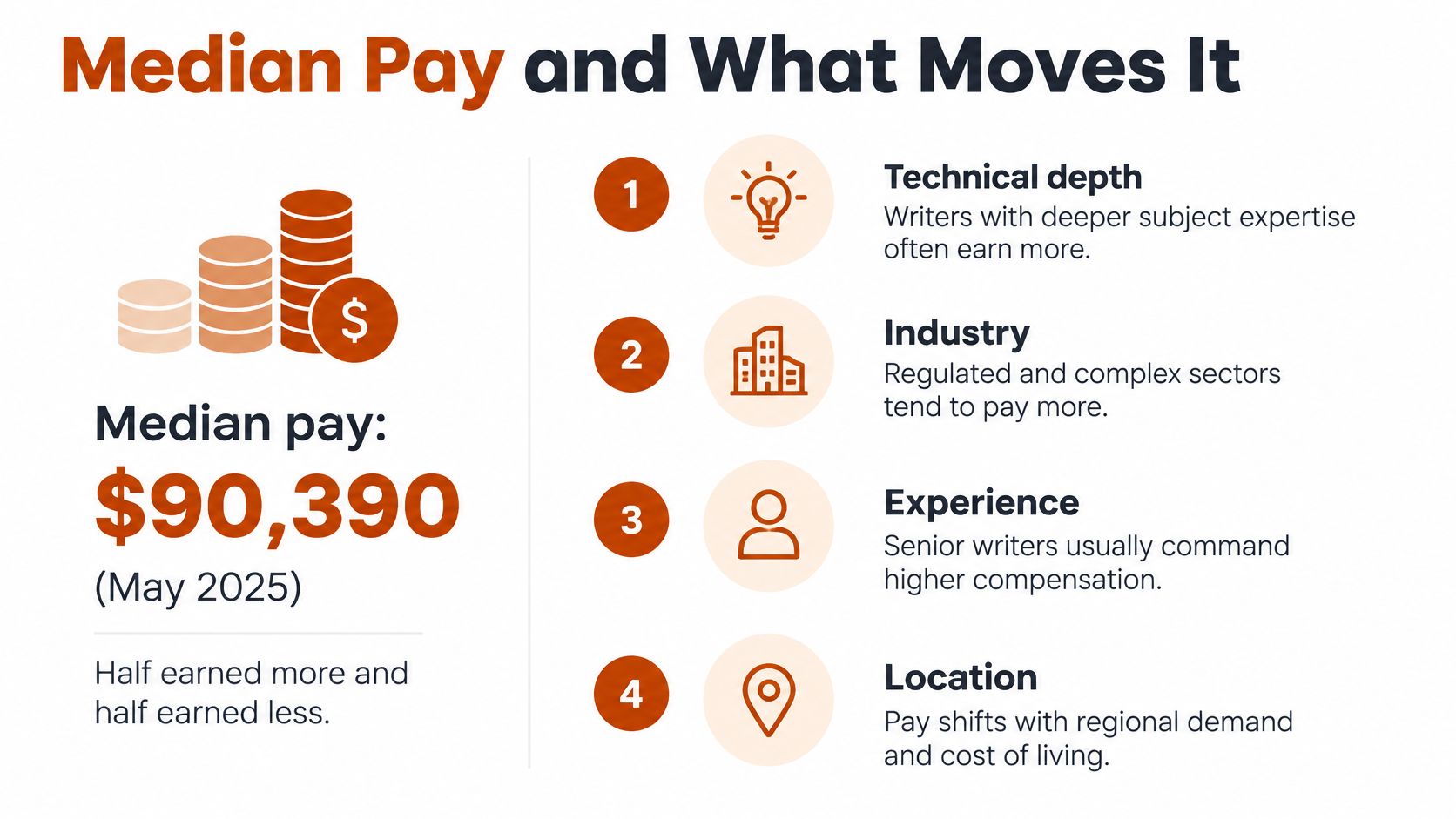
A single occupational median hides wide ranges. Treat $90,390 as a benchmark, not a promise. Pay moves with employer, location, industry, and technical depth. Writers close to software engineering, cybersecurity, medical products, aerospace, or regulated systems compete in higher-value markets than writers producing general-purpose content. Employers still need people who can read source material, decide what users must know, validate claims, organize information, and own documentation quality.
Rank the drivers before you negotiate
- Technical depth moves pay the most. Proximity to engineering, security, medical products, aerospace, or regulated systems is a different labor market from general content.
- Domain specialization comes next. Validating a claim against a specification, or reviewing a code sample, carries more weight than polishing a draft.
- Employer type changes the offer. Documentation inside a product company is valued differently from general content production.
- Location still shifts the number. Metro demand and cost of living move offers even when the job title is identical.
In a salary conversation, compare the median with postings in the same location and specialty, then adjust for experience. A national midpoint from tech salaries by role is a starting line, not the offer you should accept unchanged.
Ask three questions before you treat the benchmark as the job: Which products or systems will I document? Who reviews technical accuracy? Do I maintain revision records and online help, or only drafts?
Industries That Drive Technical Writing Demand
Demand follows products and rules that keep changing, not a publishing calendar. Match a target employer to a sector before you pick a portfolio sample.
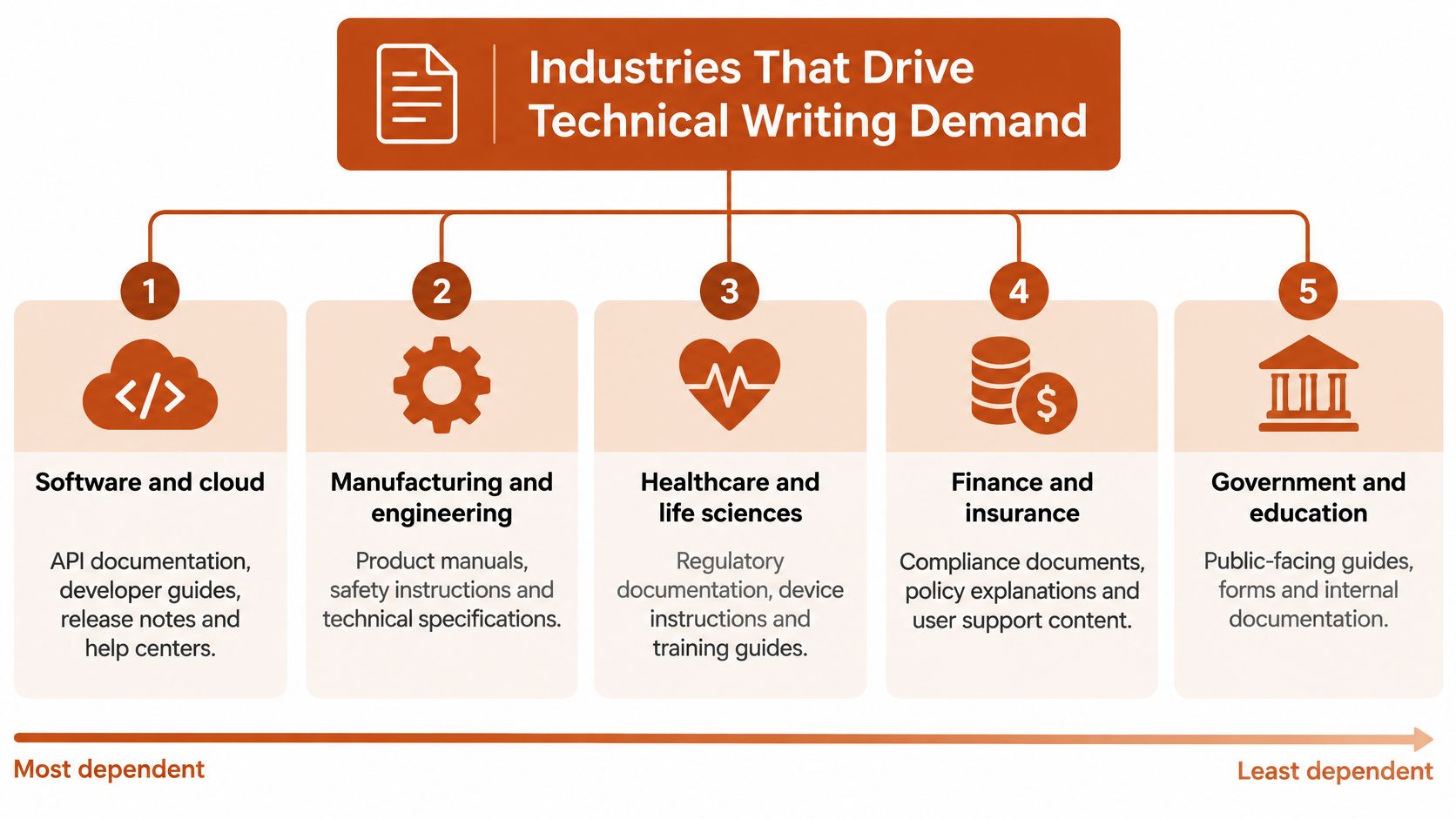
Software and cloud sits at the top of that dependence. API references, developer guides, release notes, and help centers ship with the product. Docs-as-code workflows in Git, reviewed like code, keep those pages tied to each release. Demand stays steady because every release can break a procedure.
Engineering and manufacturing runs on specifications, maintenance manuals, installation instructions, and quality records. A missed torque value or a wrong part number is a field failure, so review is heavier than a marketing edit. Products stay in service for years, which keeps the manuals alive.
Healthcare and medical products need instructions for use and labeling that pass regulatory review. The document is part of the product file. A wording change can require a controlled revision, which is why headcount doesn't vanish when a template is reused.
Finance leans on policy, system, and compliance documentation. Accuracy rules are strict, and an outdated control description is an audit problem. Systems and policies change often enough that the pages don't freeze.
Government and defense work is standards-compliant manuals and procurement documentation. Review chains are long. The document set outlives the writer who started it.
Scientific research needs method documentation and data-system guides. The audience is narrow, and a skipped step makes a result impossible to repeat.
Pick one or two of those sectors that match work you have already done, then build one portfolio sample in that domain rather than a generic "how to reset a password" page.
Skills and Portfolio Evidence Employers Screen For
O*NET's technical writer summary defines the job as controlled documentation plus cross-functional work, not prose alone. Core tasks include organizing material to standards for order, clarity, conciseness, style, and terminology; maintaining revision records; editing and standardizing source material; analyzing product or field changes to decide what must be updated; studying drawings, specifications, mockups, and product samples; and maintaining online help. Writing is a core skill. The role also collaborates with customers, vendors, executives, and engineering or production staff to set specifications and content scope.
| Skill area | Portfolio evidence to show | Employer concern it answers |
|---|---|---|
| Standards-based organizing | Style guide and template with a terminology list | Order, clarity, conciseness and consistent terms |
| Revision control | Document change log with version history | Traceable revisions and maintained records |
| Requirements gathering | Sample interview notes turned into a specification | Accurate content from incomplete subject-matter input |
| Product analysis | Documentation update triggered by a product release | Keeping docs current as products change |
| Online help and information architecture | Help-center map or topic structure | Maintaining online help documentation |
| Engineering collaboration | Diagram or API reference built with engineers | Working with engineering, production and vendors |
Build one artifact per row
A style guide with a short terminology list shows you can impose order on messy source text. Pair it with a before-and-after edit of one specification so the standard is visible, not just described.
A change log from a versioned project, even a personal repo, shows traceable revisions. Note who changed what and why. Employers screening a technical writer role look for that history because polished prose without a record doesn't prove you can maintain a live document set.
Interview notes turned into a specification prove you can start from incomplete subject-matter input. Keep the raw notes next to the finished page so the gap you closed is obvious.
A release-triggered update proves you watch the product. Show the release note, the page you changed, and the sentence you retired.
A help-center map proves information architecture. A simple topic tree is enough if it shows what a user finds first and what stays in reference.
A diagram or a short API reference built with an engineer proves collaboration. Credit the review, and show a comment you accepted and one you pushed back on.
The hiring benchmark is the ability to convert incomplete input into accurate, audience-appropriate documentation while preserving consistency and change history.
How Generative AI Is Changing the Outlook
Federal projections already treat generative AI as a limit on employment demand when organizations automate or streamline documentation. That is a productivity assumption, not a finding that the occupation disappears.
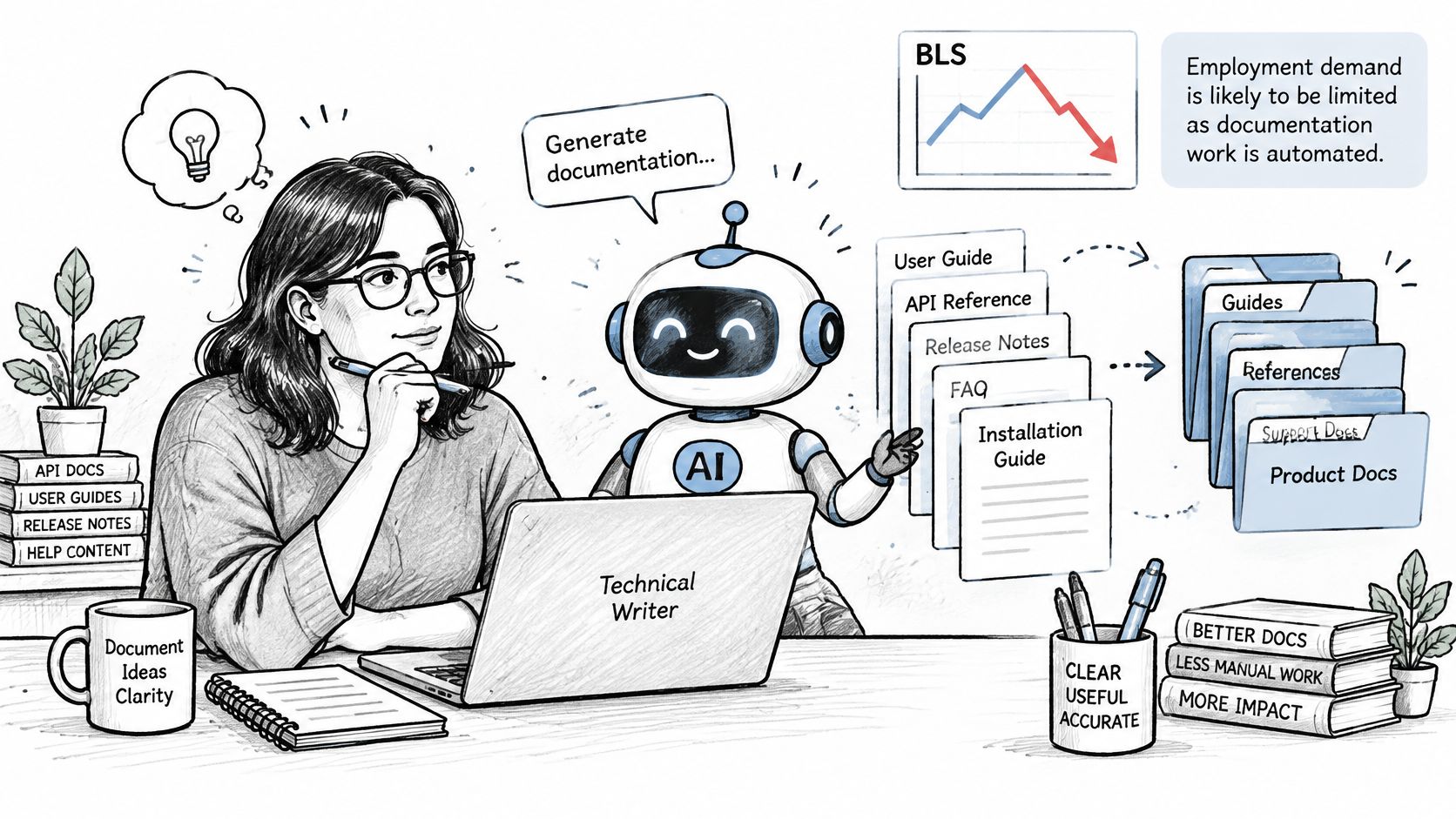
Practitioner evidence is more mixed than a replacement story. A 2025 Cherryleaf survey of 103 technical-communication professionals found that 55% used AI regularly or semi-regularly, while 15% avoided it entirely. Respondents commonly cited drafting, summarizing, and rephrasing. They also raised hallucinations, accuracy, ethics, and the substantial human editing still required.
What gets cheaper, and what doesn't
First drafts get cheaper. The work that stays expensive is validating technical claims, testing a procedure against software behavior, controlling terminology, protecting confidential information, and designing documentation systems that stay reliable across products and releases. Those tasks don't shrink just because a model can rephrase a paragraph.
There is an adoption divide. Employer restrictions and ethical rules can make AI skill an advantage in one workplace and a liability in another. A team that forbids pasting source material into a public model will not reward a portfolio built that way. A team that already drafts in an approved tool will expect you to review the output, not to refuse the tool. Broader workplace figures on AI in the workplace are a separate dataset. They don't replace a reading of the posting in front of you.
How to read a posting
- Ownership of documentation quality: The description should say who signs off, not only who drafts.
- Developer-tool workflows: Git, review comments, and a publishing pipeline signal that the draft is not the job.
- API or product documentation scope: A named product surface is a better signal than "write content."
- Review processes: Look for accuracy review, terminology control, and a record of what changed.
The risk is plain. Routine drafting is compressed, while expectations for domain expertise and editorial accountability rise.
A short walkthrough of how teams are folding assistants into documentation work, without treating the model as the author of record, is here.
Plan Your Next Move Around These Numbers
- Name the edition before you cite a figure. Say whether it is 2024 to 2034 or 2025 to 2035, and keep the scope to US figures. Don't add the two job totals together.
- Judge entry by openings, not by net growth. The annual openings count is mostly turnover. A flat headcount still refills seats.
- Choose one or two sectors and build a sample for each. Match the document type to that sector, such as an API page or an instruction for use, rather than a generic article.
- Test the sample against the skill table. It should show revision control and requirements gathering, not only polished prose.
- Set a salary target from the May 2025 median, then adjust it. Move off that benchmark for specialization and location before you anchor a negotiation.
This month, collect ten current technical writer postings in those target sectors. Record the duties, the tools, and any pay range, and compare each posting with the skill table. Check any figure against the BLS page for that edition before you cite it, because the two editions use different base years.
Mojolin publishes sourced pay, employment, and ten-year outlook figures for technical writers and other technology roles, drawn from Bureau of Labor Statistics data so you can compare a flat occupation with faster-growing ones before you choose a path. Use the role pages to line up median pay, job counts, and openings, then take those benchmarks into the postings you are already tracking. Visit Mojolin to look up the technical writer figures and the rest of the tech-role set.