
The median US software developer earned $135,980 a year in May 2025, and the middle 80 percent of the occupation earned between $82,460 and $214,670. Those two numbers answer the salary question more usefully than any single average, because they show how wide the band is that a real offer has to land inside.
Most salary pages stop there. The figure they hand over is an occupational median, which merges a first-year developer at a regional agency with a staff engineer at a platform company, and it counts wages only, not the equity and bonus that make up a large share of technology pay. Reading it properly takes three separate moves: place yourself in the percentile band, map your scope to a level, then convert the offer to total compensation. Skip any one of those and the number misleads in a predictable direction.
Table of Contents
- Software Engineer Salary Ranges at a Glance
- How to Read Percentile Pay Numbers
- Software Engineer Pay by Experience Level
- Pay Differences by Country and Market
- Remote Work and Location-Based Pay
- Total Compensation Beyond Base Salary
- Skills and Specializations That Move Pay
- Set Your Salary Target Before the First Call
Software Engineer Salary Ranges at a Glance
The Bureau of Labor Statistics Occupational Outlook Handbook reports a median annual wage of $135,980 for US software developers in May 2025, equal to $65.38 an hour. A median is a midpoint, so half the people in the occupation earned more than that figure and half earned less.
The published percentile cut-offs turn that midpoint into a usable range.
| Measure | Annual wage | Hourly equivalent |
|---|---|---|
| 10th percentile (lowest 10% earn less) | $82,460 | $39.64 |
| Median (midpoint, half earn more) | $135,980 | $65.38 |
| 90th percentile (highest 10% earn more) | $214,670 | $103.21 |
The hourly equivalents divide annual pay by 2,080 hours, the same basis the BLS uses for the $65.38 median, so the three rows stay internally consistent.
Size and entry requirements explain the stability of the range. The occupation covered approximately 1.9 million jobs in 2025, and the typical entry route is a bachelor's degree with no prior related work experience and no formal on-the-job training listed as standard. Software developers are also the largest single group of tech jobs in the US in the role data Mojolin publishes, which is why their median gets quoted as a benchmark for the whole sector.
Demand supports the pay level. The BLS projected employment across software developers, quality-assurance analysts and testers to grow 10% from 2025 to 2035, much faster than the average for all occupations, and estimated about 106,100 openings a year over that decade from a mix of new positions and workers leaving the field.
Everything in that table describes employee wages. It excludes freelance billing rates, equity packages, bonuses, benefits and regional differences, and it should not be read as an offer target.
Mojolin's tech salary statistics library carries the same percentile bands for each role it tracks, which helps when reading a developer figure next to network architects, IT managers and data scientists.
A quick placement check before anything else: a current or offered base near $135,980 sits in the typical band for the occupation, while a figure below $82,460 points to a gap worth investigating. Anything above $214,670 needs a level-based explanation rather than an occupational one, which is where compensation by engineering level comes in.
How to Read Percentile Pay Numbers
The two outer bounds do different jobs. The 10th percentile of $82,460 is a floor marker: a software developer earning less than that sits in the bottom tenth of the occupation, according to the BLS wage table published through CareerOneStop. The 90th percentile of $214,670 is a ceiling marker: earners above it sit in the top tenth.
Neither bound says anything about level. The BLS publishes one occupational wage for software developers, so a graduate in a first job and a principal engineer who owns three production systems are counted in the same distribution. A percentile position on its own is therefore a rough instrument, accurate about the occupation and silent about the person.
Now put it to work. Say a candidate with five years of experience at a mid-sized company is offered $150,000. That sits above the median and well below the 90th percentile. The offer is strong for the occupation and ordinary for the top tier, and the honest reading is that the money is fine and the level is the open question.
Rule for offer season: Use the percentile band to set your floor and your range, then adjust for level, location and total pay. The band sets the boundaries, not the number.
Software Engineer Pay by Experience Level
Occupational data can't answer the question candidates ask: what does this job pay at each rung?
| Level | Median total compensation | Source and scope |
|---|---|---|
| Entry-level engineer | $155,000 | Levels.fyi 2025, US tech companies |
| Software engineer | $226,000 | Levels.fyi 2025, US tech companies |
| Senior engineer | $312,000 | Levels.fyi 2025, US tech companies |
| Staff engineer | $457,000 | Levels.fyi 2025, US tech companies |
| Principal engineer | $551,000 | Levels.fyi 2025, US tech companies |
Those are the median total annual compensation figures reported in Levels.fyi's 2025 pay data, which includes salary, stock and bonus for engineers at US technology companies. The distance between the first row and the last is roughly $396,000, and that distance exists inside a single occupation that the BLS reports as one median.
The two datasets measure different things, and mixing them produces bad decisions. The BLS measures wages across an occupational population and excludes equity and bonus entirely. The level data reports total compensation inside a technology-company sample, which skews toward employers that grant stock. A principal engineer at $551,000 in total compensation and a developer at the occupational median of $135,980 in wages aren't describing a pay gap, they're describing two different measurements.
Level also moves pay more than title wording does. What moves a role up a band is scope: the size of the systems you own, the decisions you make without approval, how many people depend on your technical judgment, and the leadership you're expected to supply. A promotion that changes the title but not the scope usually doesn't move the number, and a job description that lists staff-level ownership while carrying a senior title usually underprices the work.
Calibration step: Write down the systems you own, the decisions you make alone and the engineers who rely on your judgment. Match that description to a level in the table before comparing any offer.
The step after level is converting the package, which the breakdown of total compensation components covers.
Pay Differences by Country and Market
The same title carries sharply different money depending on the market. Stack Overflow's 2025 Developer Survey reported a median annual salary of $200,000 for engineering managers in the United States, $118,000 in Germany and $52,000 in India.
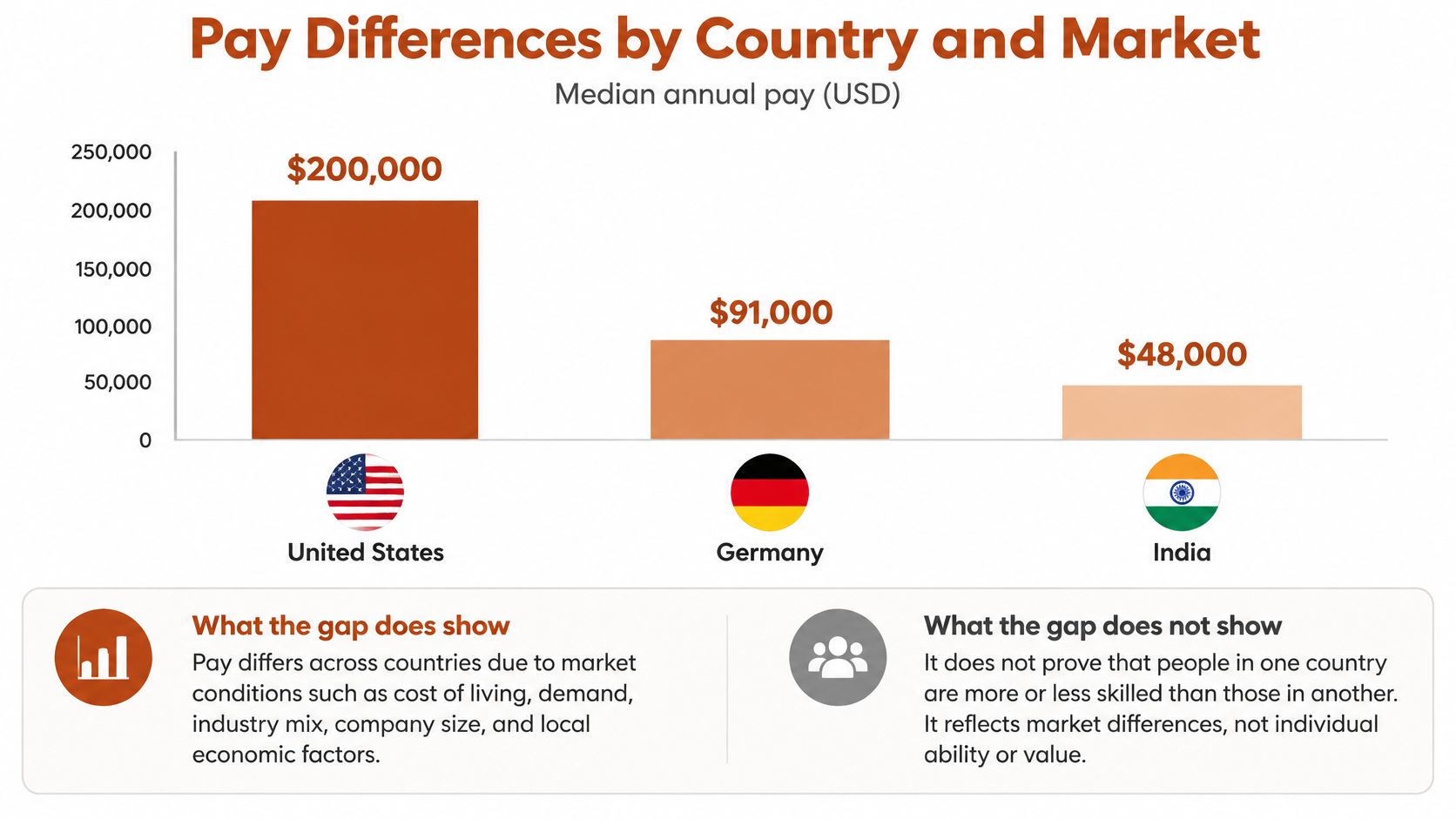
| Market or role | Median salary | Scope |
|---|---|---|
| Engineering managers, United States | $200,000 | Stack Overflow 2025 |
| Engineering managers, Germany | $118,000 | Stack Overflow 2025 |
| Engineering managers, India | $52,000 | Stack Overflow 2025 |
| Senior executives, global | $139,000 | Stack Overflow 2025 |
| Engineering managers, global | $130,000 | Stack Overflow 2025 |
| Founders, architects and product managers, global | $92,000 to $104,000 | Stack Overflow 2025 |
The US median in that comparison runs about 1.7 times Germany's figure and nearly 3.8 times India's. The gap does not shrink with seniority, which is the part that surprises people: an engineering manager in India earns a median of $52,000 against $200,000 in the US for the same scope of responsibility.
Two drivers explain most of it. Geography sets the market rate an employer competes in, because pay tracks local living costs, tax and labour supply. Role level sets the premium on top, and engineering management commands one because it bundles technical judgment with responsibility for hiring, delivery, budgets and team performance. In the global figures, senior executives at $139,000 and engineering managers at $130,000 sit above founders, architects and product managers, whose medians fall between $92,000 and $104,000.
What the gap does not prove is anything about individual ability. These are self-reported figures that reflect sample composition, bonuses, equity, currency conversion and purchasing power, and they should never be blended with government wage statistics. Compare country to country, level to level, and package to package. Everything the role pages on Mojolin publish is US data, which is the right comparison for a US offer and the wrong one for a Berlin offer.
Remote Work and Location-Based Pay
Flexibility has a price, and it's bigger than most salary comparisons admit. Harvard Business School research analyzing nearly 1,400 real job decisions found that technology workers were willing to sacrifice one-quarter of total compensation to avoid commuting to an office five days a week. For common tech roles averaging $239,000, that implies almost $60,000 in foregone pay.
That finding cuts against the assumption that remote workers will always take less. Remote work is a component of total compensation in its own right, and its value varies with commute length, household circumstances and how many office days the employer requires.
Location-based pay is harder to read. A 2025 employer survey cited by Marketivate found roughly one-third of employers still adjusted remote pay by location, down from more than half in 2022. So the majority of employers now pay the same for the same role regardless of where the engineer lives, and the minority who still adjust are cutting real money.
A $150,000 offer is not one number. It's a different number in Lisbon, Leeds and Los Angeles.
Run the comparison as a sequence rather than a single calculation:
- Nominal cash first: annual base plus a realistic bonus, in the currency you'll be paid.
- Equity next: value it on the vesting schedule, not on the headline grant.
- Tax and housing after that: net income against local rents and purchase prices, because these move faster than salaries do.
- Commuting and office costs: season tickets, childcare hours lost, the cost of a second workspace at home.
- Purchasing power last: what the remainder buys where you live.
Then label the job correctly. A fully remote role, a hybrid role with two office days and a "remote within a pay zone" role that applies a geographic adjustment are three different propositions, even when all three post the same salary range. The remote work statistics library collects the survey evidence on how often each arrangement appears in practice.
Total Compensation Beyond Base Salary
An offer that leads with base salary hides where the money comes from. Breaking the package into components makes two offers comparable in a way a single number never is.
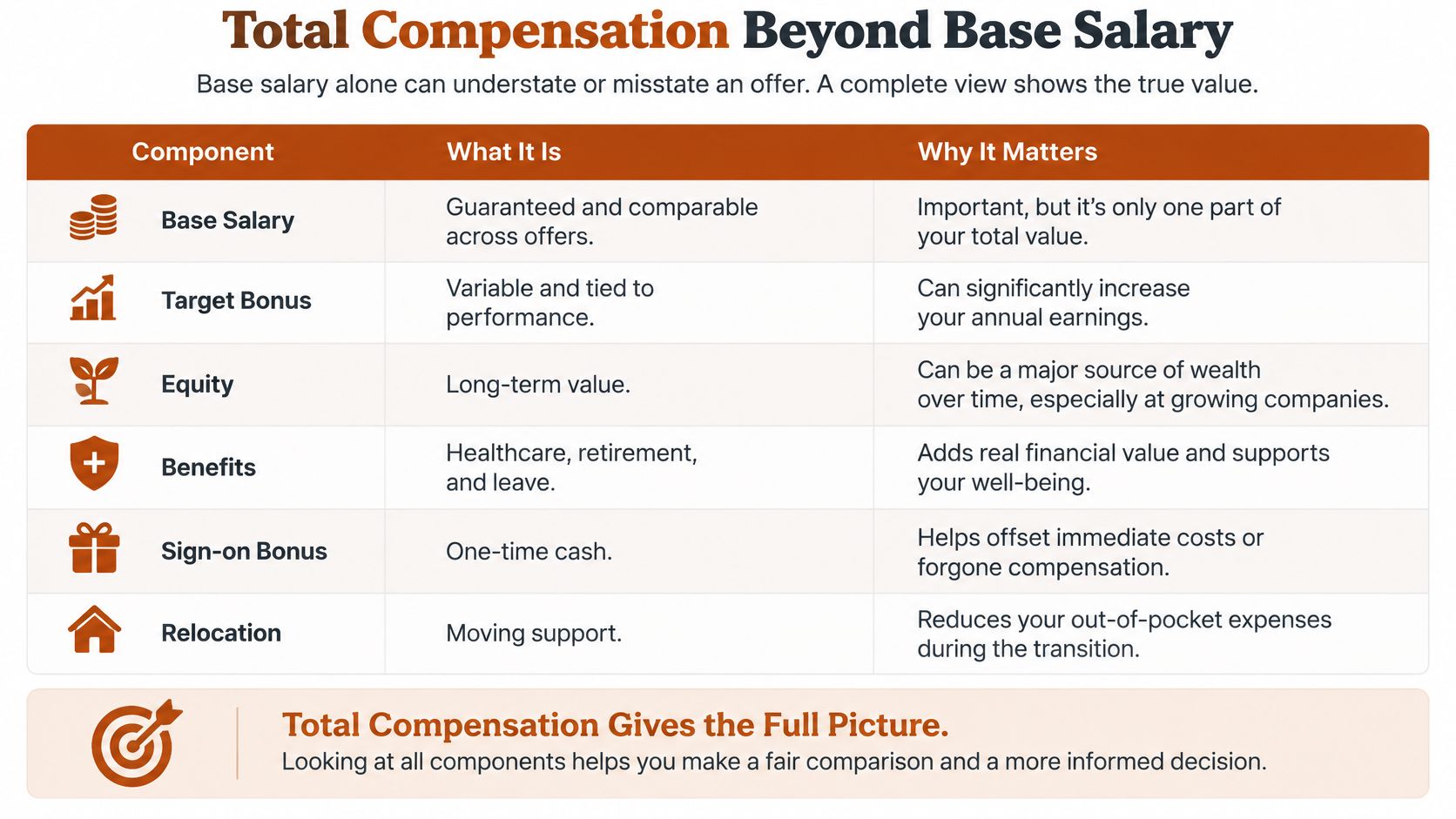
| Component | What it adds | How to compare |
|---|---|---|
| Base salary | Guaranteed annual cash | Compare annualised base directly |
| Target bonus | Variable cash | Apply a realistic payout, not the maximum |
| Equity | Ownership or stock value | Use vesting schedule and conservative valuation |
| Sign-on payment | One-off cash in year one | Count once, check repayment terms |
| Benefits | Health cover, retirement match, leave | Price each benefit, compare like for like |
| Working arrangement | Remote or office days | Set against commute and office cost |
The steps to normalise an offer follow the same order every time:
- Annualise the base. If a number is quoted monthly or as a day rate, convert it to a yearly figure before anything else, because every other component is expressed annually.
- Apply a realistic bonus. Use the average payout the employer has delivered, not the target in the offer letter, and treat a first-year bonus with no history as uncertain.
- Value equity on the vesting schedule. Divide the grant across its vesting period and assume a share price you'd defend, not the price at the last funding round.
- Count sign-on once. It belongs in year one only, and the repayment clause matters if you leave early.
- Price the benefits. Retirement match, health cover and paid leave convert into money you'd otherwise spend or lose.
- Put a number on the arrangement. Required office days cost commuting time and money; fully remote saves both.
A worked example makes the arithmetic concrete. A $140,000 base with a 10% target bonus paid in full adds $14,000, and a $40,000 equity grant vesting over four years adds $10,000 in year one. That's about $164,000 before benefits, and it's the figure to compare against the next offer.
The BLS wages Mojolin publishes are national figures that exclude equity, signing bonuses and benefits, and they mix junior and senior people under one job title. Use them to establish the occupational band, never as the total value of a package.
Skills and Specializations That Move Pay
Two large studies of job postings disagree by a factor of two on what AI skills are worth, and the disagreement is the most useful part of the evidence. PwC's analysis of nearly one billion job advertisements across 24 countries found that jobs requiring AI skills carried a 56% average wage premium in 2024, up from 25% in 2023. Lightcast's analysis of 1.3 billion postings, cited in the same report, found a smaller 28% advertised-salary premium, about $18,000 a year.
The gap comes from samples, definitions and method, and neither figure proves that an AI course raises anyone's pay. AI requirements cluster in senior, specialised and higher-value roles, so part of the measured premium is seniority wearing an AI label.
What distinguishes the four levels of AI capability matters more than the headline:
- AI-adjacent familiarity: you've used assistants and can talk about limits and failure modes. It's table stakes now and rarely commands anything.
- Production experience: you've shipped a feature that calls a model, handled latency, cost and evaluation, and can explain what broke.
- Advanced model expertise: fine-tuning, retrieval design, evaluation pipelines, or training work with real compute behind it.
- Management responsibility: you own the roadmap, the team and the risk of an AI-dependent product.
The premium attaches mostly to the third and fourth tiers, and it attaches to the work rather than the terminology. Other skills move pay the same way, through the roles they enable rather than as line items: ownership of a distributed system, security and compliance work, cloud architecture at scale, and reliability engineering where downtime has a named cost. The evidence for each of those is weaker than for AI, so treat any specific premium attached to them as directional.
Test for any skill: Can you show it in a project, a system you own or a measured outcome? A skill you can't evidence is a hobby.
The strongest link between skill and pay isn't the skill itself, it's the level it justifies. A candidate who can point to a system they designed, built and still operate has evidence for a senior or staff band, and that band does more work than any individual tool on a CV.
Set Your Salary Target Before the First Call
A target written down before the conversation begins beats a number invented under pressure. The routine below takes about an hour and covers the whole offer, not just the base line.

- Fix the occupational band. Start from the national percentile range for the role, not from a recruiter's opening figure. The band tells you whether a number is even in the right postcode of the distribution.
- Place yourself by level. Match your scope and ownership to a defined level, using responsibilities rather than job titles. Two people with the same title can sit two bands apart.
- Adjust for location and arrangement. If the role is remote or priced to a pay zone, the flexibility trade-off is part of the number and belongs in the calculation.
- Convert everything to total compensation. Base, bonus, equity, sign-on and benefits, using the same six steps across every offer so the comparison is honest.
- Ask for the range on the first call. Mojolin's hiring guidance asks teams to share the pay range early, on the first call with the candidate, and not to ask candidates about their current or past salary. Ask directly: what range is budgeted for this level? A company that won't answer has told you something useful.
- State a range, never a single figure. Anchor the bottom of your range at your target rather than at your current pay, and hold the top for the scope you can evidence. A range backed by data reads as informed; a round number with no basis reads as a guess. Mojolin's tech salary negotiation guide covers how to hold that range once you've named it.
- Set a walk-away number before the final round. Decide in writing what you'd decline, including the value of flexibility, and stick to it when the offer conversation gets warm.
The common slip is anchoring on the occupational median without a level attached. The median is where the occupation sits, not where a senior engineer with production AI experience sits, and using it as a target leaves money on the table in exactly the roles that pay best.
What a defensible target looks like on paper is short: a range, with a level attached to it, the data source behind each figure, and a total compensation view that includes equity and the working arrangement. Everything else in a negotiation is delivery.
Mojolin publishes the pay, employment and outlook figures behind every comparison here, drawn from the U.S. Bureau of Labor Statistics, alongside guides on getting hired, negotiating pay and running a fair hiring process. If you're benchmarking an offer or setting a range for a role, start with Mojolin and compare software developers against the other tech roles it tracks before your first call. Bring the range, the level and the total compensation view with you, and the conversation gets a lot shorter.