
Texas employed 138,510 software developers in May 2023, yet their employment concentration was slightly below the national level, according to the U.S. Bureau of Labor Statistics' Texas wage estimates. A large workforce doesn't make Texas a single technology market. For an engineer comparing offers, the useful question isn't what Texas employers pay, but where a particular job falls within its local wage distribution.
A software engineer salary in Texas needs several labels to be meaningful: occupation, geography, measurement year, wage measure and compensation components. Without those labels, a statewide average can look like a personal entitlement, and a stock-heavy package can look comparable to a cash salary when it isn't.
Table of Contents
- Texas Software Engineer Pay at a Glance
- Sources, Measures and Data Years Behind Every Figure
- Software Engineer Pay by Texas Metro Area
- Where You Fit in the Texas Percentile Band
- What Texas Salary Figures Leave Out
- How Texas Software Engineer Pay Has Changed
- Demand Outlook and Where Entry Is Easier
- Negotiate Your Texas Offer and Set One Number
Texas Software Engineer Pay at a Glance
Texas software developer pay by percentile, May 2025
The BLS wage distribution published through O*NET reports the following annual wages for Texas software developers in May 2025.
| Percentile | Annual pay |
|---|---|
| 10th percentile | $82,600 |
| 25th percentile | $103,350 |
| Median (50th percentile) | $132,150 |
| 75th percentile | $162,530 |
| 90th percentile | $183,680 |
The 25th percentile is the wage at or below which a quarter of the measured workforce earns; the median divides the workforce into equal lower-paid and higher-paid halves. These are positions within a wage distribution, not experience requirements or employer salary grades.
The distance between the lower and upper ends of this table matters more than a single headline average. An engineer near the lower end and an engineer near the upper end can both hold jobs classified as software development without having comparable responsibilities, employers or bargaining positions.
What the bands can establish
The table provides a market reference, not a diagnosis of whether an individual is underpaid. It combines workers across experience levels, industries, employer types and Texas locations. It doesn't identify the wage an employer must offer for a particular vacancy.
A useful reading separates three questions:
- Position within the distribution: Is the offer toward the lower end, around the midpoint or toward the upper end?
- Comparable work: Does the proposed job involve supervised implementation, independent ownership or responsibility across several systems?
- Comparable market: Does the employer recruit locally, nationally or through a location-adjusted remote pay policy?
Mojolin's role pay charts use the same distribution-first approach, showing the middle 80% of earners from the 10th to the 90th percentile, with the median marked. That presentation makes dispersion visible rather than implying that everyone should earn the average.
Practical rule: A percentile describes where a wage sits among workers. It doesn't establish what a particular engineer should accept.
The first task in an offer comparison is therefore to identify a plausible position within the distribution. Only then does a comparison with the employer's proposed pay become informative.
Sources, Measures and Data Years Behind Every Figure
A salary benchmark needs a measure trail. A mean, median and percentile answer different questions, even when they describe the same occupation and geography.
The BLS May 2023 software developer table identifies the occupation as 15-1252, Software Developers, and reports a Texas annual mean wage of $125,890, alongside metropolitan means of $128,100 in Dallas-Fort Worth-Arlington and $132,500 in Austin-Round Rock. These are average wages, not median offers or salary recommendations.
A mean divides aggregate wages by the worker count, so unusually high wages can pull it upward. A median identifies the midpoint instead. A percentile identifies a position farther down or up the distribution.
Reading the source trail
| Evidence | What it answers | Main limitation |
|---|---|---|
| BLS occupational wage estimates | What employers report paying workers in an occupation | Doesn't isolate a particular employer's level |
| O*NET local wage tables | How wages differ across distribution points and locations | Doesn't assign percentiles to years of experience |
| Historical BLS estimates | How reported wages and employment changed | Occupational classifications can change |
| Texas Workforce Commission projections | How employment may develop within the report's scope | Isn't a list of live vacancies |
| Occupational Outlook Handbook | National occupational pay and outlook | Isn't a Texas-specific offer benchmark |
Annualized wage estimates are standardized full-time benchmarks, not promises about an individual's actual annual paycheck. Unpaid time, employment duration and working arrangements can make an employee's realized earnings different.
Occupational matching also matters. Software developers and computer programmers are separate BLS occupations. Combining unlike categories can produce a benchmark that doesn't fit engineering responsibilities, even when an employer uses those titles interchangeably.
Mojolin's pay, employment and outlook figures come from the BLS Occupational Outlook Handbook edition using 2025 pay and projections for 2025 to 2035. Its role pages provide national context, while state and metropolitan wage estimates serve a different geographic purpose.
Before using any posted salary range, the comparison should record:
- Measure: Mean, median, percentile or employer pay band.
- Reference period: When the underlying wages were measured.
- Geography: State, metropolitan area or national workforce.
- Coverage: Occupation, job scope and compensation components included.
Software Engineer Pay by Texas Metro Area
Software developer pay by Texas metro, May 2025
The O*NET/BLS local wage figures identify the following metropolitan medians. The distinction between these midpoint wages and Austin's average wage is important.
| Metro area | Median annual pay |
|---|---|
| Austin-Round Rock | $134,120 |
| Dallas-Fort Worth | $133,290 |
| Amarillo | $116,530 |
| Abilene | $103,760 |
Austin and Dallas-Fort Worth are close at the midpoint. The table doesn't support treating an ordinary Austin offer as automatically worth a large premium over a comparable Dallas-Fort Worth offer.
Nor does it establish that the two markets have identical upper tails. Median similarity says something narrow: the middle worker earns a similar wage. It doesn't establish equal pay for staff engineers, scarce specialists or employees at equity-heavy technology companies.
Austin's specialization isn't a universal premium
The BLS Austin occupational employment release reports 31,960 software developers, a location quotient of 2.28, and mean annual pay of $143,630 in May 2025. A location quotient above the national reference level means the occupation accounts for a larger share of local employment than it does nationally.
That concentration makes Austin a specialized software labor market. It doesn't mean every Austin employer pays a technology-company premium, or that every applicant benefits equally from the concentration.
A candidate needs to distinguish employer access from offer quality. A concentration of relevant employers may broaden the search, but the actual offer still depends on the hiring organization's pay structure and the responsibilities attached to the vacancy.
Smaller markets need a different comparison
Amarillo and Abilene sit below the larger hubs in the median comparison. That difference shouldn't automatically disqualify either market, but it should prevent an applicant from assuming that a Texas address guarantees hub-level wages.
Calling a market cheaper also isn't enough to establish a better financial outcome. This comparison doesn't quantify housing, commuting, relocation, household costs or local purchasing power. Those items require a separate budget rather than an assumed discount.
A practical geographic adjustment follows this sequence:
- Identify the paid location. A remote employee's home address may not determine the employer's salary band.
- Start with the matching metro. A local wage benchmark is more relevant than a statewide figure when the employer hires locally.
- Evaluate scope within that market. Technical ownership and specialization can justify a different position from the local midpoint.
- Price the move separately. Relocation costs and household spending shouldn't be hidden inside the wage comparison.
A lower local median isn't evidence that hiring is easier. Accessibility depends on which employers are recruiting and which skills they need.
The strongest geographic benchmark names both the metropolitan area and the employer's location policy. Without those details, an applicant may be negotiating against the wrong market.
Where You Fit in the Texas Percentile Band
The wage sources don't assign experience levels to percentiles. Any placement based on responsibilities is a working interpretation, not a BLS classification.
A narrower job scope can justify examining the lower part of the distribution. Independent ownership can justify considering the central bands, while broader technical leadership or difficult specialization can justify investigating the upper bands. None of those relationships should be treated as a measured salary-by-seniority schedule.
Match responsibilities before titles
An engineer's evidence should describe work rather than rely on labels such as junior, senior or lead. A senior title attached to closely supervised feature work isn't equivalent to ownership of a critical production platform.
A defensible placement process includes:
- Document ownership. List the services, repositories, deployment processes and operational decisions attached to the role.
- Describe independence. Identify decisions made without review, including design choices, incident response and release approval.
- Match the occupation. Compare actual development duties with the software developer category rather than relying on the business-card title.
- Test the proposed band. Check whether location, employer type or compensation structure explains the offer's position.
For a cloud engineering vacancy, relevant evidence might include responsibility for infrastructure-as-code changes, service reliability, deployment controls and production recovery. Familiarity with AWS or Azure alone doesn't establish the scope of that responsibility.
Placement test: The case for a higher band should explain what the employer can entrust to the engineer, not merely which technologies appear on the résumé.
The result should be a short benchmark statement recording the selected part of the distribution, the source's measurement period and the paid location. That statement gives the recruiter something concrete to confirm or challenge.
What Texas Salary Figures Leave Out
Pay components and whether BLS figures include them
| Pay component | In BLS wage figure | What to check in an offer |
|---|---|---|
| Base salary | Yes | Compare against the percentile band for the role and metro |
| Nonproduction bonus | No | Target percentage and payout history |
| Signing bonus | No | Whether it is one-time and any repayment clause |
| Equity | No | Grant size, vesting schedule and valuation method |
| Employer-paid benefits | No | Health cover, retirement match and paid leave |
The software developer role reference provides a national occupational comparison, not a Texas-specific total-compensation estimate. Mojolin's BLS wage figures exclude equity, signing bonuses and benefits, and combine junior and senior workers under the occupation.
That distinction prevents a common comparison error: placing a total-compensation offer beside a wage benchmark and treating the difference as a salary premium. The packages aren't measuring the same thing.
A median base isn't a median package
Consider a hypothetical offer with base pay at the statewide midpoint, an annual target bonus and an equity grant. The guaranteed salary, contingent bonus and equity should appear as separate lines, not as a single apparently guaranteed amount.
The bonus calculation is straightforward: base salary multiplied by the target bonus rate produces target bonus dollars. Adding that amount to base produces target annual cash, not guaranteed cash.
Equity requires a different assessment. Publicly traded shares, private-company options and restricted stock units shouldn't be treated as interchangeable cash substitutes. Vesting, exercise costs, liquidity and valuation assumptions can change what the grant means to the employee.
The same base salary can therefore support very different offers. A package with predictable cash and useful benefits may be preferable to one with a larger headline value built on uncertain payouts.
Request a written compensation breakdown
The offer review should establish:
- Recurring cash: Guaranteed base, bonus target, eligibility conditions and payout history.
- One-time cash: Signing payment, payment date and repayment obligations.
- Equity terms: Award type, grant size, vesting schedule and valuation method.
- Benefits: Employee health premiums, retirement matching and paid-leave terms.
A signing payment shouldn't substitute for recurring salary. Its value belongs in the initial employment period, while any repayment condition belongs in the risk assessment.
The comparison rule is simple: benchmark base against an appropriate wage reference, then compare complete packages using consistent assumptions. Uncertain compensation should remain visibly uncertain.
How Texas Software Engineer Pay Has Changed
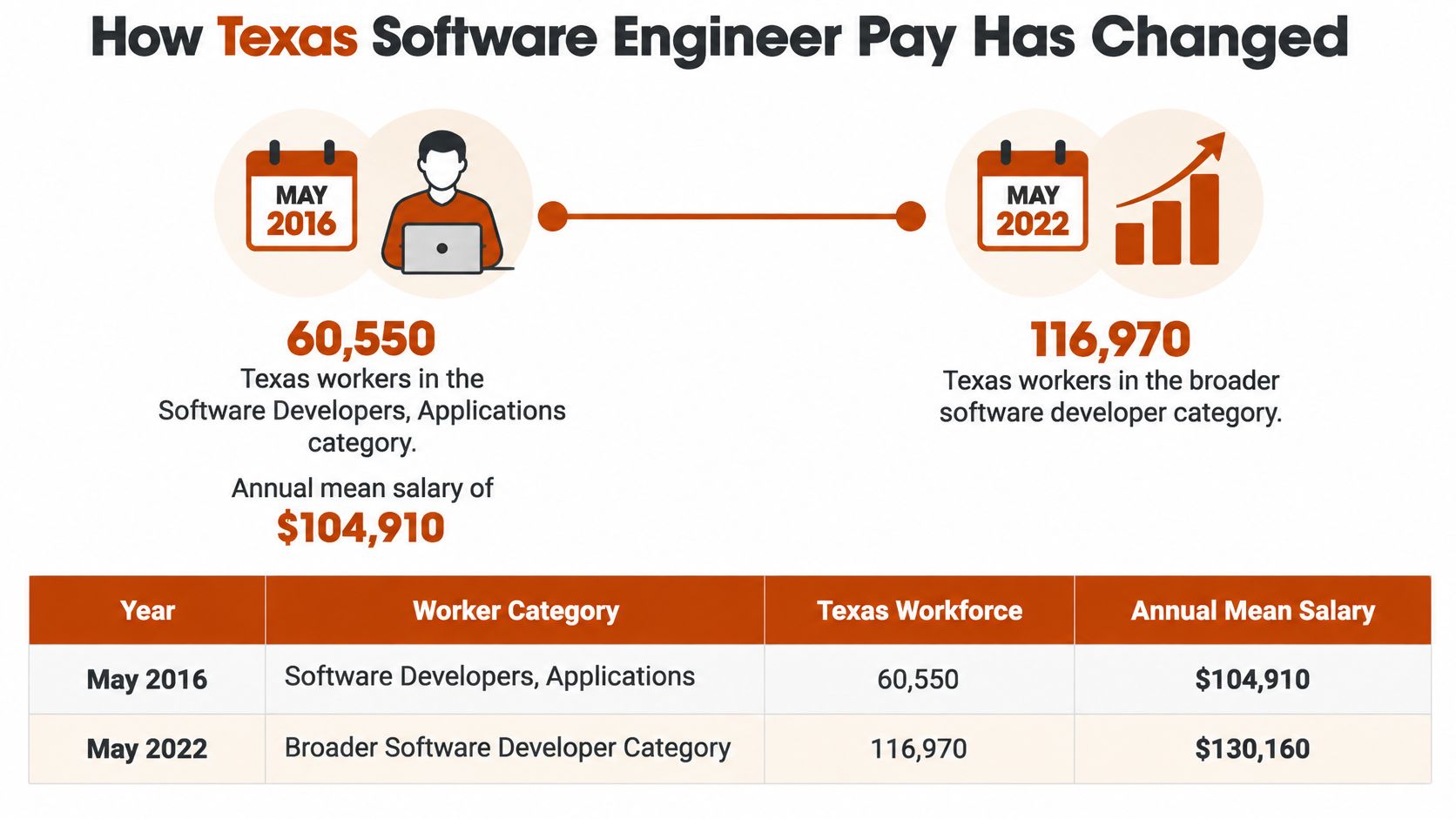
An engineer using an old salary article may be anchoring negotiations to a different labor market and a different occupational definition. The BLS historical wage comparison records the following Texas employment and annual mean wage benchmarks.
Texas software developer employment and mean pay, 2016 to 2023
| Data year | Texas workers | Annual mean wage | BLS category |
|---|---|---|---|
| May 2016 | 60,550 | $104,910 | Software Developers, Applications |
| May 2022 | 116,970 | $117,440 | Software Developers |
| May 2023 | 138,510 | $125,890 | Software Developers |
The earlier observation covers Software Developers, Applications. The later observations use the broader Software Developers category, so the employment counts aren't a perfectly like-for-like series.
The timeline illustrates the change in reported workforce size and wages.
What the trend supports
The reported mean wage increased across the observations. That supports the conclusion that an older nominal wage benchmark shouldn't automatically serve as the current negotiating baseline.
It doesn't establish how much an individual engineer's pay increased. The surveyed workforce can change as employers hire different kinds of workers, the occupational classification changes or employment shifts between industries and locations.
The figures also don't establish purchasing-power gains. A nominal wage comparison alone doesn't measure what employees could buy with their earnings.
How an older benchmark should be used
Suppose an employer cites an established internal salary band originally built from an old market survey. The relevant question is whether the organization has updated the benchmark, matched the current role scope and accounted for the paid location.
An applicant shouldn't mechanically apply the statewide historical change to an individual salary. That would convert an aggregate comparison into an unsupported personal raise formula.
The defensible approach uses the most relevant recent wage distribution as the baseline. Historical figures establish context and expose stale comparisons; they don't determine an appropriate offer by themselves.
Demand Outlook and Where Entry Is Easier
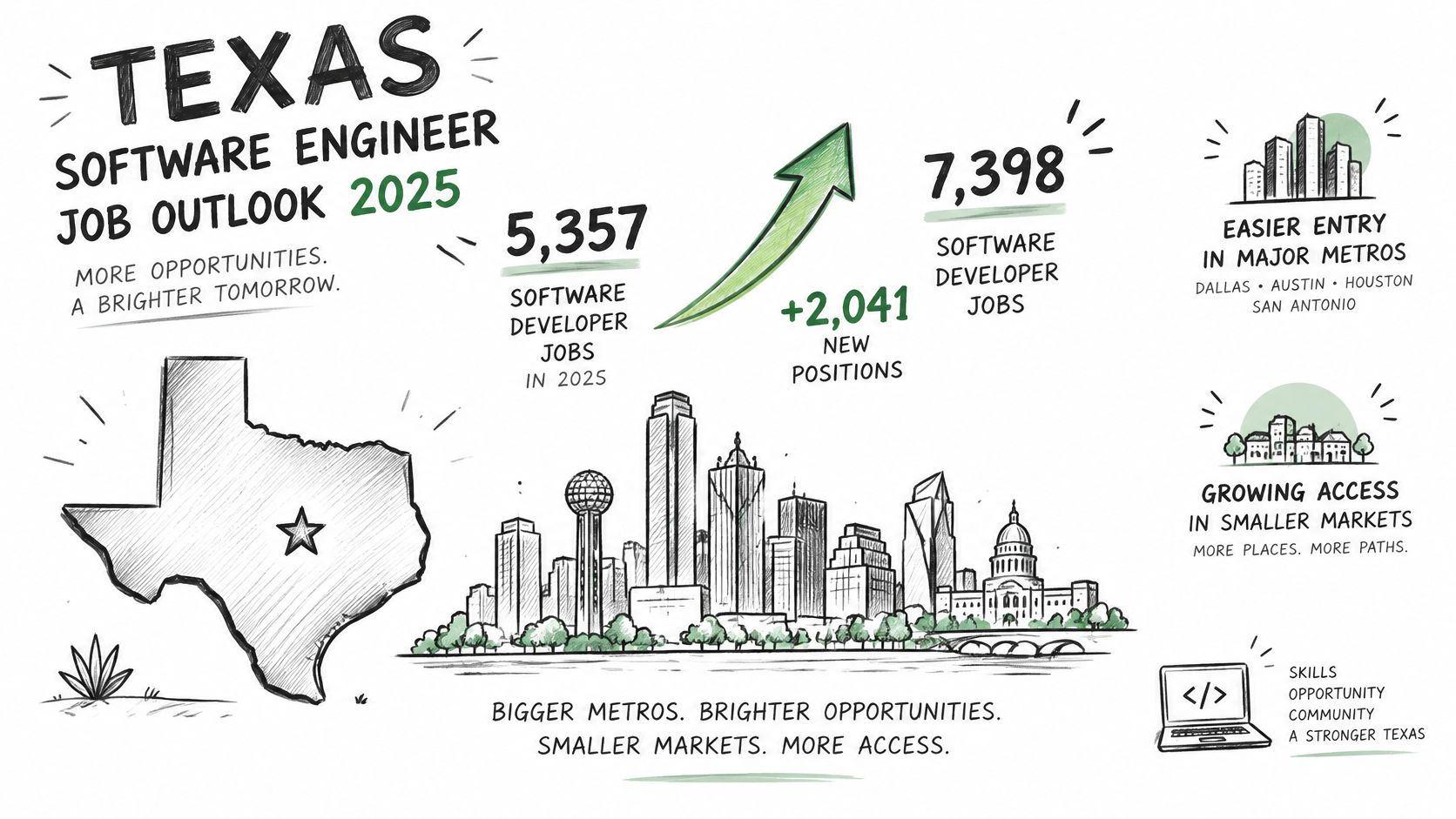
A growing occupation isn't necessarily an easy entry route. The Texas Workforce Commission's 2025 growth-occupations report includes a software developer projection from 5,357 to 7,398 workers, an increase of 2,041 jobs, or 38.1%, with reported annual pay of $129,902.
The outlook graphic provides a visual summary of the reported growth figures.
Growth isn't a vacancy count
That projection's employment base is much smaller than the statewide BLS workforce benchmark. It shouldn't be treated as the same population without verifying geographic coverage, occupational scope and projection period.
Nor should growth rates from differently scoped sources be ranked as though they measure identical markets. A projection describes an expected employment path, not positions available for applications today.
Software developers are the largest group of technology jobs in the United States, with 1.7 million jobs. National scale, however, doesn't reveal which local employers will consider an applicant without substantial professional experience.
The software developer statistics reference offers broader occupational context. For an entry decision, live postings should answer more immediate questions:
- Experience requirements: Whether employers accept project work or require production ownership.
- Technical fit: Which languages, platforms and domain skills recur.
- Location restrictions: Whether remote work is genuinely available from the proposed address.
- Hiring breadth: Whether several relevant employers are recruiting, rather than a single organization.
The accompanying video provides an additional career-research resource.
A smaller market may fit an applicant better, but lower wages alone don't establish easier entry. The practical choice is the regional market where current vacancies match the applicant's demonstrated skills, acceptable pay and relocation budget.
Negotiate Your Texas Offer and Set One Number
A useful salary request combines market position, role scope and package terms. It doesn't rely on a statewide average as proof that every employer should pay the same amount.
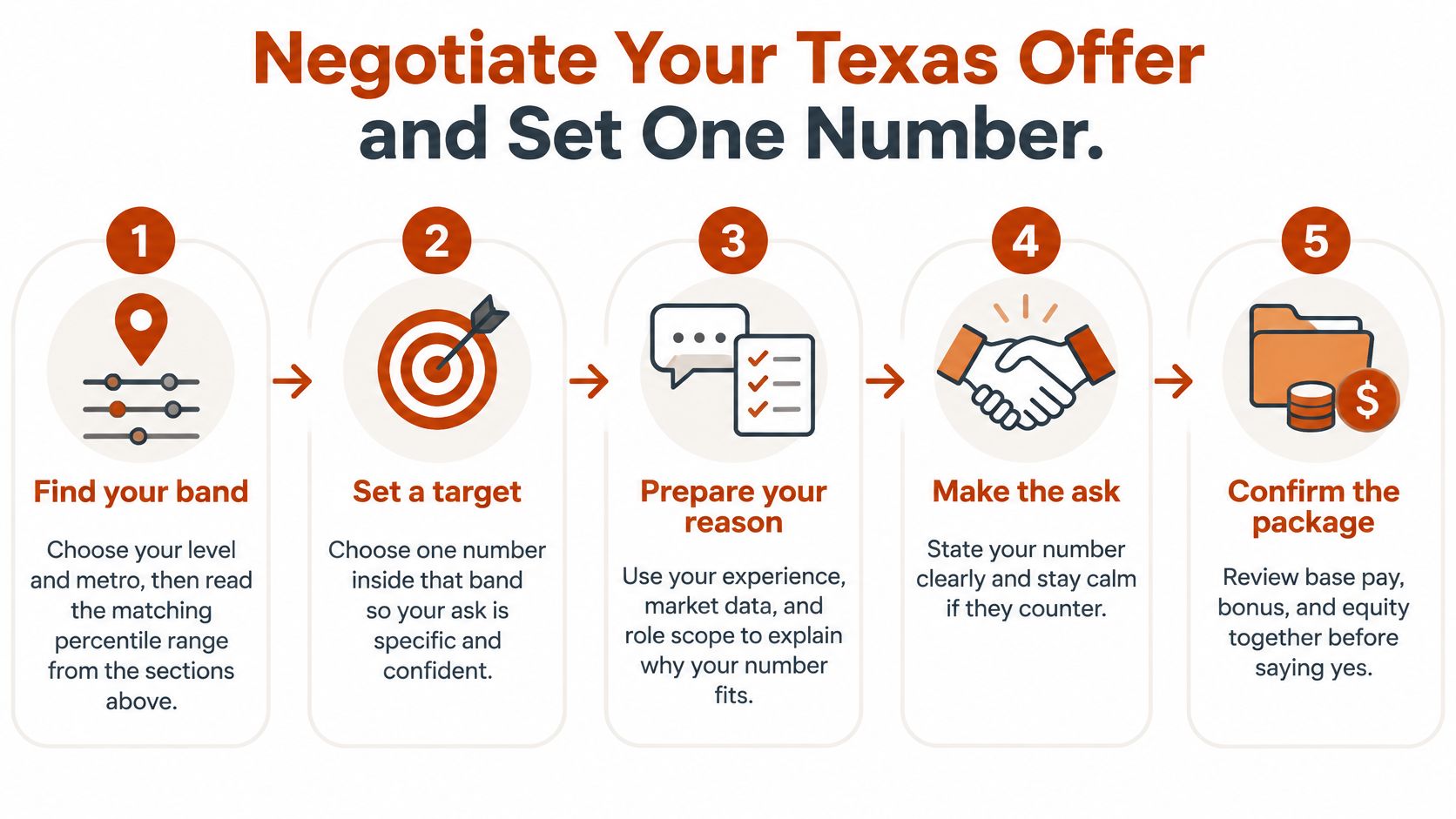
The negotiation process can be organized around preparation, a specific request and written confirmation.
Build the request
Find the appropriate band. The candidate should select the paid location and match the vacancy's responsibilities to a plausible position in the distribution. An employer title alone isn't enough to justify the placement.
Choose a target within that band. Independent ownership, specialist responsibilities and cross-team technical decisions can support an upper-band argument. The explanation should connect those capabilities to work the employer needs completed.
Confirm the employer's range early. The initial recruiter conversation should establish the approved base range and whether it covers different levels or locations. This prevents an extended interview process built around incompatible expectations.
Keep the discussion on the vacancy. Candidates can decline to provide salary history and state that expectations concern the responsibilities and range for the proposed role. This is a negotiating approach, not a claim about a Texas legal prohibition.
Evaluate the entire package. Guaranteed cash, contingent cash, equity and benefits should remain distinguishable. An uncertain stock valuation shouldn't erase a shortfall in recurring cash without an explicit decision to accept that risk.
Counter with a specific base request. The candidate should name the target and explain the location, scope and wage reference behind it. A concise reason is more useful than a long list of unrelated salary figures.
Obtain written terms. The final document should identify base salary, bonus terms, equity, start date and material conditions. Verbal assurances about future reviews shouldn't substitute for agreed compensation.
Turn the benchmark into a concrete target
Consider a hypothetical mid-level Austin engineer whose proposed role includes cloud deployment ownership and production incident responsibility. A target of $150,000 in base salary can serve as an illustrative negotiating choice between the local midpoint and an upper statewide reference, not as a measured Austin mid-level market rate.
The distinction matters. The candidate's cloud skills don't automatically command that amount, and the statewide upper band doesn't become Austin-specific just because the vacancy is in Austin.
The request would need evidence of scope: responsibility for deployment safety, recovery procedures, architecture decisions or infrastructure costs. If the employer describes a more closely supervised implementation role, the placement should be reconsidered rather than defended with an unrelated percentile.
Keep concessions explicit
If the employer can't meet the base target, the comparison should identify what changes instead. A signing payment, improved equity award or earlier compensation review has different timing and certainty from recurring salary.
The technology salary negotiation guide provides a framework for preparing that discussion. The immediate preparation should produce a written target, the relevant wage measurement period, the paid metro and the compensation documents still needed.
Before the next recruiter call, the candidate should also record the minimum acceptable package and the responsibilities that justify the preferred target. That preparation makes the discussion specific without pretending that an occupational wage table can decide the offer alone.
Mojolin publishes sourced careers data and guides on getting hired, choosing a career path, negotiating pay and running a fair hiring process. Visit Mojolin to compare occupational pay references and prepare a Texas offer comparison that separates location, role scope and total compensation.