Software developers in Florida earned a median annual wage of $130,980 in May 2025, equal to $62.97 an hour, across roughly 87,890 jobs. The spread around that median is wide: the lowest-paid tenth of Florida developers earned below $80,050, and the highest-paid tenth earned above $204,400.
Anyone quoting one Florida number for a software role is quoting the middle of a distribution, not a rate card. The median says where the halfway point sits. The percentiles say whether a specific offer is ordinary, generous, or low for the work being described. What follows treats the federal wage estimates as a measuring instrument: which survey year each figure comes from, whether it's a mean or a median, what it leaves out, and which comparison an offer should be held against.
Table of Contents
- Florida Software Developer Pay in 2025
- Pay by Software Job Title in Florida
- Software Developer Pay by Florida Metro
- Florida Remote and Out-of-State Offers
- What the Florida Wage Excludes
- Placing a Candidate Within the Florida Band
- Quick Reference for Florida Pay Terms
- Check a Florida Software Engineer Offer
Florida Software Developer Pay in 2025
The state's official benchmark for this work sits in a single occupational code. The U.S. Bureau of Labor Statistics files software engineers under Software Developers, SOC 15-1252, and in May 2025 that category covered roughly 87,890 Florida jobs at a median annual wage of $130,980, equal to $62.97 an hour, according to the BLS occupational estimate for Software Developers in Florida.
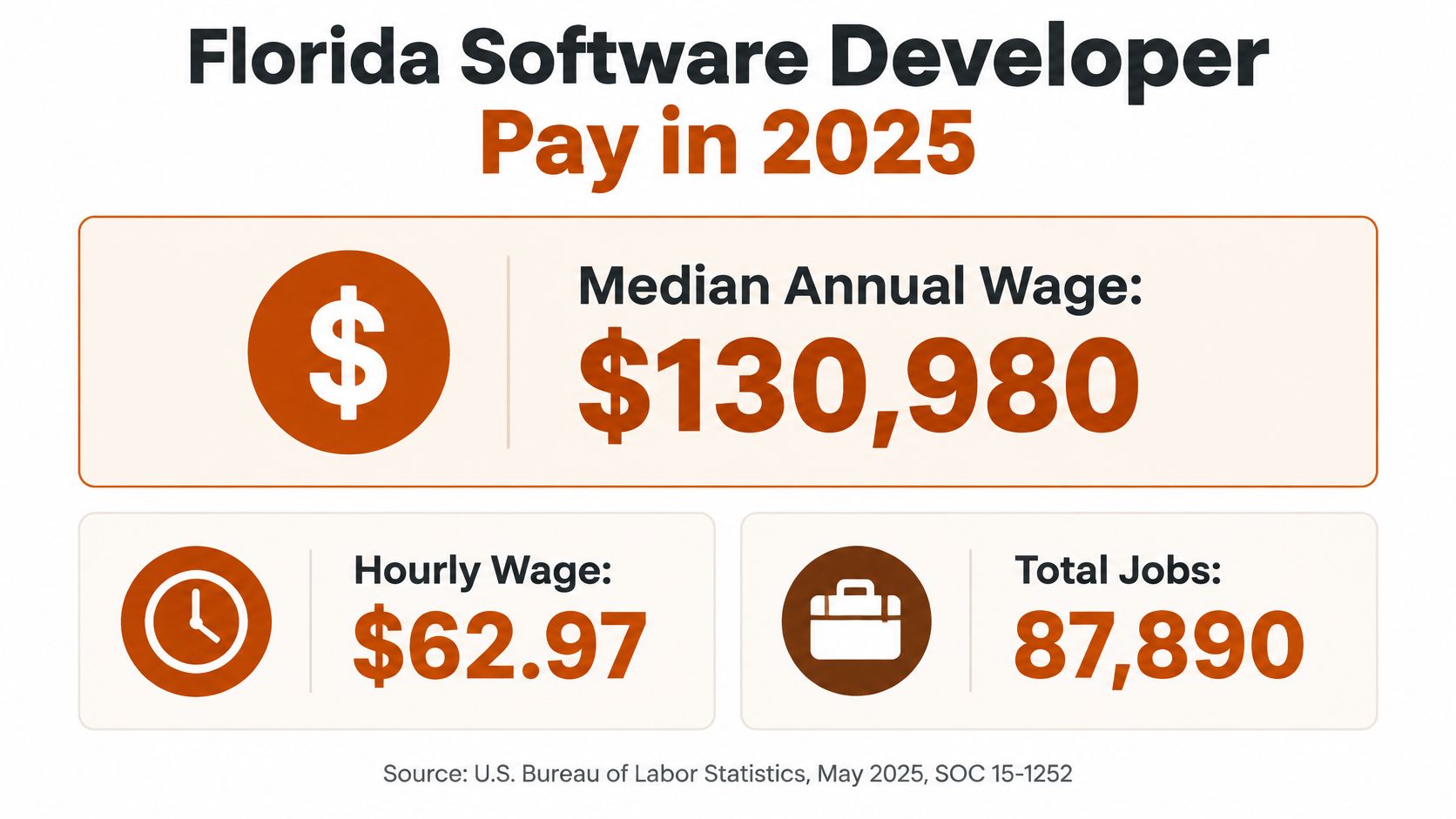
The midpoint is not the market. One in ten Florida developers earned below $80,050, and one in ten earned above $204,400. That means a reader who quotes the median for a senior platform engineering role and for a first front-end job is quoting the same number for two positions that sit at opposite ends of the same survey table.
Read the percentile ladder before the midpoint
| Benchmark | Annual figure | Hourly | How to read it |
|---|---|---|---|
| 10th percentile | Below $80,050 | About $38.49 at 2,080 hours | One in ten earned less |
| Median | $130,980 | $62.97 | Half earned more and half less |
| 90th percentile | Above $204,400 | About $98.27 at 2,080 hours | One in ten earned more |
| Employment | 87,890 jobs | Not a wage | Statewide employee count |
Work down the rows in that order and the estimate becomes usable. The 10th percentile is a floor: an offer below $80,050 sits under nine out of ten Florida developers in this category, so it needs an explanation such as an internship conversion, a narrow support role, or a market far from the large metros. The median is the reference point for a developer doing standard production work. The 90th percentile is where seniority meets scarcity, whether that scarcity comes from a specialty, an industry, or a clearance requirement.
The employment line carries as much weight as the wages. An estimate built on 87,890 jobs rests on a large statewide count, spread across every industry sector and every metro, which is why it holds up better as a benchmark than a single-city survey or a handful of salary reports from one employer.
What the wage figure leaves out
These are employee wages and salaries before taxes. The survey excludes self-employed workers, and the published figures generally do not include employer-paid benefits or some bonuses. That distinction decides how an offer gets compared.
A package quoted as base plus an annual bonus plus a stock grant is not the same number as the survey wage. Strip the offer down to base salary, hold that against the percentile row it matches, and keep everything else on a separate line. A base of $125,000 with a 10 percent bonus and a meaningful equity grant can beat a flat $135,000 base, and the wage table alone won't show it.
Comparison rule: benchmark the base salary against the matched percentile, then evaluate bonus, equity and benefits as separate items rather than blending them into one headline figure.
How the Florida market reached this level
The workforce behind that median grew fast. In May 2016, BLS counted 48,590 Florida workers across the two software developer categories then in use: 33,070 application software developers at an annual mean wage of $88,300, and 15,520 systems software developers at $99,460, per the BLS May 2016 Florida occupational estimates.
By May 2022, the occupations had been consolidated under the modern code, and BLS reported 73,090 Florida jobs at a statewide mean wage of $113,300, or $54.47 an hour. Those older figures are context, not a baseline to subtract from today's median. They're means from earlier releases under a different classification, and the categories aren't perfectly identical across years, so any comparison is directional at best. What they establish is straightforward: Florida's developer workforce became materially larger, and statewide average compensation moved above $100,000 well before the 2025 survey.
Pay by Software Job Title in Florida
Two Florida job titles that both sound like software engineering sat $32,180 apart in employer-reported mean wages, a gap of roughly 40%. Software Developers, the closest statewide match to the software engineer title, reported 73,090 jobs at a May 2022 annual mean of $113,300, or $54.47 an hour. Web Developers reported 4,920 jobs at $81,120, or $39.00 an hour, according to the BLS May 2022 Florida occupational wage estimates.
| Occupation | Survey | Annual mean | Hourly mean | Florida jobs |
|---|---|---|---|---|
| Software developers | May 2022 | $113,300 | $54.47 | 73,090 |
| Web developers | May 2022 | $81,120 | $39.00 | 4,920 |
| Computer programmers | May 2023 | $97,480 | $46.87 | Wage and rate only |
| Web developers, Miami metro | May 2022 | $71,200 | About $34.23 at 2,080 hours | 2,460 |
| Web developers, Panama City | May 2022 | $115,470 | About $55.51 at 2,080 hours | 40 |
Every row above is a mean from its own release, not the 2025 statewide median. Reading them side by side is the point: the occupation code attached to a job description moves the benchmark by tens of thousands of dollars before experience enters the conversation.
The programmer title is its own estimate
Computer programmers form a separate line again, reported at an annual mean of $97,480, or $46.87 an hour, in the May 2023 release. That sits below the developer mean from a year earlier and well below the 2025 developer median. A role advertised as "programmer" may be narrower in scope than a role advertised as "software developer," and the wage tables treat them as different occupations for that reason.
Small counts are not targets
Geography adds its own distortion inside a single title. Miami-Fort Lauderdale-West Palm Beach employed 2,460 web developers at a mean of $71,200, while Panama City reported $115,470 for 40 web developers. The Panama City figure rests on a very small occupational count, so it says more about a handful of employers than about the metro, and it says nothing at all about software developers.
Panama City's web-developer mean belongs to a 40-person occupation. It isn't a Florida target for software developers, and it isn't evidence that small metros pay more.
The practical rule is to match the posted work to the code. Application and systems development belongs under SOC 15-1252 and gets priced against the developer figures. Front-end work that's mostly CMS templates and marketing pages can price closer to the web developer mean. A programmer title is not automatically the developer median, and the software developer role profile puts that occupation's pay and outlook next to the other tech roles it's commonly confused with.
Software Developer Pay by Florida Metro
Miami-Fort Lauderdale-West Palm Beach sets the top of the state's metro range. In May 2025, software developers there had a median annual wage of $132,650 and a mean annual wage of $144,730, according to BLS data reported by WageDex. The $12,080 gap between those two figures is itself a reading: a concentration of high earners pulls the average above the midpoint, which is typical of a metro with finance and corporate headquarters employers.
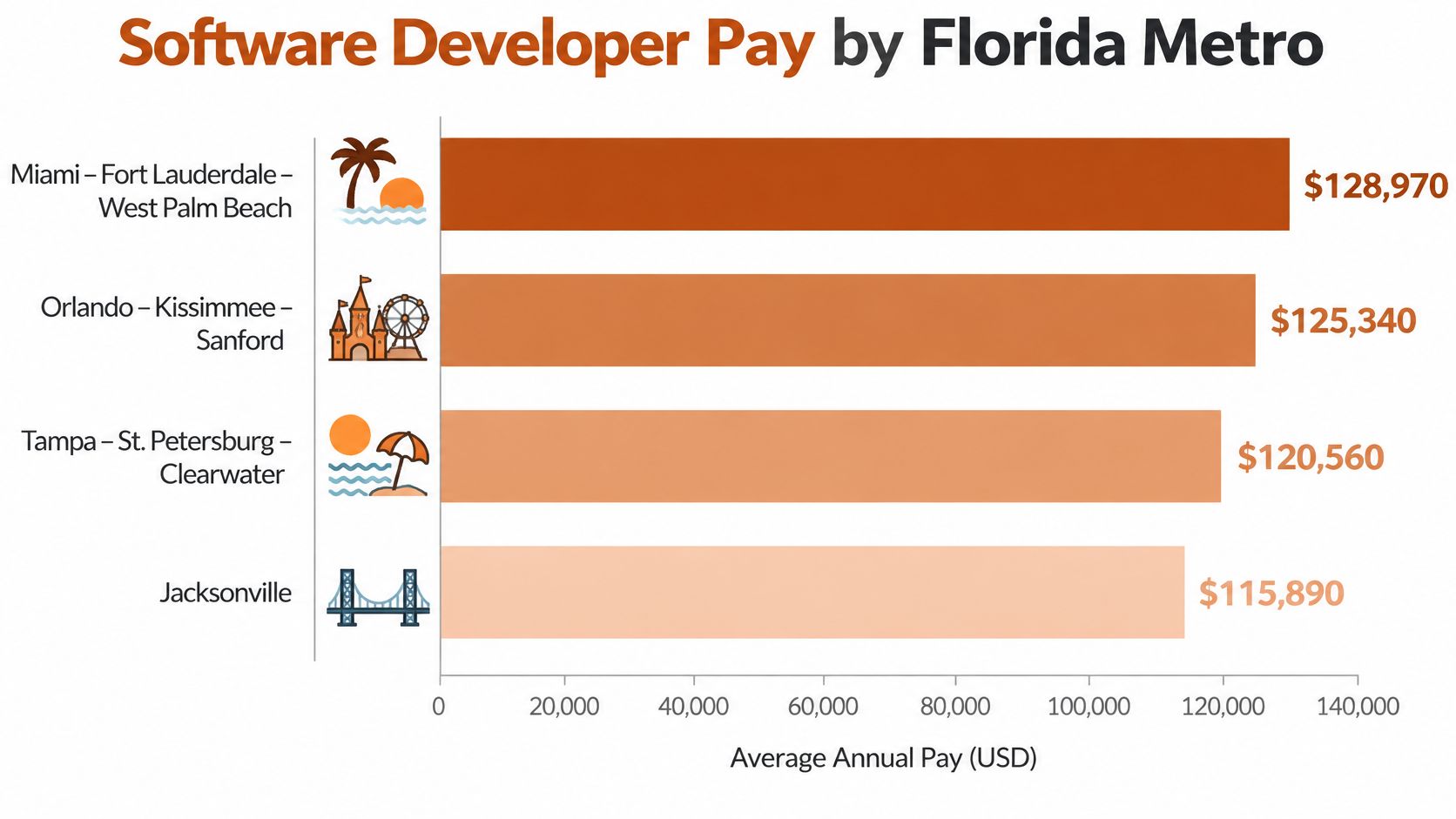
The older metro release fills in the rest of the state, and it's a different statistic. The May 2023 Occupational Employment and Wage Statistics release reported software developer annual means: $116,600 in Orlando-Kissimmee-Sanford across about 12,490 jobs, $118,560 in Jacksonville across 6,270 jobs, and $115,160 in Cape Coral-Fort Myers across 1,230 jobs, per the BLS May 2023 metro estimates for Orlando-Kissimmee-Sanford.
| Metro | Survey | Published pay | Jobs | Statistic |
|---|---|---|---|---|
| Miami-Fort Lauderdale-West Palm Beach | May 2025 | Median $132,650; mean $144,730 | Not given in this release | Median and mean |
| Orlando-Kissimmee-Sanford | May 2023 | $116,600 | 12,490 | Annual mean |
| Jacksonville | May 2023 | $118,560 | 6,270 | Annual mean |
| Cape Coral-Fort Myers | May 2023 | $115,160 | 1,230 | Annual mean |
Which benchmark to open first
Three cases cover most offers. If the job is on site in a listed metro, use that metro row and keep its label intact, so a 2023 mean is never quoted as though it were a 2025 median. If the metro is missing from the table, the count is small, or the role is statewide remote with a Florida-based employer, use the statewide 2025 median and its percentile band instead. If the offer spans two metros, use the one where the office and the team sit, because that's where the employer benchmarked the role.
A mean and a median from different years aren't subtractable. The Orlando mean of $116,600 and the Miami median of $132,650 describe different statistics from different surveys, and the honest comparison is directional: Miami's midpoint sits above Orlando's average, which is consistent with a deeper concentration of high-paying employers rather than proof of a fixed premium.
Small counts deserve a caveat
Cape Coral-Fort Myers employed about 1,230 software developers in that release, against 12,490 in Orlando. The methodology is employer-based and covers all industry sectors, and the underlying tables publish percentile estimates and relative standard errors alongside each mean. A smaller count or a higher relative standard error widens the plausible range around the published figure, so treat a smaller metro's number as a zone rather than a precise target.
Here's how the metro figures fit together in practice.
Rule of four fields: before comparing two offers or two salary reports, write down the metro, the occupational code, the survey year, and whether the published figure is a mean or a median.
Florida Remote and Out-of-State Offers
Wage estimates are tied to the area where employers hire, so a remote role doesn't automatically inherit the statewide figure. The benchmark depends on who is doing the hiring and where the worker lives.
- Name both locations. Identify the employer's location policy and the worker's actual residence. A Miami company hiring a developer in Tallahassee and a California company hiring a developer in Tampa are two different comparisons.
- Use the metro row when the role is tied to one. If the job is anchored to Miami, Orlando, Jacksonville, or Cape Coral-Fort Myers, take that metro line and keep its mean or median label intact.
- Fall back to the statewide figures when the metro isn't listed. For a worker elsewhere in Florida, or an employer hiring statewide remote with a Florida base, the statewide median and its percentile band are the defensible anchor.
- Drop the Florida numbers when neither side is in Florida. If the worker lives outside the state and the employer sets pay from its own location policy, the Florida figures are a reference point, not the rate.
The survey doesn't measure remote pay bands directly. Any remote benchmark is a comparison tool, not a promised offer, and metros with smaller counts or higher relative standard errors carry wider uncertainty than the large ones. The remote tech jobs guide covers how location policies get applied in practice, which matters more than the state line on a job posting.
What the Florida Wage Excludes
National role pages answer a different question than a Florida percentile does. Mojolin's pay, employment and outlook figures come from the U.S. Bureau of Labor Statistics Occupational Outlook Handbook, edition with 2025 pay and 2025 to 2035 projections, and the pay and job counts on those pages are national figures. Software developers are the largest group of tech jobs in the US at 1.7 million, and the Florida count is a small fraction of that, so a national median describes a much broader population.
The exclusions run the same way in both places. National BLS wages exclude equity, signing bonuses and benefits, and they mix junior and senior people under one job title. A Florida percentile carries exactly those limits when it's read as total compensation. The pay chart on those role pages shows the middle 80 percent of earners, from the 10th to the 90th percentile, with the median marked, which is the same shape as the Florida band. Both charts answer "what does this occupation pay," not "what will this person be paid."
A wage estimate prices the occupation. An offer prices a person, a scope and a package.
When an employer quotes a number, separate it into parts and record only what's stated.
- Base salary. The figure that belongs beside a percentile.
- Bonus. Whether it's discretionary, target-based, or guaranteed changes its value.
- Equity or profit sharing. Vesting schedules and share classes decide what it's worth.
- Benefits. Health coverage, retirement contributions, tuition support, and paid leave.
Leave any item the employer doesn't state as unstated. Filling a gap with an assumed figure turns a comparison into a guess.
Placing a Candidate Within the Florida Band
The survey behind these figures doesn't split developer pay by years of experience, so the percentile positions are the only anchors available. That's a limitation worth naming, because it means placement is an argument, not a lookup.
- A first developer role or a narrower title usually sits in the lower part of the band, near the 10th percentile, and the reason should be stated: limited production experience, a support-heavy scope, or a structured graduate program.
- A mid-level developer with standard scope sits near the median. This is the default position for someone who owns features end to end and works without close supervision.
- Senior scope, a scarce specialty, or a high-paying industry moves the position toward the 90th percentile. Architecture ownership, security clearance eligibility, distributed systems experience at scale, or a regulated industry with deep compliance requirements all justify the shift.
A job title alone doesn't justify a top-band number. "Senior" appears on postings that manage two services and on postings that own a platform, and the wage spread between those two jobs is real.
A title doesn't move a number. Scope, specialty and industry do.
Two adjustments keep the placement honest. A web or CMS-heavy role belongs in the web-developer comparison, not the developer band, because the occupation code differs. And when the job is on site in a listed metro, the metro row overrides the statewide anchor.
Before quoting or accepting a figure, write down the single factor that justifies the position inside the band. If no factor can be named, the number is a preference rather than a benchmark, and the pay negotiation guide covers how to argue the factor rather than the title.
Quick Reference for Florida Pay Terms
Six terms carry most of the confusion in Florida pay research. Each one changes what a number means, so it's worth fixing the definitions before the tables get quoted in an interview.
Median. The middle wage, with half of the people in the category earning more and half earning less. It resists a handful of very large salaries, which makes it the better headline figure for a typical developer.
Mean. The arithmetic average. A small group of high earners lifts it above the median, and the distance between the two is information about how top-heavy a market is. The WageDex Miami metro listing for software developers, which republishes BLS figures, prints a median and a mean for the same metro and month, and the two don't agree.
10th and 90th percentile. The ends of the middle 80 percent of earners. A figure below the 10th percentile is a floor estimate for the occupation, not a starting salary promise.
SOC 15-1252. The BLS occupational code for Software Developers. It's the closest official match to a software engineer title, and it's the code every figure in this guide refers to unless stated otherwise.
OEWS. The Occupational Employment and Wage Statistics survey, the employer-reported program behind the state and metro estimates. It excludes self-employed workers and generally excludes employer-paid benefits and some bonuses.
Metro versus statewide. A Miami median describes Miami. It isn't a Florida median, and a statewide mean isn't a metro rate.
Where each set of numbers lives:
- Median, percentile band, hourly rate, job count, and the 2016 to 2022 history: the 2025 Florida pay section.
- Web developer and programmer means, plus the small-count warnings: the job title section.
- Miami's median and mean, and the 2023 metro means: the metro section.
- Remote and out-of-state anchoring: the remote offers section.
- What the wage excludes: the exclusions section.
- Positioning by experience and scope: the candidate placement section.
- A live number checked against a real offer: the offer check below.
Check a Florida Software Engineer Offer
Run one offer through this sequence, then decide.
Step 1. Confirm the occupation. The work needs to match Software Developers, SOC 15-1252, rather than web developer or computer programmer. Read the posting for what the person builds. If the job is maintaining a Sitecore front end for a retail site, the web-developer comparison is the honest one.
Step 2. Locate the base salary on the ladder. Start from the May 2025 statewide median of $130,980 and place the base pay near the bottom tenth, the middle, or the top tenth. The position inside the band is a claim that needs a reason attached.
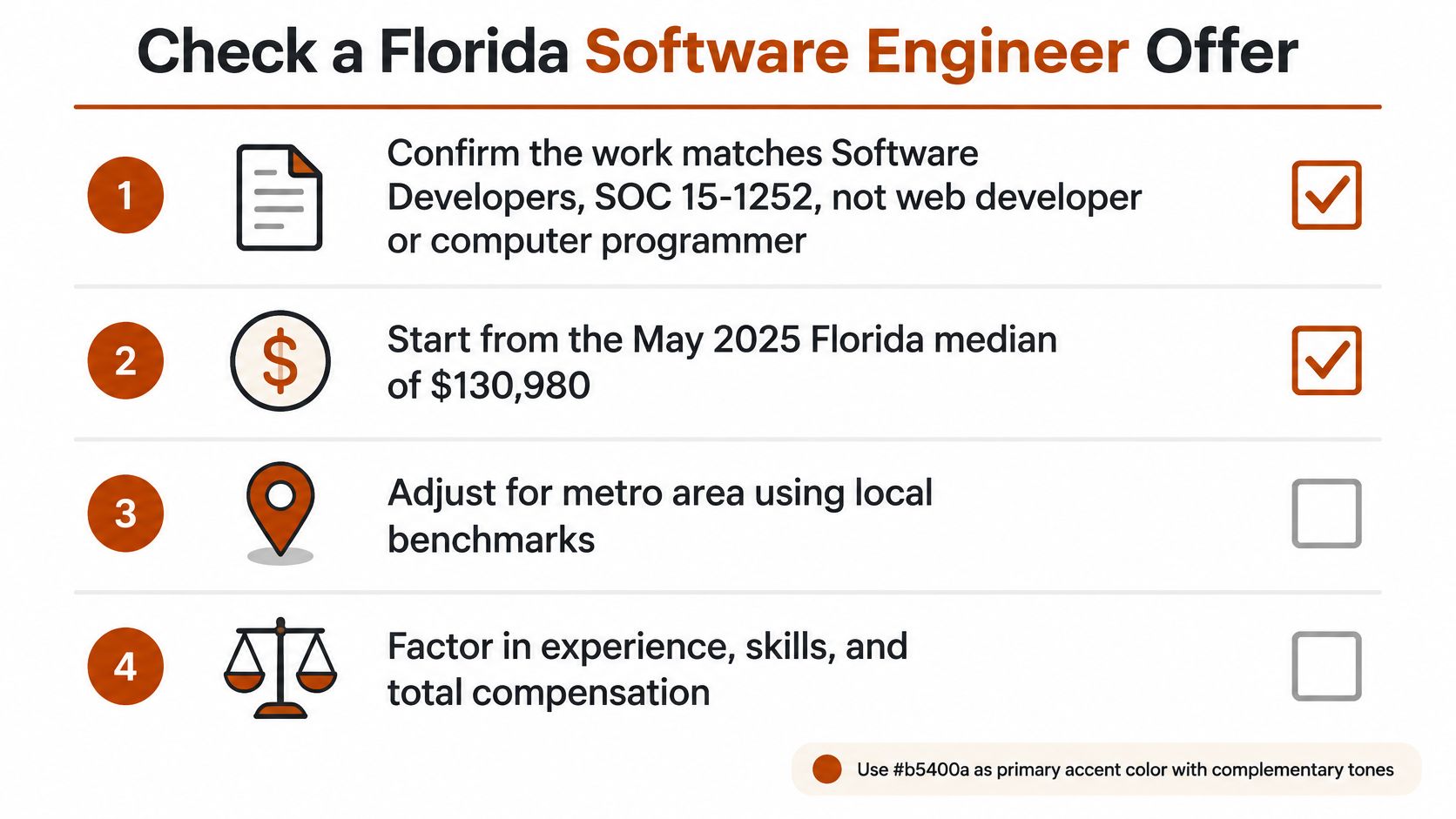
Step 3. Switch to the metro row if the office sits in one. A Miami offer gets compared with Miami figures, keeping the mean and median labels straight. A Lakeland or Pensacola offer with no metro row falls back to the statewide anchor, and the reasoning should say so.
Step 4. Ask what the quoted number includes. The survey wage is base salary before taxes, without equity, bonus, or benefits. An employer quoting "total compensation" is quoting a different measure than the one in the tables, and the two can't be compared without splitting the package apart.
Step 5. Handle the range conversation early. The pay range should be shared early, on the first call with the candidate, and interviewers should not ask candidates about their current or past salary. Judge the candidate against the work and the band rather than against a previous employer's decision.
Step 6. Write one comparison line. Base salary against the matched Florida median or metro row, with any bonus, equity, or benefit listed separately beside it. That single line is the whole exercise, and it's the one note worth carrying into the negotiation.
If the base sits far from the median, name the reason out loud. An entry-level scope, a narrow title, a small metro, or a senior architecture role all explain a gap. A gap with no explanation is usually a stale budget.
Two follow-ups help from here. Mojolin's role pages compare the software developer median against the other tech roles it tracks, which shows where the occupation ranks among US tech jobs overall, and the negotiation guide covers what to do once the Florida median is the agreed anchor rather than a disputed one.
Mojolin publishes the pay, employment and outlook data behind this kind of comparison, along with practical guides on getting hired, negotiating pay, and running a fair hiring process, so a Florida offer can be checked against a named source instead of a rumor. If you're weighing a software engineering offer or hiring for one, start at Mojolin and put the base salary beside the matched percentile before you answer.