
The May 2023 median annual wage for software developers in the Chicago-Naperville-Elgin metropolitan area was $127,960, a wage benchmark rather than a total-compensation figure that includes equity, signing bonuses and benefits. That's a metro-wide occupational estimate, not a Chicago city-only salary or an employer's current offer.
The useful question isn't whether a software engineering offer beats a headline average. It's whether the comparison matches the occupation, geography, survey year and pay components of the job. Without those matches, a seemingly precise salary comparison can point a candidate or hiring manager toward the wrong conclusion.
Table of Contents
- Software Engineer Salary in Chicago at a Glance
- Chicago Pay Versus National Benchmarks
- Chicago Pay Percentiles From Entry Level to Top Earners
- Pay by Employer Type and Seniority Level
- Job Demand Behind Chicago Software Engineer Pay
- What the Salary Figures Leave Out
- How to Check Chicago Salary Data Step by Step
- Set Your Chicago Salary Target Before the Next Call
Software Engineer Salary in Chicago at a Glance
The strongest starting point for Chicago software engineer salary research is the software-developer occupation, rather than an average covering every technology worker. The Bureau of Labor Statistics' May 2023 Chicago metropolitan estimates report a median annual wage of $127,960 and a mean hourly wage of $61.52 for software developers.
Annualizing that hourly mean across 2,080 hours produces approximately $127,962. The near equality of the mean and median is useful, but it doesn't establish that individual salaries cluster tightly around the midpoint.
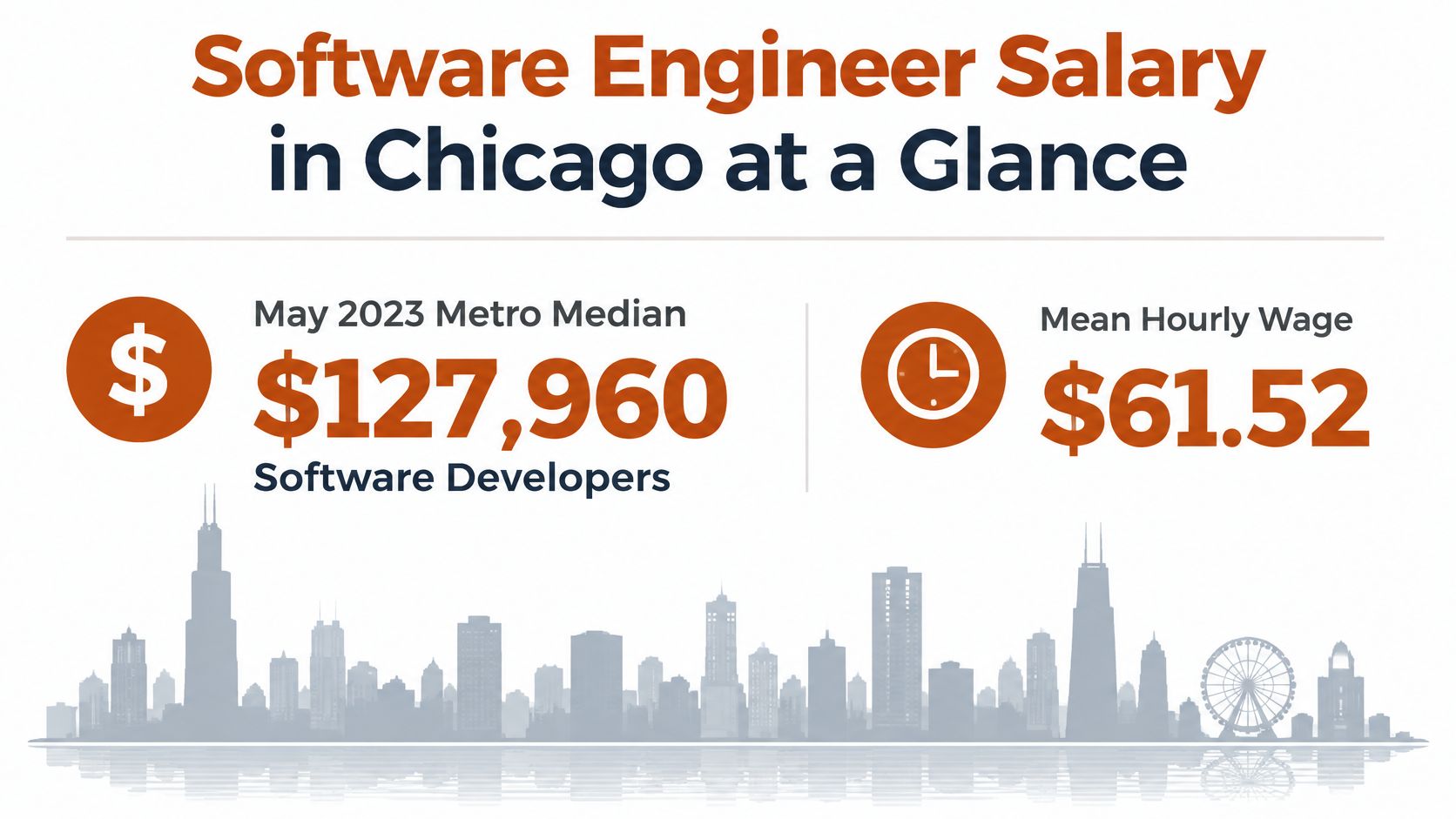
Chicago Software Developer Pay at a Glance
The local figures below describe the software-developer occupation across the metropolitan area. The national row is a later-year comparison benchmark, not evidence of a change in Chicago pay.
| Measure | Value | Year | Geography |
|---|---|---|---|
| Mean hourly wage | $61.52 | May 2023 | Chicago-Naperville-Elgin metro |
| Mean annual wage, 2,080 hours | About $127,962 | May 2023 | Chicago-Naperville-Elgin metro |
| Median annual wage | $127,960 | May 2023 | Chicago-Naperville-Elgin metro |
| Software developer jobs | About 41,210 | May 2023 | Chicago-Naperville-Elgin metro |
| Median annual wage | $135,980 | May 2025 | United States |
The hourly mean answers a different question from the median. The mean averages wages across the surveyed occupation, while the median identifies its midpoint. The employment estimate describes the occupation's size, not the number of vacancies available to applicants.
What the Headline Can Support
These are occupational estimates, not salary quotes from a particular employer. They combine developers working under different titles, with different responsibilities, across organizations that need software engineering for different reasons.
That distinction matters when interpreting the similar mean and median. Their similarity doesn't establish equal pay across junior developers, technical leads and experienced specialists. Nor does it establish that a particular employer should offer the midpoint for every opening.
A defensible salary worksheet should therefore preserve the full label: software developers, Chicago-Naperville-Elgin metropolitan area, reference year and wage measure. Recording only the dollar amount strips away the information needed to compare it responsibly.
The practical baseline is the local occupational median, with a separate field identifying whether another salary source reports a mean, median or percentile. Candidates can then evaluate a target against the right measure instead of treating every published average as interchangeable.
Chicago Pay Versus National Benchmarks
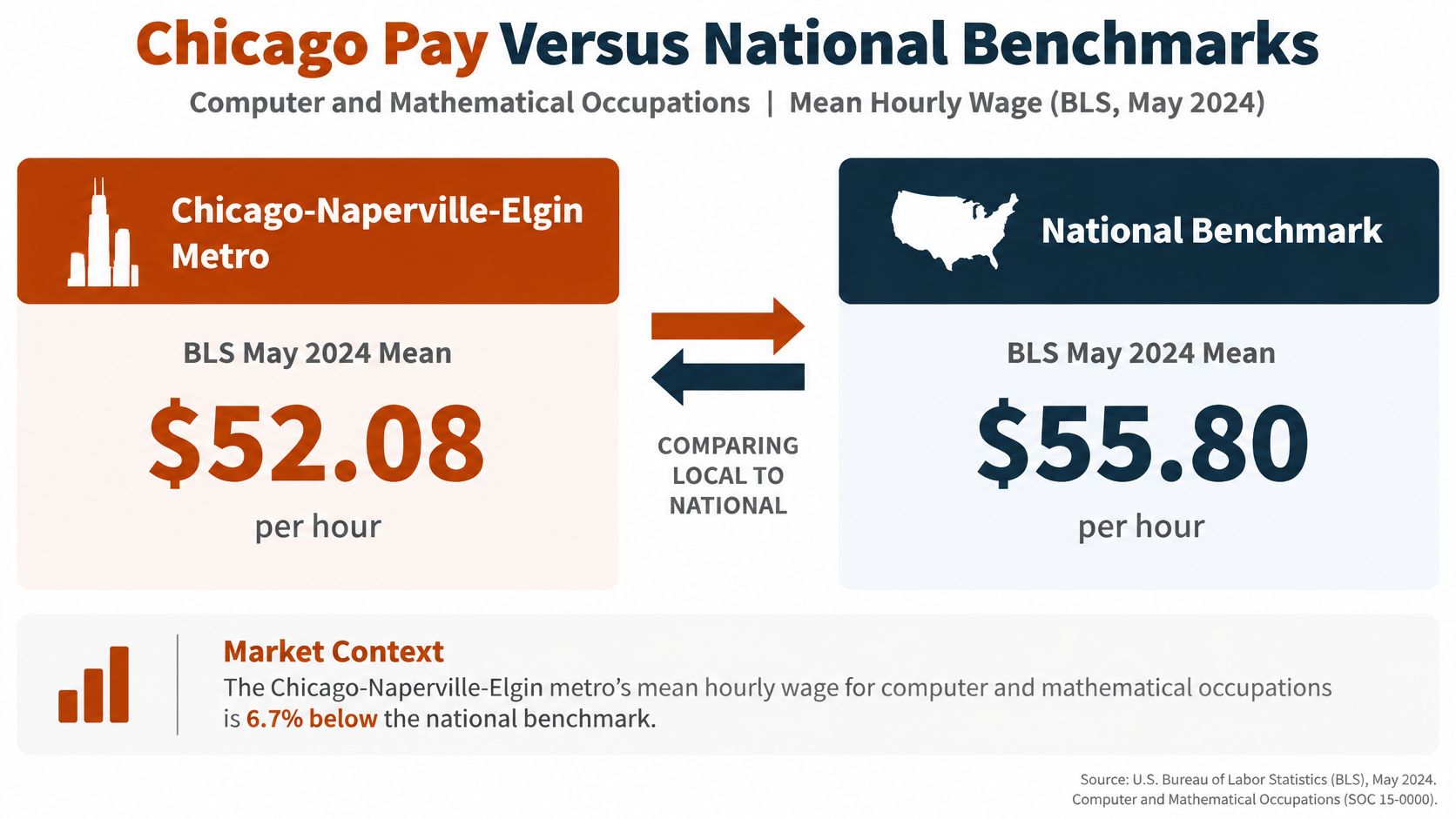
Chicago's broad technology wage comparison is informative, but it isn't a software-developer comparison. The BLS Chicago occupational wage release reports a May 2024 mean of $52.08 per hour for computer and mathematical occupations locally, compared with $56.16 nationally, putting Chicago approximately 7.3% below the national mean for that group.
That comparison holds the occupational group and reference period constant. It does not establish that every Chicago software engineer should earn the same percentage less than a nationally hired developer.
Match the Occupation Before Comparing Pay
Computer and mathematical occupations include more than software development. Programmers, analysts and other computing professionals contribute to that average, so using it as an engineering offer target substitutes a broader workforce for the job being evaluated.
For occupation-specific calibration, the BLS software-developer occupational profile reports a national May 2025 median of $135,980, with the lowest 10% earning below $82,460 and the highest 10% earning above $214,670. Those figures describe the national distribution, not a Chicago employer's salary schedule.
The profile concerns workers who design computer applications or programs. Although BLS discusses developers alongside quality-assurance analysts and testers, readers should preserve the developer-specific wage label rather than combining the occupations.
A comparison of technology salaries by role can help distinguish adjacent career paths before a candidate chooses the relevant local occupation. The role match comes before the geographic comparison.
Comparison rule: A local discount is defensible only when the occupation, reference period and wage measure match.
An offer below the local developer midpoint therefore calls for an explanation, not an automatic rejection. The candidate should establish whether the employer is pricing a supervised role, a different occupational category or a narrower scope of responsibility.
Likewise, a national benchmark shouldn't become a Chicago minimum without examining the job. Product ownership, infrastructure responsibility, data-intensive work and management duties can change the appropriate comparison group.
Chicago Pay Percentiles From Entry Level to Top Earners
A percentile distribution provides more useful context than a single average, but it doesn't assign salaries to job titles. The BLS May 2022 software-developer wage table gives the Chicago-Naperville-Elgin metropolitan distribution used below: $71,280 at the 10th percentile, $127,260 at the median, $161,480 at the 75th percentile and $198,100 at the 90th percentile.
The Chicago and national columns come from different reference years. Their side-by-side placement illustrates the distributions, not wage growth or a same-year geographic premium.
Software Developer Percentile Ladder
| Percentile | Chicago metro, May 2022 | United States, May 2025 |
|---|---|---|
| 10th percentile | $71,280 | $82,460 |
| Median | $127,260 | $135,980 |
| 75th percentile | $161,480 | Not established by the cited profile |
| 90th percentile | $198,100 | $214,670 |
The lower percentile is a lower-end occupational benchmark, not a measured entry-level salary. Junior developers may fall there, but so may experienced employees at lower-paying employers. The wage table doesn't identify which explanation applies.
The median marks the midpoint of the distribution. It's useful for understanding the center of the occupation, but it isn't a mid-level engineering pay band. A percentile measures wage position, whereas a level describes responsibility.
Seniority Is an Interpretation, Not a Published Label
The upper percentiles provide useful reference points when evaluating senior, staff or principal opportunities. They do not prove that those titles command those amounts. An employer might place a senior developer near the midpoint while another pays an individual contributor near the upper end.
The slightly different local medians in the headline table and percentile ladder reflect different reference years. Neither should be substituted for the other, and the difference alone doesn't support a conclusion about wage movement.
The strongest interpretation is that Chicago employers do not constitute a single pay market. An occupation-wide distribution can combine banks, insurers, hospitals, contractors, consulting firms, startups and product companies without revealing each employer category's separate salary curve.
A candidate can place an offer more carefully by checking:
- Responsibility: Does the role involve supervised delivery, independent ownership or cross-team technical decisions?
- Employer comparison: Are the competing jobs in similar organizations and industries?
- Compensation basis: Is the stated amount recurring salary, cash compensation or a package including equity?
- Evidence quality: Does the employer explain the level and salary-band placement?
The percentile ladder narrows the inquiry. It cannot replace employer-specific evidence or turn an occupational distribution into a guaranteed progression from junior to principal engineer.
Pay by Employer Type and Seniority Level
Employer category helps explain what questions belong in a compensation discussion. It doesn't justify assigning a salary premium without evidence. The available occupational figures don't establish separate Chicago wage bands, bonus rates or hiring speeds for each industry.
Employer Categories Change the Questions
Banks and insurers. The relevant distinction is whether the engineer supports internal systems, customer-facing products or business-critical infrastructure. Candidates should establish the recurring salary and the conditions attached to any incentive compensation before comparing the package with another employer.
Hospitals and health systems. An application-development position, an integration role and a platform-engineering position may carry different responsibilities despite similar titles. Benefits should be evaluated separately rather than assumed to compensate for a lower salary.
Government agencies and contractors. Applicants should distinguish direct employment from contractor employment and identify the applicable pay structure. A contract assignment shouldn't be compared with a permanent role without examining continuity, benefits and employment terms.
Consulting firms. Client delivery, travel expectations, utilization requirements and responsibility for winning work belong in the comparison. A senior title may refer to project execution rather than organization-wide technical leadership.
Startups and technology product companies. Equity terms require their own assessment. An equity grant isn't interchangeable with recurring cash, and a product-company label alone doesn't establish a higher-paying employer.
Compare Scope Before Title
A useful seniority assessment begins with the decisions the engineer is expected to make. Entry-level work involves more supervision; independent delivery, architectural judgment, cross-team influence and personnel management represent different forms of responsibility.
Those distinctions should guide the search for comparable openings. Management-track work also warrants checking whether the job still fits the developer occupation rather than assuming that every engineering-related title belongs in the same wage distribution.
A title is a starting description. Ownership, decision authority and accountability make the stronger comparison.
For any posted range, a candidate or recruiter can build a short comparison card:
- Employer category: The industry and business model.
- Actual level: The expected independence and scope.
- Pay definition: Salary, incentives and equity shown separately.
- Band placement: The employer's explanation for the proposed position within its range.
Hiring pace should be checked against active recruiting activity, not inferred from employer type. A startup can pause hiring, and an established organization can recruit urgently for a particular team.
Job Demand Behind Chicago Software Engineer Pay
A large workforce doesn't prove that employers are adding jobs. The Chicago tech-ecosystem report gives a 2025 metropolitan estimate of 144,351 digital-technology jobs, including 29,567 in custom computer programming and 26,734 in computer systems design.
Those employment counts establish scale and breadth. They don't identify current vacancies, the number of applicants competing for them or whether hiring is accelerating.
Employment and Openings Answer Different Questions
Government occupational estimates describe employed workers across employers. Job-posting datasets describe advertised opportunities and can disproportionately reflect organizations actively recruiting.
Consequently, a collection of posted salary ranges can differ from the existing workforce's wage distribution without either dataset being wrong. The populations being measured are different.
National context also needs a geographic label. Software developers are the largest group of technology jobs in the United States, with 1.7 million jobs. The software developer statistics resource provides broader occupational context, but national scale doesn't establish Chicago hiring conditions.
Run a Matched Openings Check
A useful demand check compares live opportunities with the candidate's actual eligibility. Software services, fintech, logistics, healthcare and internal enterprise technology are categories to investigate, not a verified ranking of local growth.
- Match the work: Search for responsibilities and technical requirements, not just software engineer titles.
- Separate hiring geography: Distinguish Chicago office or hybrid positions from nationally remote openings.
- Remove duplicates: Avoid counting a reposted job or agency listing as an additional vacancy.
- Track comparable periods: Record matching openings consistently before describing a sector as expanding or contracting.
An Excel or Google Sheets log can record employer, sector, level, work arrangement, posting date and advertised range. Changes in that matched set provide more relevant job-search evidence than a general claim that Chicago is a technology hub.
A durable entry route requires accessible openings, not merely attractive wages among people already employed. Candidates should evaluate both before committing to a specialization or relocation.
What the Salary Figures Leave Out
An occupational wage estimate isn't a complete offer valuation. Equity, signing bonuses and benefits require separate treatment, and a wage figure shouldn't be relabeled as total compensation.
Nor should every BLS wage measure automatically be called pure base salary. The defensible approach is to retain the source's wage terminology and compare offer components explicitly rather than assume that every cash payment receives identical treatment.
What Each Salary Source Measures and Leaves Out
| Source | What it measures | What it covers | What it leaves out |
|---|---|---|---|
| BLS metro estimate, Chicago | Mean and percentile wages | The occupation across Chicago metro employers | Equity, signing bonuses and benefits as a complete package |
| BLS national profile | Median and lower- and upper-percentile wages | The occupation across US employers | A Chicago-specific cost-of-living or metro comparison |
| Job postings | Advertised pay ranges | Roles employers choose to publish | Pay for unposted roles and a complete account of hiring |
| Self-reported salary sites | Submitted pay or offers | Respondents who choose to report | A representative sample unless the methodology establishes one |
The sources answer different questions. An occupational survey estimates wages among employed workers; a posting describes what an employer advertises; a self-reported offer describes a participant's submitted experience.
A candidate shouldn't average those figures together without examining their definitions. Combining incompatible measures produces a more complicated number, not necessarily a better estimate.
Missing Information Should Stay Visible
Self-reported salary pages should be checked for sample size, submission dates, location rules and compensation definitions. If those details aren't available, the reader can't confidently determine how closely the result matches the target job.
Posted ranges also require interpretation. A broad advertisement may cover several levels or locations, and the publication of a range doesn't establish where an eventual hire will land.
Mojolin's role-page pay and job figures are US figures. Its BLS wage comparisons exclude equity, signing bonuses and benefits, and combine junior and senior workers under an occupational title.
Evidence standard: A salary figure without its population and measurement rules is incomplete evidence.
Survey timing is another limitation. An older occupational estimate remains useful as a labeled historical benchmark, but it shouldn't be presented as a live quote from employers.
The practical rule is to retain the source, reference period, geography, occupation and exclusions wherever a figure is reused. Any missing field should remain visible rather than be filled with an assumption.
How to Check Chicago Salary Data Step by Step
A defensible range can be rebuilt from official tables without borrowing a salary website's headline. The BLS Chicago metropolitan wage release provides the local starting point and access to occupational comparisons.
The important distinction is between the publication date and the reference period. A newly published page can describe wages collected for an earlier period.
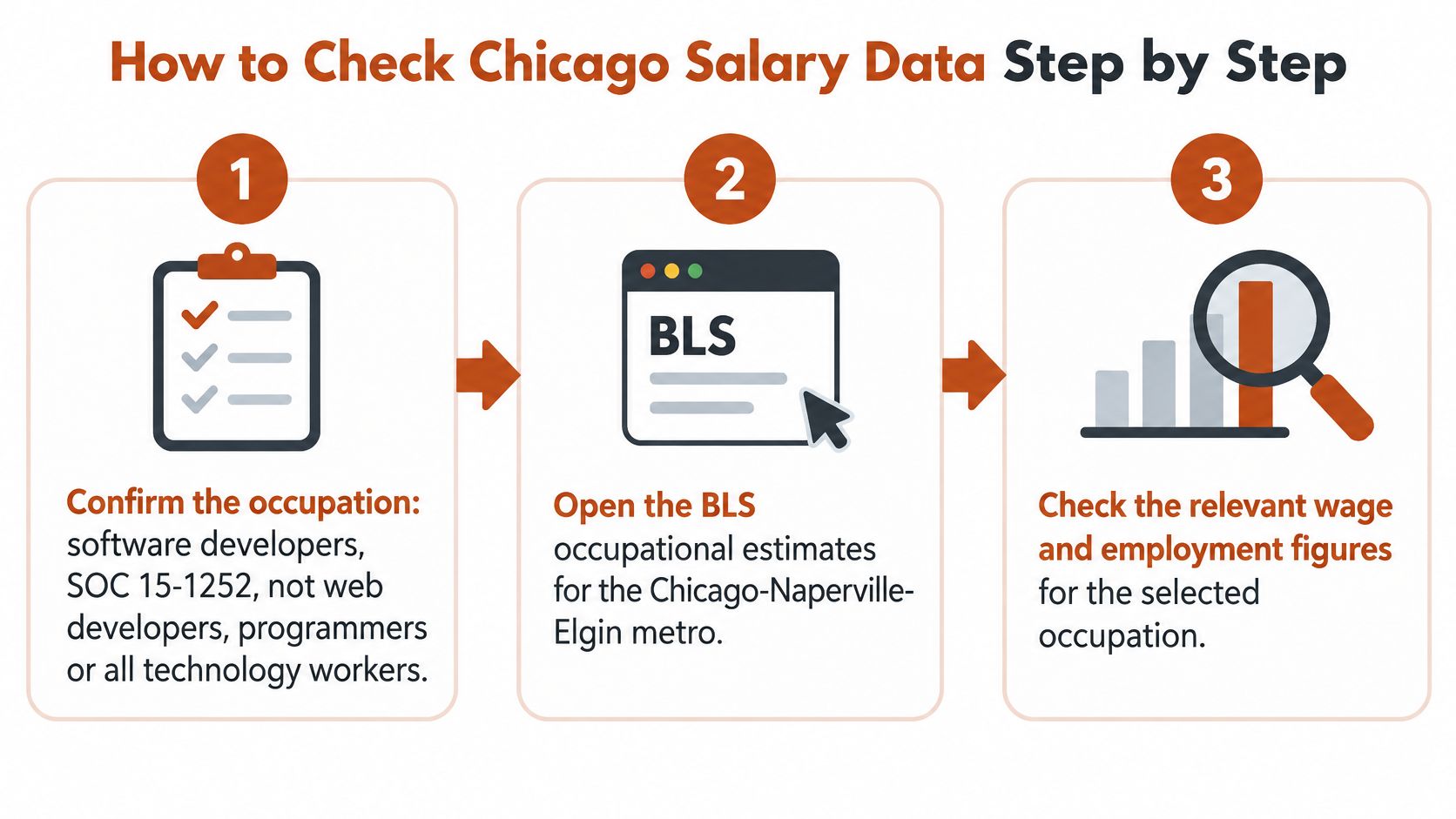
Build a Reproducible Salary Worksheet
Confirm the occupation. Find the software-developer entry and save its occupational code alongside the job description. Web developers, computer programmers and the broader computing group are separate comparisons, not substitute labels.
Choose the metropolitan table. Use Chicago-Naperville-Elgin rather than a statewide Illinois result or an unspecified Chicago page. Save the table's geographic title so the coverage remains clear when the number is copied into a spreadsheet.
Record the reference period. Enter the survey period, wage measure and occupation in separate columns. Keeping them separate makes mismatched comparisons easier to spot than a note containing only a salary and a link.
Select the measure for the question. Use a median to describe the occupational midpoint and percentiles to examine wage position. Don't interpret an upper percentile as a formal staff-engineer salary band or the lower end as a measured graduate salary.
Handle hourly conversion transparently. If an annual approximation is needed, multiply the hourly mean by the explicitly stated annual-hours assumption. Preserve the hourly value and label the result as an annualization rather than substituting it for a published annual estimate.
Check national comparability. Compare the same occupation and wage measure, preferably from the same reference period. When periods differ, retain both labels and avoid presenting the difference as a local premium or a pay trend.
Build an offer comparison separately. Add salary, recurring incentives, signing payments, equity and benefits as distinct fields. Record employer category and role scope as comparison criteria rather than pretending the occupational table measures them.
Preserve an Audit Trail
A browser bookmark alone isn't enough when a rolling release page changes. Saving the table title, access date and reference period makes later checking easier.
A conversation-ready statement should identify the selected wage measure, its survey period and metropolitan coverage, then distinguish it from the employer's total offer. That format gives a recruiter something concrete to evaluate without claiming that the survey determines an individual's pay.
Set Your Chicago Salary Target Before the Next Call
The candidate's target should be a documented working range, not the highest visible salary. For a role with independently verified senior responsibilities, the local midpoint through the upper-middle distribution can serve as an initial comparison zone, subject to matched employer evidence.
The target should identify whether it concerns recurring salary or total compensation. The range should be shared early, on the first call, so the candidate and employer can establish whether their expectations overlap.
Resolve the Offer Terms
Before treating an advertised package as comparable, the candidate should clarify:
- Bonus: The target, eligibility rules and payment conditions.
- Equity: The instrument, vesting schedule and valuation assumptions.
- Signing payment: Any repayment conditions.
- Benefits: Employee costs and relevant coverage.
- Level: The responsibilities attached to the employer's internal band.
Interviewers should not ask candidates about current or past salary. If asked, a candidate can decline politely and redirect the discussion toward the role's approved range, responsibilities and market evidence.
The technology salary negotiation guide provides a practical companion to that preparation. The strongest discussion concerns the value and scope of the position, not an applicant's historical pay.
Before the next call, the candidate should write a target, a defensible range, the source reference period and the unresolved compensation questions on a single worksheet. That turns salary research into a decision tool rather than a collection of disconnected averages.
Mojolin profiles 14 technology roles with BLS-based pay, job counts and a ten-year outlook, alongside guides to hiring and salary negotiation. Visit the role comparisons to check the occupational match, then use the linked metropolitan wage resources to build a clearly labeled Chicago salary target.