About 21 software developers work in the United States for every web developer. The Bureau of Labor Statistics occupational wage release counts 1,654,440 software developers against 78,860 web developers in May 2024, and that ratio reframes the comparison before any salary table gets a chance to.
These aren't two trades of similar size standing side by side. Software development is a broad occupation that reaches into banking, logistics, healthcare, games, logistics platforms and cloud infrastructure. Web development is a specialization inside the same technical field, defined by what a browser renders rather than by which language gets typed.
Pay follows the same shape. The median web developer earns a great deal less than the median software developer, and the reason is scope and employer base rather than talent. Occupational data can measure pay, headcount and projected growth. Whether you'd rather spend a Tuesday chasing a cross-browser layout bug or a query that times out under load at 2am is something no wage table answers.
Table of Contents
- Software Developer vs Web Developer at a Glance
- What Each Role Does Day to Day
- Skills, Tools and Learning Paths Compared
- Pay, Demand and Growth Compared
- Will AI Change Either Developer Path
- Choosing the Right Role by Situation
- Confirm Your Path Before You Enroll
Software Developer vs Web Developer at a Glance
Software developers build applications, operating systems, back-end services and other software products. Web developers build and maintain websites and the browser-based features inside them. The Bureau of Labor Statistics draws that boundary by output rather than by programming language, and it treats the two as related careers rather than interchangeable occupational categories.
The overlap is real and worth naming before the differences. A front-end engineer on a product team can spend a year doing work that looks like web development, and a full-stack web developer writes server code, database migrations and tests. The boundary that holds is the product. If what you ship is reached through a browser, styled with CSS and tested in Chrome, Safari and Firefox, the work is web work. If it's a service, a data pipeline, a desktop client, an operating system component or an API that other systems consume, it's software work.
Job titles blur that line constantly. "Web developer" at an agency often means HTML, CSS, a CMS and a client's marketing calendar; "software developer" at an insurer can mean Java services, batch jobs and a bridge into a mainframe. Read the deliverable in the posting, not the title.
| Criterion | Software Developer | Web Developer |
|---|---|---|
| Core focus | Applications, operating systems, back-end services and other software products | Websites and web applications, from page layout to browser behaviour |
| Typical deliverable | Systems, APIs, mobile and desktop apps, data pipelines | Front-end interfaces, site features, CMS-based sites, web apps |
| Typical employers | Software companies, banks, insurers, cloud and tech firms, government IT | Agencies, e-commerce teams, media sites, startups, freelance clients |
| Typical work setting | Product or platform teams, often with longer release cycles | Client projects or in-house marketing and product teams, often with shorter release cycles |
| Where the work sits | Back end, systems and infrastructure-facing code | Browser side, page rendering and site integrations |
Read the table as a checklist rather than a scorecard. Those who move from one path to the other do it because a single row started to matter more than the rest: release cadence, employer type, or the wish to own a system end to end. Whichever row pulls hardest is the one to test against real postings, and software developer statistics collects the labor figures behind that comparison in one place.
What Each Role Does Day to Day
A typical week in either role is mostly writing, reviewing and fixing code. The difference shows up in what breaks, and in who notices first.
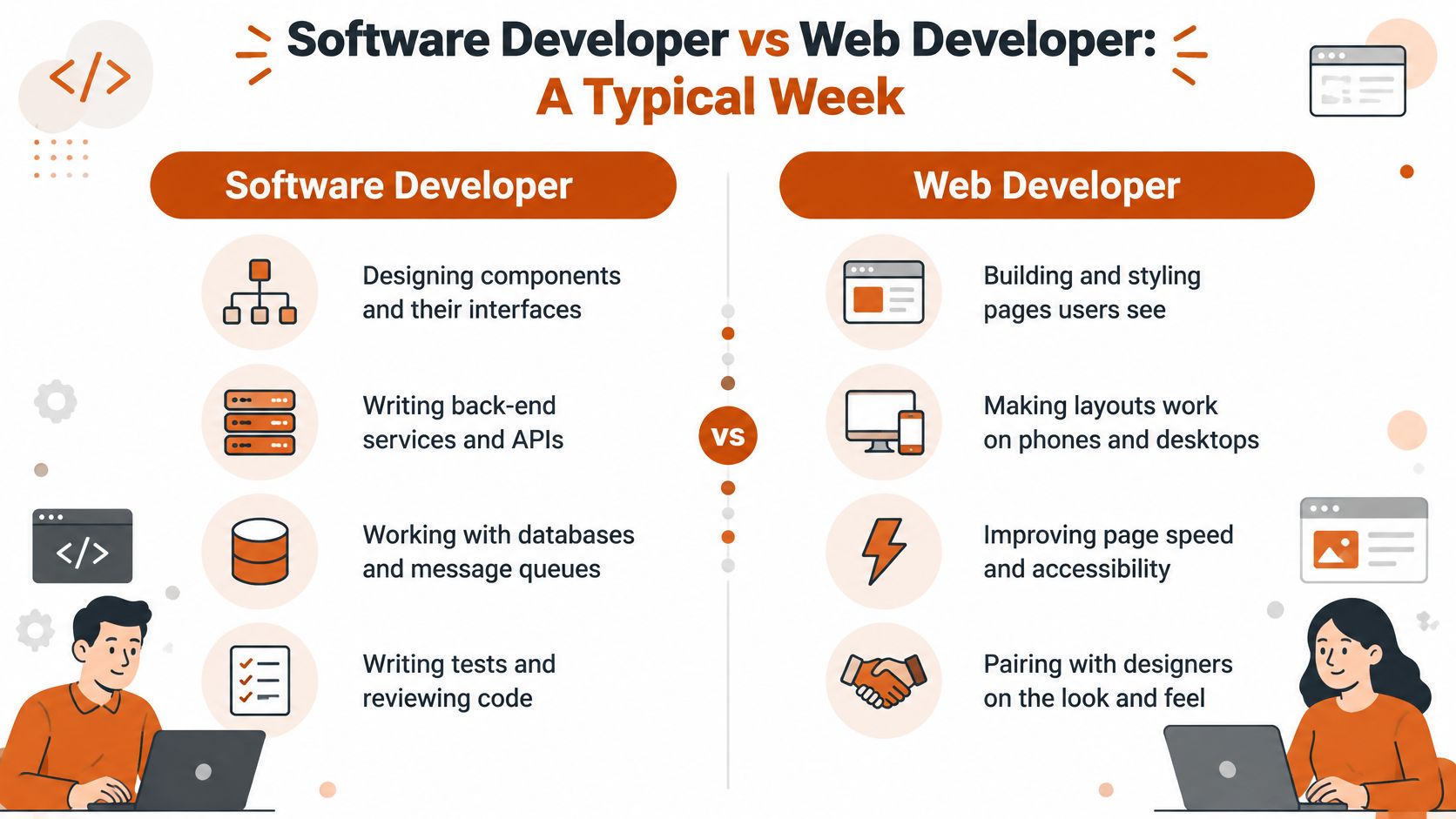
The two weeks run like this, side by side.
A Week on the Software Side
- Designing components and interfaces. Before code, the developer settles what a service accepts, what it returns, what happens on failure, and which other teams depend on it.
- Writing back-end services and APIs. Endpoints other clients call, plus validation, authentication, rate limits and the logging that makes a 3am alert actionable.
- Working with databases and message queues. Schema changes, indexes, migrations that must run without downtime, and retry logic for a downstream system that's slow.
- Writing tests and reviewing code. Unit and integration tests, pull request review, and an on-call rotation where the fix has to be safe rather than clever.
A Week on the Browser Side
- Building and styling pages users see. Turning a design file into responsive CSS, then into reusable buttons, cards and form fields checked at 360px, 768px and desktop widths.
- Wiring up content and flows. Connecting pages to a CMS or headless CMS, then handling contact forms, checkout steps and confirmation emails.
- Making layouts work on phones and desktops. A date picker that behaves differently in Safari, a sticky header that fights mobile scroll, a table that overflows at the narrowest breakpoint.
- Improving speed and accessibility. Core Web Vitals work on images and scripts, keyboard navigation, focus states and screen reader labels.
Both roles write JavaScript or TypeScript, both live in Git and code review, and both ship through CI pipelines. What differs is what the pipeline protects.
The split that matters: web work is judged by what users see and how fast the page loads. Software work is judged by reliability, data correctness and how the system behaves under load.
Take one paired example. A checkout page breaks at 360px width, the pay button slides off screen, and conversion drops within hours, so the fix is urgent and visible. A payment service starts timing out under load, and alerts, retries and idempotency keys catch it before a customer ever complains, so the fix is invisible and permanent.
The question to ask about any posting is whether most of the work sits in the browser or behind it. A role that lists React, CSS and a design system is browser work with a server attached. A role that lists Kafka, Postgres and service ownership is systems work that happens to have a web front end.
Skills, Tools and Learning Paths Compared
| Skill Area | Software Developer | Web Developer |
|---|---|---|
| Core languages | Java, C#, C++, Python, Go, Kotlin | HTML, CSS, JavaScript, TypeScript, PHP |
| Frameworks and tools | Spring, .NET, Django, Git, Docker, CI pipelines | React, Vue, Next.js, Tailwind CSS, WordPress, browser developer tools |
| Concepts to master | Data structures, algorithms, testing, system design | Responsive layout, accessibility, performance, security basics, HTTP |
| First portfolio project | A small API with a database and automated tests | A responsive site with a working contact form and fast page load |
The tools differ more than the thinking does. Both paths reward someone who can read an unfamiliar codebase, isolate a failure and explain the fix.
A Learning Order That Works for Either Path
- Learn one language well enough to write without copying. Functions, loops, data structures, error handling. Every later skill sits on top of this, and technical interviews test it directly.
- Build one small project in the path you're leaning toward. A two-week project teaches fit faster than a month of tutorials, because you hit the boring parts: setup, deployment, a bug you can't explain.
- Add Git and a testing habit. Both roles ship through review, and a project with three tests reads as more professional than one with none. Reviewers trust a candidate who writes a failing test before the fix.
- Learn the path-specific layer. Browser work means HTML and CSS layout first, then DOM handling in JavaScript, then one framework such as React or Vue. Systems work means object-oriented or functional design, databases and SQL, then one back-end framework such as Spring, .NET or Django.
- Publish the project and write a short note on one decision. "Why I used server-side rendering here" or "why this table has a composite key" is what a hiring manager reads to judge thinking, not the code itself.
The trade-off is time to visible proof. Web developers can show a working site within weeks, which makes the first portfolio cheap to build and easy to talk about in an interview. Software developers usually need longer on data structures and system design before a hiring manager can judge their work, and the payoff arrives in the size of the systems they're trusted with later.
The same JavaScript or TypeScript skill opens both paths, so a learner who can't decide can start there and defer the choice without losing ground. TypeScript in particular works as a bridge: it's the default language of modern front ends and a common choice for Node services.
If the browser is your answer, build the responsive site with a working contact form and a page load you're willing to show on a mid-range phone. If systems are your answer, build the small API with a database, migrations and automated tests, then deploy it somewhere real.
Pay, Demand and Growth Compared
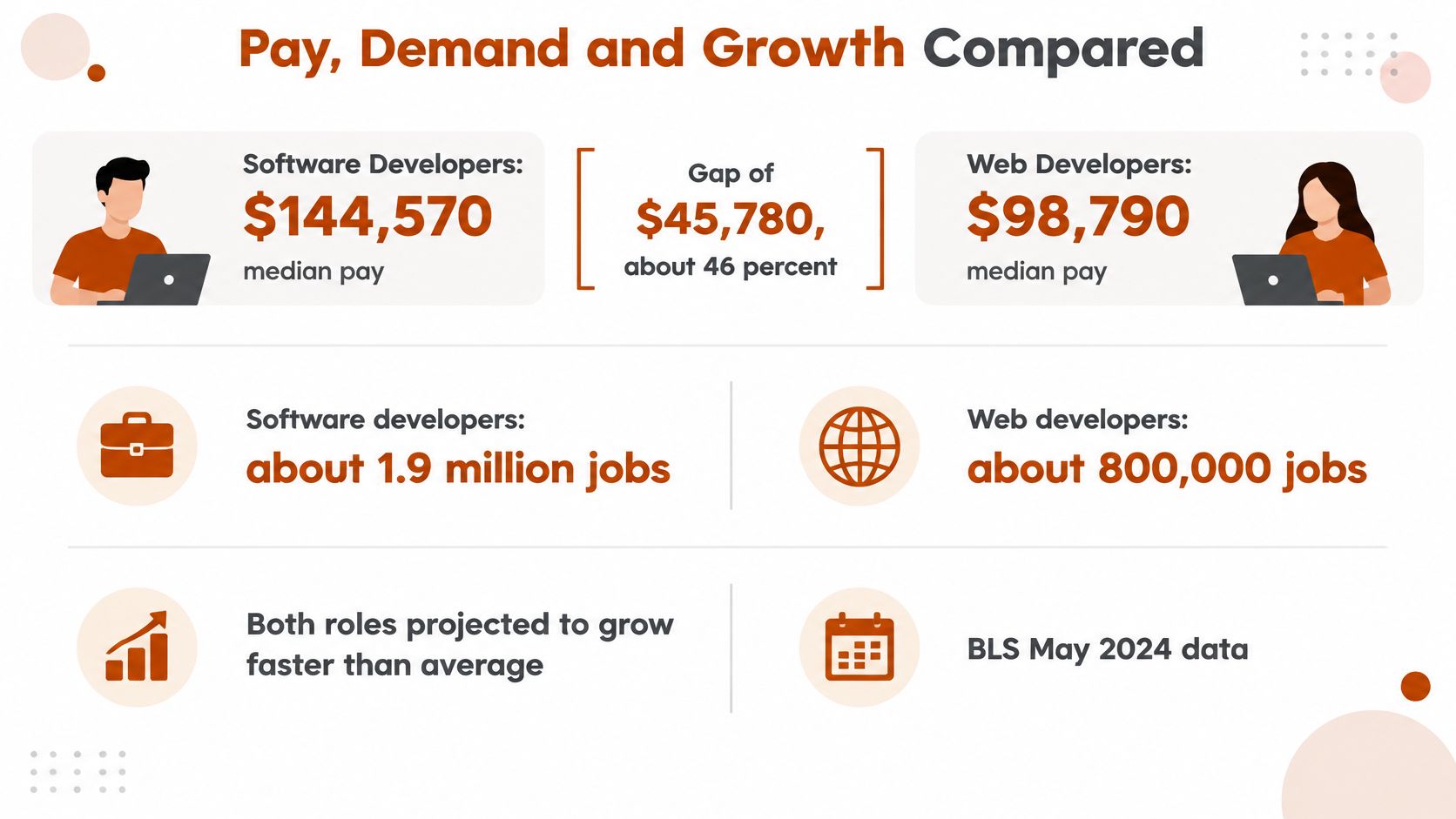
The BLS occupational outlook for software developers reports May 2024 median annual pay of $144,570 for software developers, against $98,790 for web developers. That is a difference of $45,780, or roughly 46 percent, measured as straight-time gross pay and excluding premium pay.
| Measure | Software Developers | Web Developers |
|---|---|---|
| National median annual pay, May 2024 | $144,570 | $98,790 |
| Employment in the US, May 2024 | 1,654,440 | 78,860 |
| Projected employment change, 2025 to 2035 | 10.2 percent | about 5 percent (web developers and digital designers) |
Those medians describe whole occupations, not a specific job offer. They average junior and senior staff together on both sides, so neither figure is what a first offer looks like.
What the Employment Ratio Means
Read the middle row of the table as a ratio: for every web developer position in the US, there are about 21 software developer positions. Software development is the largest group of tech jobs in the country, at about 1.7 million positions, and a base that size puts openings in banks, insurers, retailers, hospitals and government IT rather than only in tech companies. A job seeker benefits from that spread twice: more postings in more cities, and more room to move between industries without changing craft.
Web roles concentrate differently. Agencies, e-commerce teams, media sites and in-house digital teams hold most of the work, and hiring there rises and falls with client budgets and marketing calendars. The smaller base, 78,860 positions, doesn't make the path weaker, but it does make the local market thinner, which matters if you don't want to relocate.
Growth and the Category Caveat
The BLS employment projections for computer and information technology occupations put software developer employment at 1,717,800 jobs in 2025, rising to 1,892,600 in 2035, a projected increase of 10.2 percent.
The web side is measured on a different footing. The BLS occupational outlook for web developers projects 5 percent growth from 2025 through 2035 for the combined web developers and digital designers category, against 10 percent for the broader grouping that bundles software developers with quality assurance analysts and testers. Digital designers sit inside the web figure, and testers sit inside the software figure, so neither growth rate describes one clean job title.
That grouping matters when you read any comparison, including this one. Where the BLS groups two jobs together, Mojolin's role pages use the detailed occupation that matches the role and say so, and the figures above compare categories rather than identical jobs. Slower percentage growth on a small base can still mean stiff competition for each opening, while faster growth on a base of 1.7 million means far more openings in absolute terms.
A national median blends a two-year developer with a fifteen-year one, so an entry-level offer well below the median is normal in both paths. Experience-banded figures in BLS or survey data show how the climb unfolds, and Mojolin's tech salaries by role gathers the published ranges for comparison.
The video below covers the same two roles side by side:
Will AI Change Either Developer Path
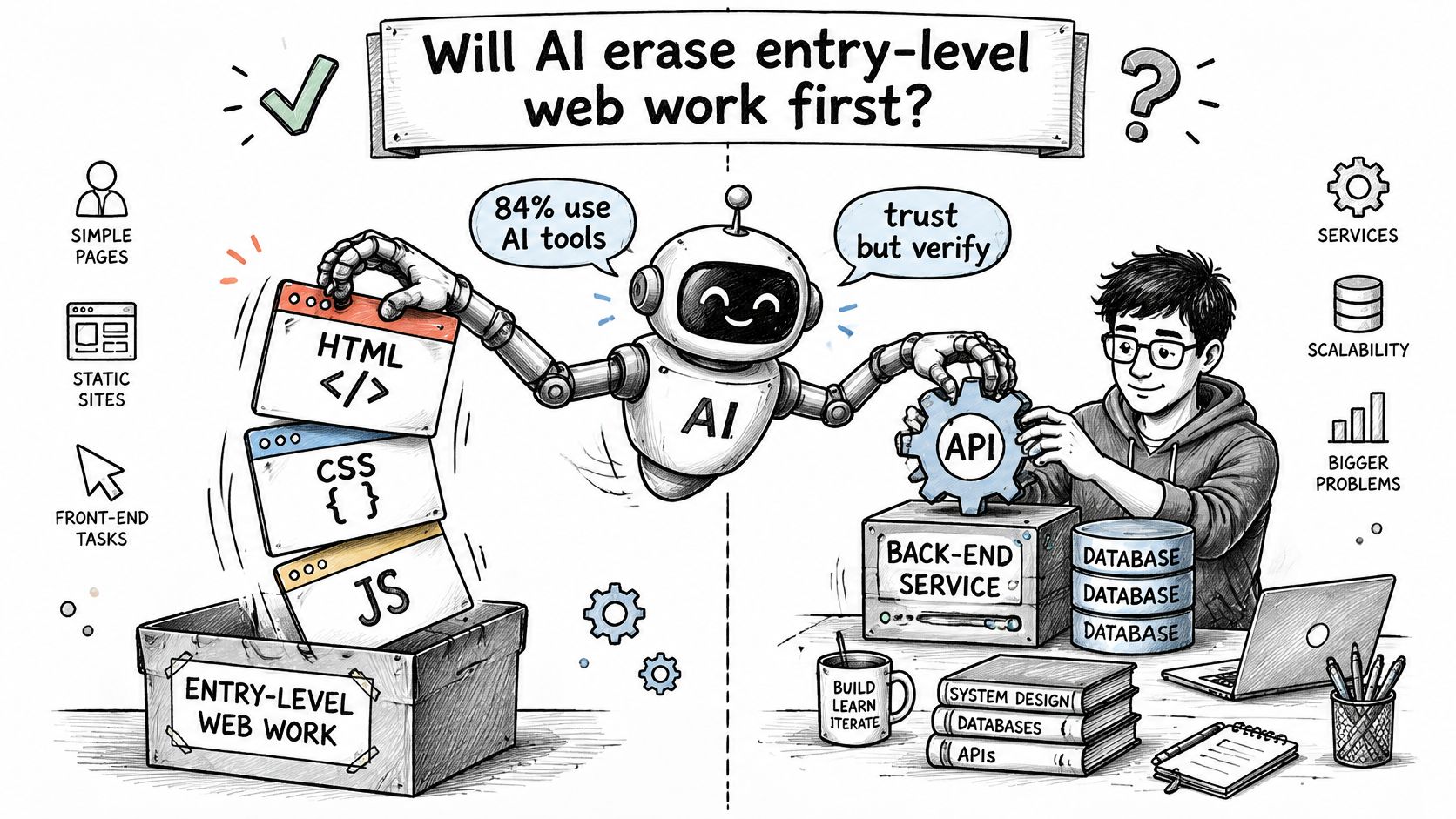
The claim circulating in career advice is specific: AI will take entry-level web work first, because layout, styling and simple CRUD are the easiest things for a model to generate. The evidence behind that claim is messier than the claim itself.
The 2025 Stack Overflow developer survey found that 84 percent of respondents were using or planning to use AI tools in development. Among the same respondents, 66 percent said their biggest frustration was AI-generated solutions that were "almost right", and 45 percent said debugging AI-generated code could take more time.
A randomized METR study of experienced open-source developers points in a similarly awkward direction. Those developers took 19 percent longer on the tested tasks when using early-2025 AI tools, even though they expected the tools to reduce their completion time.
Where Each Path Is Exposed
- Web work, most exposed. Standardized landing pages, basic CRUD applications and routine styling are exactly the tasks a model produces quickly, and a client can often accept the output without review.
- Web work, defensible. Whether a screen reader announces a form correctly, whether a page holds its load times on a mid-range Android phone, whether analytics answers the client's question, and whether the checkout flow survives a real card decline.
- Software work, most exposed. Boilerplate, glue code and test scaffolding now arrive faster from a prompt than from a keyboard.
- Software work, defensible. Architecture decisions, the test strategy that catches a bad generation, debugging under production pressure, and the judgment about what the requirements meant.
Neither path is protected by job title. What's protected is the part of the work that requires verifying something a model can't check for itself, and taking responsibility when it's wrong.
Practical rule: assume the first draft of nearly any code is free, and price your skills on the review, the test and the production judgment that follow it.
Which skills stay defensible when code generation is cheap but verification and product accountability aren't is still unsettled. Track hiring data for both titles, and treat any confident prediction about AI and entry-level work as a hypothesis rather than a plan.
Choosing the Right Role by Situation
There's no overall winner here, and any guide that declares one is answering a different question than the one a career changer is asking.
| Your Situation | Better Starting Fit | Why |
|---|---|---|
| You want visible product work and a fast portfolio | Web developer | Browser-facing projects show results within weeks |
| You want systems, data or back-end depth | Software developer | Broader job market and higher national median pay |
| You plan to work in a high-paying metro such as San Francisco | Software developer | The software title carries the higher mean pay in the San Francisco, Oakland and Hayward metro, at $181,220 |
| You want freelance or agency client work | Web developer | Client-facing sites and CMS work are common entry points |
| You are undecided | Start with shared JavaScript or TypeScript skills | The skill transfers to either path |
Each row assumes the rest of your situation is neutral, which it rarely is. The location case is often underweighted.
In the San Francisco, Oakland and Hayward metropolitan area, BLS data for May 2023 put mean annual pay at $181,220 for software developers and $148,820 for web developers. That's a gap of about $32,400 inside one metro, and it survives even though both titles earn far more there than nationally. If rent is set by local tech salaries, an absolute gap of that size decides neighborhoods, not just budgets.
There's an edge case worth naming for anyone already employed. A help desk analyst or front-end contractor at a software company often has a shorter route into software development than an outsider does, because the internal move runs on demonstrated work rather than a fresh interview loop. Ask a manager what internal transfers into engineering have looked like, and what the team expects to see first.
The decision is a sequence, not a coin flip. Decide first whether the browser or the system is your main output, because everything else follows from it: the languages, the portfolio, the employers. Then check local postings for both titles and count how many are hiring at your level. Then pick the role whose daily work you'd accept at the lower of the two salaries, since pay differences narrow once you're inside a team and scope differences don't.
The gap tracks scope, not ability. A web developer who owns accessibility, performance and a client's revenue funnel is doing work a cheaper replacement can't do, and the market pays for that too, just inside a narrower band.
Confirm Your Path Before You Enroll
A course deposit is a poor place to discover you dislike the work. Three checks, run this week, cost almost nothing.
- Read ten job postings per title in your city. Count how many list back-end languages, browser-side skills, or both. A market where eight of ten "web developer" postings ask for React and a CMS tells you what local employers mean by the title, which is worth more than a national average.
- Build a two-week test project. A responsive site with a form that submits, or a small API with a database and three tests. The point isn't the artifact, it's whether you open the editor on day nine without forcing yourself.
- Ask a working developer in each role what they did last sprint. Compare the answer with what you expect the job to be. If the software developer describes meetings, migrations and a review backlog, believe them.
A clear result looks like this: the test project makes you want to keep building after the deadline, and the postings match the work you enjoyed. Commit to that path for six months, then rerun the same three checks with the project and the postings as your evidence.
If the results conflict, settle the conflict before spending money. A person who loved browser layout but found only three local web postings is choosing between relocation and a different path, and no course resolves that.
Mojolin publishes guides on getting hired, choosing a career path, negotiating pay and running a fair hiring process, and how to become a software developer walks the entry route step by step.
Two things stay true regardless of which path wins the checks. Web development is a career, not a waiting room for something better, and plenty of people build a long one on accessibility, performance and client work. The national medians quoted here are BLS figures, so treat them as a baseline and price them against local postings before you judge any offer.
Mojolin publishes sourced pay and employment figures for 14 technology roles, along with software comparisons and guides on getting hired and negotiating pay, so the numbers in a career decision can be checked rather than guessed. Its role pages carry the median pay, job counts and ten-year outlook behind every claim in this comparison, each linked to the report it came from. If you're weighing a software developer vs web developer route, start at Mojolin and compare the figures for both titles before you pay for a course.