The BLS median for information security analysts was $129,180 in May 2025; the 75th and 90th percentiles, $163,500 and $199,850, provide a senior reference range, although BLS doesn't isolate senior titles.
The useful question isn't whether a senior security engineer earns more than the average analyst. It's whether the role carries enough design authority, incident responsibility, and control ownership to justify an upper-percentile benchmark. For compensation planning, scope determines the starting rung; location and package structure determine the adjustment.
Table of Contents
- Senior Security Engineer Pay Benchmarks at a Glance
- Matching Percentiles to Seniority Levels
- Leveling Your Role With NICE Work Areas
- Why the Median and Base Pay Mislead
- Measuring the Senior Title Premium
- Skills That Raise Senior Security Pay
- Pay Data Outside the United States and Smaller Markets
- Set Your Senior Salary Target Before Negotiating
Senior Security Engineer Pay Benchmarks at a Glance
The most defensible starting point is an occupational distribution, not a single salary average. The Bureau of Labor Statistics occupational profile reports a May 2025 median annual wage of $129,180, with the 75th percentile at $163,500 and 90th percentile at $199,850 for information security analysts.
Those are national occupational wages, not a published senior-engineer pay band. The table separates that benchmark from a title-specific posting estimate, an individual employer's advertised range, and a broader workforce survey.
Headline US pay figures for senior security engineer roles
| Benchmark | Source and date | Figure | What it measures |
|---|---|---|---|
| BLS median wage | BLS, May 2025 | $129,180 | Information security analysts, all experience levels |
| BLS mean wage | BLS, May 2025 | $132,510 | Average wage across the same occupation |
| BLS 75th percentile | BLS, May 2025 | $163,500 | Upper-quartile wage, a planning proxy for advanced senior scope |
| BLS 90th percentile | BLS, May 2025 | $199,850 | Top-decile wage, a reference for extensive architecture or leadership scope |
| Title-specific average base salary | Job-posting estimate, October 27, 2025 | $151,845 | Base-pay estimate drawn from 777 posting salaries |
| Government posting range | DHS senior security engineer posting | $143,913–$187,093 | Advertised salary range for one employer |
| Average US cybersecurity salary | ISC2 2025 study | $157,583 | Broad, self-reported cybersecurity workforce average |
These rows aren't interchangeable. A mean measures an arithmetic average, while a median identifies the middle worker. A posting range describes what an employer advertises, not necessarily what an applicant accepts, and a cybersecurity workforce average spans more than senior engineering.
For an experienced US candidate, the upper occupational percentiles provide a neutral starting framework when the responsibilities support them. The title-specific estimate serves a different purpose: checking whether that framework is consistent with advertised jobs carrying the senior security engineer title.
The distinction matters for hiring teams, too. A national benchmark can support an initial budget, but it can't establish the correct level before the employer defines the job.
Matching Percentiles to Seniority Levels
A percentile shows where a wage sits within everyone in an occupation. It doesn't establish what a particular position is worth, and it doesn't mean an employee at that wage has a particular title.
The BLS information security analyst career profile supplies the occupational context for using the wage distribution as a planning framework. The level assignments below are analyst heuristics, not BLS classifications.
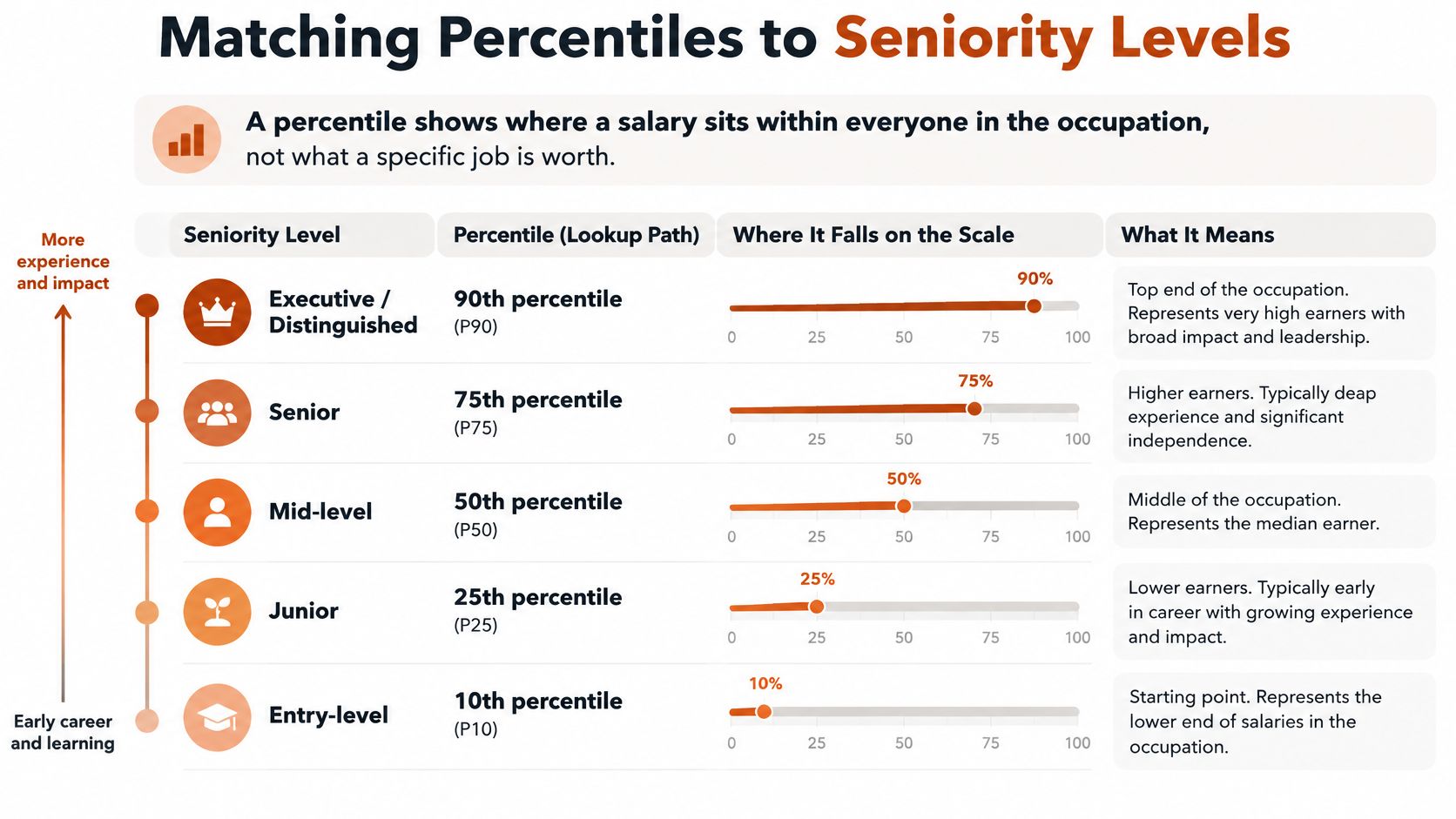
BLS percentile ladder mapped to seniority
| Percentile | BLS annual wage (May 2025) | Typical level it suits | How to use it |
|---|---|---|---|
| 10th | $75,090 | Entry or associate analyst | Lower-tail reference for junior comparisons, not a senior anchor |
| 25th | $97,810 | Early-career or support-heavy role | Lower comparison point for implementation-focused work |
| Median (50th) | $129,180 | Mid-level engineer | Starting point when the job mainly executes established designs |
| 75th | $163,500 | Senior engineer with advanced scope | Primary senior anchor for control design or incident leadership |
| 90th | $199,850 | Staff, principal or security architect | Upper occupational reference for organization-wide ownership, not a salary ceiling |
Choose the Rung Through Decision Authority
Consider an engineer who configures access policies according to an approved architecture. Technical difficulty alone doesn't demonstrate architecture ownership: another person still chooses the design, approves exceptions, and accepts residual risk.
Contrast that with an engineer who defines privileged-access standards across product teams, resolves conflicting requirements, and owns the migration away from standing access. That scope supports testing a higher rung because the engineer makes consequential decisions rather than merely implementing them.
A practical lookup should examine:
- Design authority: Whether the engineer selects the control architecture or implements an existing specification.
- Breadth of ownership: Whether the work covers a bounded service or shared controls across teams.
- Incident accountability: Whether the engineer performs assigned response tasks or directs containment and recovery.
- Lasting responsibility: Whether ownership continues after delivery, including exceptions and operational failures.
Planning rule: Broader responsibility supports testing a higher percentile. It doesn't automatically justify a fixed salary increase.
Cross-team ownership is a reason to investigate a higher rung, not mechanically move upward. Budget, local wages, and the employer's leveling system still need separate checks.
The information security analyst role profile offers an occupational comparison point. Candidates should record the proposed rung alongside concrete evidence of authority, then test that evidence against a consistent work-area rubric.
Leveling Your Role With NICE Work Areas
A title can conceal very different jobs. A cloud security engineer might maintain approved configurations, design shared cloud controls, or hold responsibility for security decisions across an enterprise.
The NICE Workforce Framework, developed by NIST and described by CISA's NICE Framework resource, provides a common language for describing cybersecurity work and workers. It helps employers compare responsibilities rather than assume that matching titles mean matching scope.
The following rubric adapts that responsibility-based approach for compensation planning. Its pay-band signals are analytical judgments, not salary grades published by NICE.
NICE-aligned work areas and senior signals
| Work area | Mid-level signal | Senior signal | Band it points toward |
|---|---|---|---|
| Systems protected | One product or team | Enterprise or multi-cloud estate | Higher scope band |
| Engineering depth | Implements existing controls | Designs controls and architecture | Upper-quartile reference |
| Security-control ownership | Runs tools and tickets | Owns control outcomes and exceptions | Upper-quartile reference |
| Threat analysis | Triage and detection | Threat modeling and risk assessment | Specialized-skill comparison band |
| Incident authority | Responds when assigned | Leads high-impact response | Top-decile reference when responsibility is sustained |
| Knowledge, skills and abilities | Core security tooling | Cloud, AI and governance depth | Specialized-skill comparison band |
Document Ownership, Not Exposure
A useful leveling packet names the system, the decision, and the engineer's authority. Familiarity with HashiCorp Vault, for example, isn't the same as owning secrets-management architecture, approving access exceptions, and directing recovery when the service fails.
Hiring managers should request artifacts that reveal those distinctions: architecture decisions, threat models, incident-command responsibilities, control exception records, and operational runbooks. Candidates can summarize confidential work without disclosing sensitive designs or internal vulnerabilities.
The strongest evidence connects technical work to a continuing obligation. Writing a Terraform module demonstrates implementation; owning the control's adoption, failure modes, and exception process demonstrates a broader responsibility.
- For candidates: Separate work personally owned from work supported as part of a team.
- For managers: Identify which decisions the position can make without escalation.
- For compensation reviewers: Price the recurring scope, not an isolated stretch assignment.
NICE defines work; it doesn't set wages. A role can therefore meet a senior responsibility standard while still requiring a local-market comparison before an employer establishes its band.
Promotion reviews also need a different question from annual merit reviews. When a position gains architecture authority or sustained incident leadership, the employer should reassess its level rather than assume an ordinary annual adjustment resolves the change.
Why the Median and Base Pay Mislead
A senior security engineer salary comparison can fail even when every quoted figure is accurate. The problem is often measurement mismatch: different populations, locations, employers, or compensation components presented as though they describe the same job.
The national occupational median blends experience levels and markets. Mojolin's BLS wage figures are national, mix junior and senior workers under an occupational title, and exclude equity, signing bonuses, and benefits; its role-page pay and job figures are US-specific.
Correct the Comparison Before Adjusting the Number
A compensation analyst should first match the geography and employer context, then choose the scope-appropriate rung. Selecting a national senior anchor and adding an unsupported location premium creates false precision.
For example, an architecture-heavy role in a smaller city should be checked against the relevant state or metropolitan distribution and the employer's industry. The analyst shouldn't assume that either a national median or a high-cost technology hub describes that hiring market.
The DHS senior security engineer posting advertises $143,913–$187,093, illustrating why an individual employer's salary band must be read as a job-specific constraint rather than a national standard.
A government band and a private-sector package with substantial stock can overlap on salary while differing materially in compensation structure. Neither comparison is useful until the analyst separates recurring cash, conditional awards, and benefits.
| Component | Information required | Comparison treatment |
|---|---|---|
| Base salary | Guaranteed annual cash | Compare directly with other base offers |
| Annual bonus | Target, eligibility and performance conditions | Keep separate from guaranteed salary |
| Equity | Grant type, vesting and liquidity conditions | Show separately from cash |
| Sign-on award | Payment timing and repayment terms | Treat as nonrecurring |
| On-call compensation | Eligibility and payment method | Confirm whether separate or embedded |
| Clearance-related pay | Explicit premium or applicable salary band | Count only documented terms |
| Benefits | Coverage, retirement and employee costs | Compare outside the cash subtotal |
Diagnose the Largest Mismatch First
There's no supported universal ranking of these drivers by dollar effect. A practical review order is employer pay structure, then equity and bonus terms, followed by clearance requirements, specialization, and management responsibility.
That order helps identify constraints before arguing about a premium. A fixed government band requires a different negotiation from a private employer that can shift value among salary, stock, and a sign-on award.
Certification comparisons require similar restraint. A holder's credential doesn't isolate the effect of experience, country, job family, or employer, so a certification salary median shouldn't be converted into a guaranteed senior-engineer premium.
An afternoon comparison can produce a defensible worksheet:
- Normalize the market: Record location, industry and employer type.
- Confirm the level: Match decision authority and control ownership.
- Separate the package: Keep guaranteed cash apart from conditional or nonrecurring awards.
- Check obligations: Record on-call duties, clearance conditions and repayment clauses.
- Flag uncertainty: Mark missing terms instead of assigning them an optimistic value.
A larger headline package isn't necessarily a better offer when the additional value depends on uncertain awards or restrictive conditions.
Measuring the Senior Title Premium
The title-specific job-posting estimate reports average base pay of $151,845 as of October 27, 2025, drawn from 777 posting salaries over the preceding 36 months. Against the occupational benchmarks, that is $22,665, or approximately 17.5%, above the median, and $19,335, or approximately 14.6%, above the mean.
The estimate is more title-specific than the occupational distribution, but its sample reflects advertised compensation, employer demand, regional concentration, and company mix. It doesn't measure accepted offers or follow the same employees through a promotion.
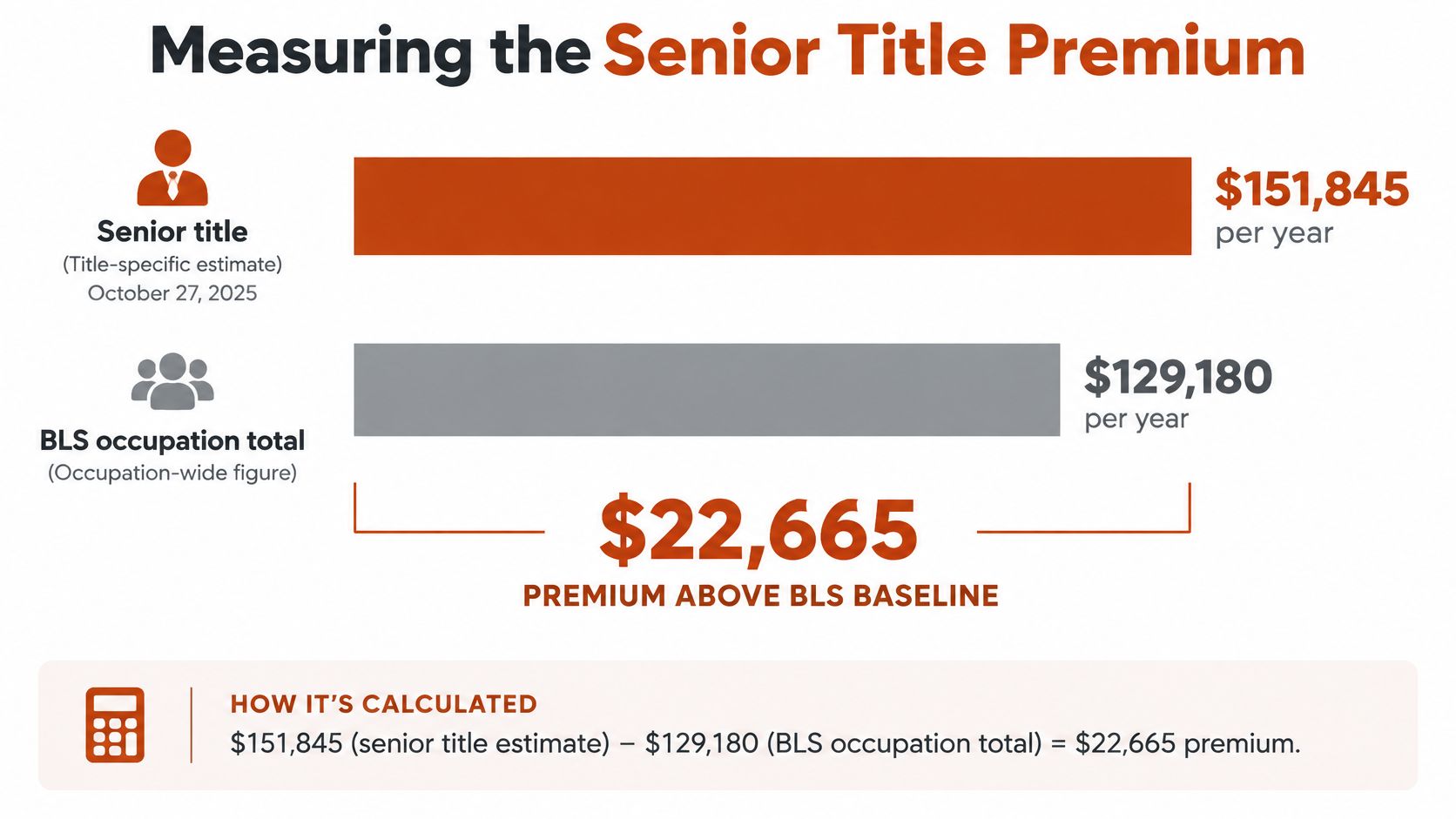
What the Comparison Establishes
The positive gap is consistent with senior-titled jobs attracting higher advertised base pay than the broader occupation. It does not establish a causal promotion premium.
A clean promotion calculation would need otherwise comparable workers, employers, markets, responsibilities, and pay components. Here, the title-specific sample and the occupational population differ, so the observed gap includes more than seniority.
| Comparison | What it helps assess | What it cannot establish |
|---|---|---|
| Senior-title estimate versus occupational median | Whether senior advertisements sit above the occupational midpoint | The correct raise for an individual promotion |
| Senior-title estimate versus occupational mean | Whether the result persists against a different central measure | The value of architecture ownership alone |
| Advertised base versus an actual offer | Whether the cash offer warrants closer investigation | Whether the complete package is competitive |
The important analytical conclusion is that title specificity and scope specificity aren't the same thing. A posting sample can precisely match the words in a job title while mixing narrow implementation jobs with enterprise engineering responsibilities.
Apply the Estimate as a Cross-Check
For an experienced US candidate, the posting estimate is a practical reference for advertised base pay. An employer offering less should be assessed through local conditions and actual scope, rather than rejected solely because the title matches.
Likewise, an offer above the estimate doesn't automatically compensate for organization-wide authority, demanding on-call expectations, or weak benefits. The candidate still needs a role-level comparison and a component-by-component offer review.
Skills That Raise Senior Security Pay
AI adoption doesn't, by itself, establish downward pressure on senior security pay. Automation of repetitive monitoring work and demand for specialized judgment can appear in the same hiring plan.
In the 2025 ISC2 Cybersecurity Workforce Study, 73% of respondents believe AI will create more specialized cybersecurity skills, and 72% expect a greater need for strategic security mindsets. The same study identifies cloud security, AI, security engineering, security analysis, and risk assessment among hiring priorities. Those findings describe skills expectations, not measured salary premiums.

Turn a Skill Claim Into Evidence
The salary implication is a hypothesis to test: employers may value engineers who can own new security problems more highly than engineers whose responsibilities remain limited to conventional monitoring. The study does not isolate a dollar premium for any individual capability. A skill argument moves a candidate's percentile rung only when the role's scope gives that capability real weight; a monitoring-heavy position won't pay for governance work it never performs.
The useful skill groups are specific:
- AI system security: Define access boundaries, protect sensitive inputs, and assess failure paths in AI-enabled applications.
- AI governance: Translate permitted-use policies into technical controls and exception decisions.
- Cloud control design: Build identity, secrets, logging, and deployment safeguards into shared infrastructure.
- Detection validation: Test automated findings against realistic attack paths and document blind spots.
- Threat modeling and risk governance: Explain which risks require engineering changes and who owns the remaining exposure.
A candidate should attach each claim to an owned system, control, or decision. Listing AI tools used during routine work doesn't demonstrate responsibility for securing those tools.
Scarcity is a negotiation hypothesis until comparable employers attach compensation to the capability.
Certification planning follows the same discipline. The CISSP certification reference can support credential evaluation, but a credential complements evidence of applied judgment rather than substituting for it. A senior candidate weighing study hours should compare the credential's signal against a documented project that demonstrates the same judgment directly.
The strongest negotiation narrative connects a specialized capability to the employer's actual problem. If the role requires securing agent access to production services, evidence of access-control design outweighs a general claim of AI familiarity. Where the posting never touches that problem, the skill supports a scope discussion rather than a higher anchor.
Pay Data Outside the United States and Smaller Markets
The dollar benchmarks used for the central salary comparison are US figures. Applying them elsewhere through currency conversion alone would preserve the number while discarding the labor market that produced it.
A local benchmark should begin with a national labor statistics agency's closest information-security or IT-security occupation. The analyst should inspect the occupation's definition before assuming it includes comparable engineering work.
Build a Local Comparison
- Start with local wages: Prefer occupational data for the country of employment, then narrow by region where available.
- Check the measure: Establish whether the publication reports gross salary, net income, wages, or total compensation.
- Match the period: Keep hourly, monthly and annual figures distinct until working-time and payment conventions are clear.
- Use percentiles cautiously: An upper-distribution anchor is appropriate only when advanced responsibility supports it.
- Normalize currency transparently: If comparison requires conversion, record the exchange-rate date and retain the original currency.
Exchange rates don't correct for local taxes, benefits, employment protections, or purchasing power. A converted US salary should therefore be labeled as a cross-border reference, not a local expectation.
For US candidates outside major technology centers, state, metropolitan, and industry wage tables provide a better starting comparison than assumptions about national averages. Remote applicants should also establish which location the employer uses to set pay.
An individual posting remains an employer-specific observation. Several closely matched advertisements, with clear base-pay definitions and comparable responsibilities, are more useful for testing a local target than an unrelated headline range.
Set Your Senior Salary Target Before Negotiating
A defensible target is a decision supported by evidence, not the highest available number. The candidate needs a preferred base salary, a private minimum, and a clear view of which package components could justify a trade-off.
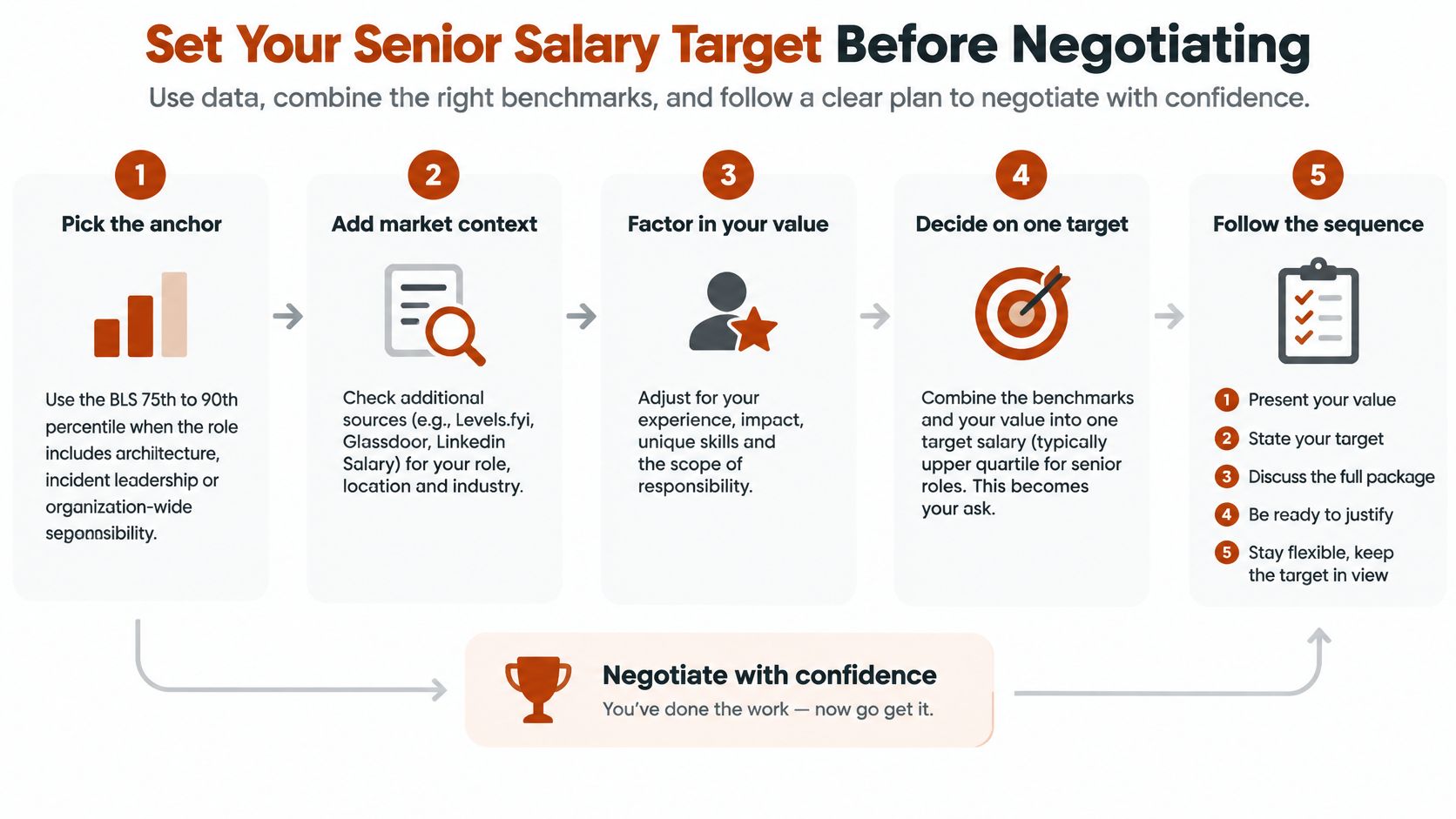
Build the Target in Order
Pick the anchor according to authority, because architecture, incident leadership, and organization-wide control ownership call for a different comparison from implementation-focused work. The role's recurring responsibilities should determine the initial position within the occupational distribution.
Cross-check title-matched advertisements, because a broad occupational anchor can miss how employers advertise senior engineering jobs. The candidate should compare actual duties rather than accept matching titles as sufficient evidence.
Localize the benchmark, because the hiring location and industry establish the relevant comparison market. For remote work, the recruiter should identify whether the employer prices by employee location, office location, or another stated policy.
Validate the level against work areas, because responsibility must support the proposed band. The candidate should prepare concise examples of design decisions, exception ownership, and incident authority that match the position.
Separate base from the rest of the package, because stock, bonuses, sign-on awards, on-call arrangements, clearance terms, and benefits don't have identical certainty or timing. Missing terms should remain unresolved rather than being counted as compensation.
Set a base target and a private walk-away figure, because a preferred outcome and an acceptable minimum serve different purposes. The minimum should account for recurring obligations, personal constraints, and the value of credible alternatives.
Establish the range on the first call, because an early pay discussion prevents an extended interview process built on incompatible expectations. The employer should share its range, and the candidate should explain the scope assumptions behind the expected base.
Prepare the Conversation, Not Just the Number
The candidate's discussion can stay concise: identify the role's expected ownership, state the corresponding base-pay expectation, and ask which compensation components remain flexible. If the employer's range is lower, the next question is whether the scope, level, or package can change.
The tech salary negotiation guide provides a reference for structuring that conversation. A candidate shouldn't disclose the private minimum merely to make the first discussion easier.
Before the next recruiter call, the candidate should have a written base target, a walk-away figure, and an offer-comparison sheet with unresolved terms marked clearly. That preparation turns a senior security engineer salary search into a decision about a specific job, not a contest between incompatible averages.
Mojolin publishes sourced technology pay and careers data, certification comparisons, and salary negotiation guides. Visit Mojolin to compare the relevant occupational benchmarks and prepare a scope-based salary expectation before the next hiring conversation.