The PC support specialist salary benchmark is $61,860 a year, the median annual wage for computer user support specialists in May 2025. The broader computer support specialist group, which also includes network support roles, had a median of $62,890.
That $1,030 gap matters less than the title behind each figure. A help desk or desktop role maps to the first number, while a network-heavy role maps closer to the second. Neither figure is a starting salary, a guaranteed offer, or a ceiling. Each one marks the middle of a national pay distribution that mixes new hires with experienced specialists.
Table of Contents
- PC Support Specialist Salary at a Glance
- How Pay Has Moved Since 2019
- Job Titles Behind the Pay Figures
- Reading Median Pay and Hourly Equivalents
- Why Your Pay May Differ From the Median
- Entry Routes and Certifications That Shape Starting Pay
- Career Ladder From Support to Higher-Paying Roles
- Use These Figures to Set Your Salary Expectations
PC Support Specialist Salary at a Glance
Two occupation definitions sit behind every PC support pay figure, and the difference between them is scope rather than seniority. The narrower group, computer user support specialists, covers the help desk, desktop and device work the role usually describes; the broader group folds network support specialists into the same estimate. Both figures below are US medians, the same scope the pay and job figures on Mojolin's role pages use, so they describe the national market rather than any single city or country.
BLS Pay for Computer Support Occupations
| Group | Median annual pay | Median hourly pay |
|---|---|---|
| Computer user support specialists, May 2025 | $61,860 | $29.74 |
| Computer support specialists, broader group incl. network support, May 2025 | $62,890 | $30.24 |
| Computer user support specialists, May 2019 | $52,270 | $25.13 |
Each row measures something different. The first two come from the same survey point, so the lift in the broader group's median shows what happens once network support roles join the count. The 2019 row is the narrower occupation surveyed six years earlier, kept here as a reference level for how the role paid at that point. User support alone accounts for about 750,600 jobs, which puts the first row's median on one of the larger occupational bases in the BLS technology estimates.
The pay measure is a median, not an average. It reports the wage of the worker in the middle of the group, so a thin band of top earners can't drag it upward the way a mean would allow. The hourly column converts the same wage onto a full-time schedule, which matters because many support postings quote pay per hour rather than per year.
Practical rule: Convert before you compare. An offer quoted per hour multiplies out to an annual figure, and a salaried offer divides back to an hourly rate, so either form can be checked against the same row.
Read together, the rows supply three reference points: the current level for the role, a scope check from the wider group, and the occupation's standing six years ago.
How Pay Has Moved Since 2019
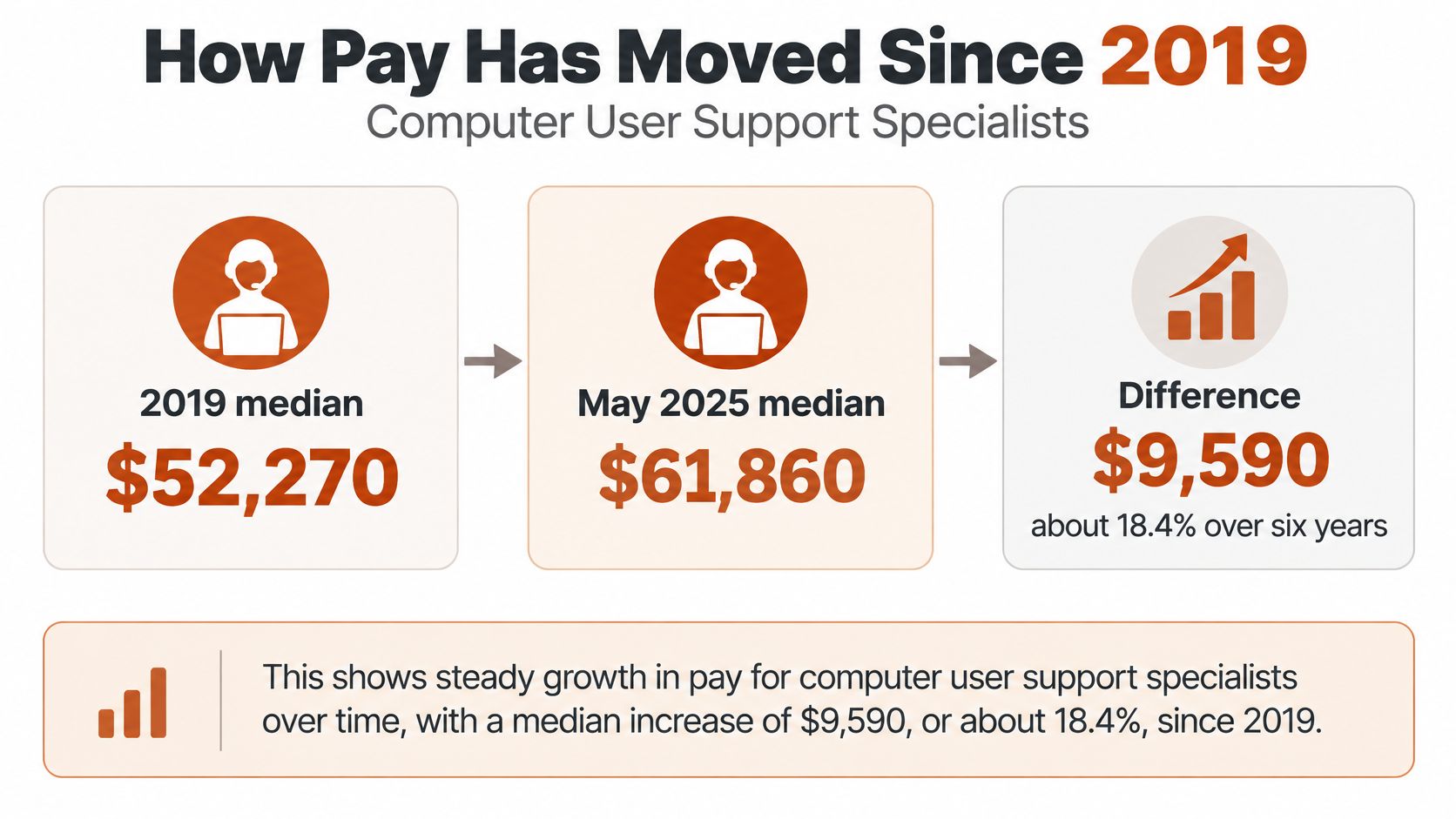
Pay for this work has risen in nominal terms, but the size of that rise needs careful reading. The Bureau of Labor Statistics occupational profile for computer support specialists recorded 2019 median pay of $52,270 for computer user support specialists, against $61,860 in May 2025. That's nominal growth of $9,590, or about 18.4%, over the six-year period to 2025.
What the Increase Does Not Show
That comparison spans different survey years and doesn't adjust for inflation. It measures change in reported dollars rather than real purchasing power, so it can't tell a reader whether the typical specialist can buy more with a paycheck today than in 2019. It also can't show the path between the two years, including whether pay rose steadily or in steps.
The practical use is narrower and more useful. An offer built around the 2019 figure is anchored to an old market, and quoting $52,270 in a current negotiation hands the employer a stale benchmark. The 2025 median is the reference worth using, with the older figure kept only as trend context.
Use the $61,860 May 2025 median as the current reference point for user support work.
Job Titles Behind the Pay Figures
PC support specialist is a working title used by employers, not the label on the official pay table. The work sits inside computer support, split between user support, focused on people and their devices, and network support, focused on the systems those devices connect to. Job postings blur that split, which is why title matching comes before any salary comparison.
Readers comparing postings against the IT support specialist role profile will see the same work advertised under several names. The duties in the posting, not the title at the top, decide which pay figure applies.
Job Titles and the Pay Figure to Use
| Job title | Typical work | Pay figure to use |
|---|---|---|
| Computer user support specialist | Help desk tickets, device setup, end-user troubleshooting | $61,860 median (May 2025) |
| Network support specialist | Network configuration and outage response | $62,890 broader group median (May 2025) |
| Desktop support technician | On-site hardware, operating system and application support | No separate published figure, nearest $61,860 user support median |
| Help desk analyst | First-line ticket triage and escalation | No separate published figure, nearest $61,860 user support median |
Two of these titles have no published figure of their own. That's normal, since employers invent titles freely while official statistics group similar work together. The nearest benchmark is the honest comparison, as long as the reader knows it's a proxy.
Before comparing any offer, run this check:
- List the duties: Write down the three main tasks named in the posting.
- Find the matching row: Pick the table row whose typical work matches those tasks.
- Use that row's figure: Benchmark the offer against that median, not the highest number available.
Reading Median Pay and Hourly Equivalents
The median is the midpoint of all earners in the survey, so half of workers earned more and half earned less. That is what makes it the most useful single benchmark for an offer, since a few very high or very low salaries cannot drag it around the way they drag an average. It is not a floor, a starting rate, or a promise of what any one employer will pay.
The hourly equivalent is simpler than it looks. It is the annual median divided by full-time hours, a conversion for comparing against hourly postings rather than a separate pay rate. Take a posting offering $30 an hour on a standard schedule. Multiply by 2,080 full-time hours and the offer annualizes to about $62,400, which lands between the $61,860 user support median and the $62,890 broader group median. A candidate reading only the hourly number might assume it clears both benchmarks. It clears one. Part-time hours, contract terms, or heavy overtime change the math again, so the conversion only holds for a standard full-time schedule.
Pay Terms and How to Use Them
| Term | What it measures | Use it when |
|---|---|---|
| Median | Midpoint of all earners in the survey | Benchmarking a base salary offer |
| Hourly equivalent | Annual median divided by full-time hours | Comparing with hourly job postings |
| Broader group | Includes user support and network support roles | Checking the wider market |
Percentile ranges work differently. A percentile shows where a pay level falls among workers, with the 10th percentile marking lower earners and the 90th marking higher earners. The figures in this article are medians rather than percentile bands, so a reader who wants a range around the user support midpoint needs a source that publishes one rather than an estimate built around $61,860.
The practical sequence for any posting runs in three steps. Convert the offer to the same unit as the benchmark. Pick the benchmark that matches the duties, user support or the broader group. Then read the result as a position relative to a midpoint, since half of the workers behind that median already earn more than it.
Match the term to the posting before comparing numbers. An hourly rate, an annual salary, and a broader-group median are three different measurements.
Why Your Pay May Differ From the Median
A national median compresses very different jobs into one number. Five factors move an individual offer away from it.
- Experience: A specialist who administers the ticketing system, writes knowledge base articles, and mentors new hires sells documented scope. A first-year tier-one agent resetting passwords sells potential, and employers price those differently.
- Industry: Support work in healthcare or finance carries compliance duties, audit trails, and restricted data handling. The same skills in a retail chain carry different risk, and pay follows the risk.
- Geography: A metro employer competing for staff against high living costs usually posts higher offers than a rural employer hiring locally. Remote postings complicate this, since some employers pay by the worker's location rather than headquarters.
- Employer size: A large enterprise typically runs structured pay bands with defined levels, which limits negotiation but adds predictability. A small firm may offer lower base pay alongside broader duties and faster title growth.
- Technical specialization: Adding network, security, or cloud skills moves a specialist toward the broader support group and beyond it. Each added system a person can own without escalating raises that person's replacement cost.
Caveats on the National Figure
BLS wages on Mojolin are national figures that exclude equity, signing bonuses, and benefits, and they mix junior and senior people under one job title. A PC support specialist salary offer below the median can still win on total compensation once health coverage, retirement matching, overtime, and on-call payments are counted. The reverse also happens, where a strong base salary hides thin benefits.
Compare the full package, not base pay alone.
Entry Routes and Certifications That Shape Starting Pay
This occupation stays open to newcomers in a way many technology roles don't. Mojolin's IT support specialist page says no prior experience is required to enter the role, which explains why many specialists start below the median and move up as scope grows. Employers know new hires arrive unfinished, so moderate-term on-the-job training is typical, covering the ticketing system, internal network, and supported software.

One credential dominates entry-level screening. Mojolin's IT support specialist page identifies CompTIA A+ as the standard first certification for help desk work, and the CompTIA A+ certification guide covers what the credential involves. It signals baseline hardware, operating system, and troubleshooting knowledge before an interview tests any of it.
A Sequence That Builds Toward the Median
- Earn CompTIA A+ or enroll in a course for it. The credential gets an application past screening for tier-one roles.
- Apply for tier-one help desk or user support roles. These postings accept newcomers because training is built into the job.
- Log consistent ticket volume for six to twelve months. Closed tickets, first-contact resolution, and user feedback become evidence at review time.
- Ask for a review tied to scope. Handling escalations, owning device imaging, or training new hires justifies a higher band.
Reality check: A specialist holding CompTIA A+ with a year of documented ticket work shouldn't accept an entry-band offer. That combination is exactly what the lower band is priced without.
Credentials open the door, but recorded scope is what moves pay afterward.
Career Ladder From Support to Higher-Paying Roles
Progression out of support follows a recognizable sequence. Help desk or user support leads to desktop or network support, then to network administrator or engineer, then senior engineer. Each rung adds systems the person owns outright, not just years served at a desk.
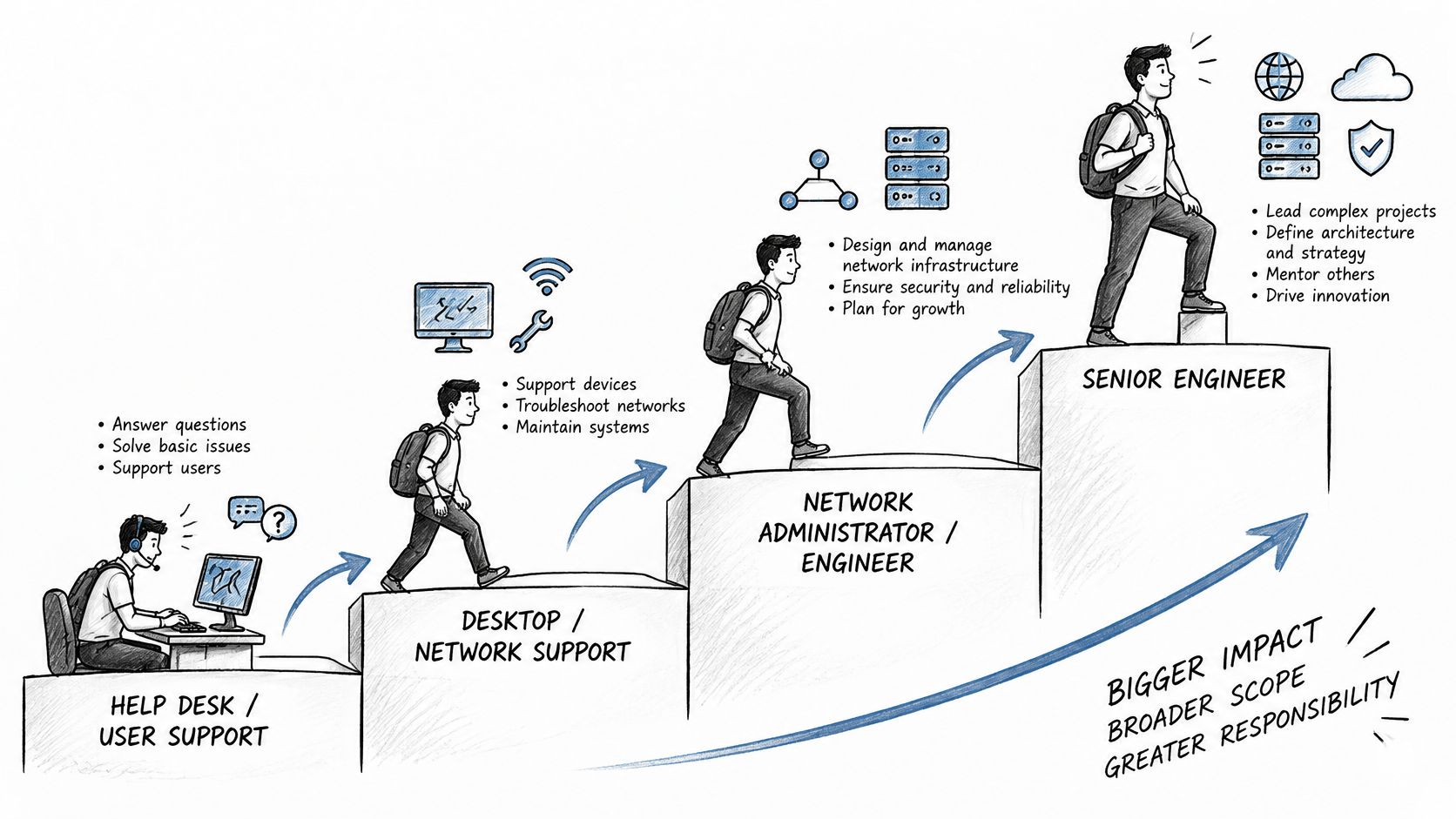
Almost nobody is hired straight into the network architect role. The usual path runs from help desk or network support to network administrator or engineer, then senior engineer, then architect. Mojolin's network architect page lists median pay of $134,050 in 2025, with the middle 80% of earners between $79,900 and $202,680, which shows how far the ladder extends beyond support pay.
The first move matters most for PC support specialist salary growth. Shifting from user support into network administration crosses from helping people use systems to running the systems themselves, and employers pay for that accountability. Mojolin publishes guides such as 'Entry-Level IT Jobs: Starting in Help Desk and Moving Up' and 'Are IT certifications worth it? When they help and when not' for readers planning that move.
The skill to add depends on the current rung. A help desk specialist gains most from networking fundamentals, while a desktop technician gains from scripting repeated fixes. Keeping a written record of scope taken on at each rung turns that growth into evidence for the next offer.
Use These Figures to Set Your Salary Expectations
A defensible personal number takes three steps.
- Choose the benchmark. Help desk and desktop work uses the $61,860 user support median, while network-heavy roles use the $62,890 broader figure. Titles without a published figure use the nearest benchmark.
- Adjust for the factors. Several years of scope, a credential such as CompTIA A+, or a high-cost metro can justify a target above the median. A first-year tier-one role in a rural area may reasonably sit below it.
- Set a range and state it early. The pay range should be shared early, on the first call with the candidate, anchored to the chosen benchmark. The low end should be a figure the candidate would accept.
That range should cover total compensation, so bonuses, benefits, and equity belong in the conversation before anyone settles on a number. Mojolin's tech salary negotiation guide walks through that discussion, and each role page on Mojolin compares that role's median pay against the other 13 roles Mojolin tracks. The median is a starting anchor, not a ceiling.
Mojolin publishes sourced pay, job count, and outlook data for technology roles, including the support occupations behind these benchmarks, with every figure linked to its source. Readers setting expectations for a PC support specialist salary can compare roles side by side and check certification pages before the first salary call. Visit Mojolin to explore the role pages and negotiation guides.