The U.S. benchmark for a Linux sysadmin salary is $99,130 a year, or $47.66 an hour, the May 2025 median for network and computer systems administrators. A job advertised with Linux in the title can sit below or above that figure because employers bundle the operating system with cloud platforms, automation, networking and security duties that change the value of the role.
That single benchmark is useful, but it isn't a Linux-only price. It covers a broad occupation, while a hiring manager prices a specific estate, a specific on-call burden and a specific set of consequences if a service fails. A candidate who quotes the benchmark without naming those differences risks anchoring too low for production ownership or too high for supervised work. The figures that follow separate the official occupation median, self-reported pay for the Linux title, advertised posting ranges and a UK government range, then show how experience and responsibility move a person inside each one.
Table of Contents
- Linux Sysadmin Salary Benchmarks for 2026
- Where the Pay Figures Come From and How to Update Them
- Pay by Years of Linux Experience
- How Job Scope Changes the Advertised Range
- United Kingdom Pay for Adjacent Network Roles
- Skills That Sit Beside Linux Pay
- Offer Checklist Before You Compare Pay
- Place Yourself in the Range and Set Your Anchor
Linux Sysadmin Salary Benchmarks for 2026
The most defensible starting point for a Linux sysadmin salary in the United States is the U.S. Bureau of Labor Statistics profile for network and computer systems administrators, which reported a median annual wage of $99,130 in May 2025, equivalent to $47.66 per hour for a full-time worker. That's the closest official occupational category to Linux systems administration, and it's the number a U.S. reader can quote today with a publisher and a reference date attached. The figures come from the Occupational Employment and Wage Statistics program, so they describe a surveyed labor market rather than a handful of adverts.
Context changes how that median should be read. The same BLS profile places the occupation below the $109,470 median for all computer occupations and almost twice the $50,980 median across all occupations. A systems administrator therefore earns well above the overall workforce, but the broad occupation doesn't sit at the top of computer work. That ordering matters in negotiation because a Linux role that has absorbed platform, cloud or security engineering duties may no longer resemble the middle of systems administration, even if HR keeps the older title.
Why the official figure is not a Linux premium
The BLS category includes administrators working with multiple operating systems, not Linux alone. It therefore works as a broad market benchmark, not as evidence that Linux knowledge adds a fixed premium. Employers increasingly combine Linux administration with cloud infrastructure, automation, networking, security or DevOps responsibilities, and each addition pulls the job toward a different pay comparison.
PayScale reported an average 2025 salary of $92,353 for people using the title Linux System Administrator, with an observed span of about $61,000 to $120,000. That average is a second view of the market, not a correction to the BLS median. A median from an employer survey and an average from self-reported title data answer different questions, so they aren't interchangeable. The BLS also identifies a bachelor's degree as the typical entry-level education for the occupation, which helps explain why the benchmark assumes more than hobbyist command-line familiarity.
| Figure | Amount | Source and date | Who is included |
|---|---|---|---|
| Occupation median | $99,130 a year ($47.66 an hour) | BLS OEWS, May 2025 | Network and computer systems administrators, all operating systems |
| All computer occupations median | $109,470 a year | BLS, May 2025 | Computer occupations as a group |
| All occupations median | $50,980 a year | BLS, May 2025 | Every occupation in the survey |
| Linux job-title average | $92,353 a year | PayScale, 2025 | People reporting the title Linux System Administrator |
| Reported Linux title span | About $61,000 to $120,000 | PayScale, 2025 | Observed low and high of those reports |
How a reader should use the benchmark
A candidate whose work matches the middle of the occupation, with production servers, routine troubleshooting, patching and service support, can treat $99,130 as the national reference point. A junior administrator, a worker in a lower-paying local market, or a person whose duties stop at account changes and supervised maintenance shouldn't expect the median to act as a floor. At the other end, a role that owns automation, availability or regulated security controls needs a scope argument, because the word Linux alone won't justify the top of a range.
The pay and job figures on Mojolin's role pages are US figures, which keeps them aligned with the BLS benchmark rather than a converted international estimate. Experience explains much of the movement inside the title, job scope explains why two adverts with the same title diverge, and UK readers need a sterling benchmark instead of a dollar conversion. Those three adjustments are where the headline number becomes a usable salary expectation.
Where the Pay Figures Come From and How to Update Them
Three kinds of evidence appear in Linux sysadmin salary research, and they don't measure the same thing. Mixing them produces a confident but false number. Separating them gives a reader a benchmark, a title-specific signal and a set of live examples, each with a clear limit.
The BLS Occupational Employment and Wage Statistics program surveys employers and codes workers to Network and Computer Systems Administrators. Its reference month here is May 2025, and it's published annually at national level and also by state and metro area. Only this source gives a population median for the occupation. Its wage table publishes 10th, 25th, 50th, 75th and 90th percentile columns, so a reader who needs a floor or ceiling for a state should read those rows for that geography rather than inventing percentiles from another dataset.
The three sources and the question each one answers
- BLS OEWS: A candidate asking what the broad U.S. occupation pays in the middle should start here, then check the state or metro row and the percentile columns before quoting a local range.
- PayScale title reports: A candidate asking what people who call themselves Linux System Administrator reported in 2025 gets a narrower signal, built from self-reported submissions and total compensation that includes tips, bonuses and overtime.
- Advertised ranges: A candidate asking what one employer is willing to publish for one vacancy gets an example of current demand, not an estimate for the occupation.
PayScale's experience figures rest on 34 salaries for workers with less than one year of experience and 229 salaries for workers with one to four years. Those sample sizes don't make the figures useless, but they do make the entry estimate more sensitive to who chose to report. A government employer survey and a self-selected title sample shouldn't be averaged together to create a supposedly better number.
Advertised ranges such as $61,324 to $95,680 and $52,000 to $94,000 belong to single employers. They show how a named bundle of duties was priced in a posting, and they can reveal which duties appear beside wider bands. They can't prove that the occupation's 25th percentile is the bottom of an advert or that its 90th percentile is the top. PayScale's observed span of about $61,000 to $120,000 carries the same warning. An observed low and high aren't official percentiles.
Check the reference month before quoting any figure, and label May 2025 as the latest data behind a 2026 article.
The refresh rule is simple. When a new OEWS release appears, replace the national median and then recheck the state and percentile rows, because local movement doesn't always match the national headline. When PayScale updates, note the new sample and whether the figure is salary or total compensation. When a posting is used, record the employer, duties and range together. A Linux sysadmin salary claim without source type, date and population is only a number looking for authority.
Pay by Years of Linux Experience
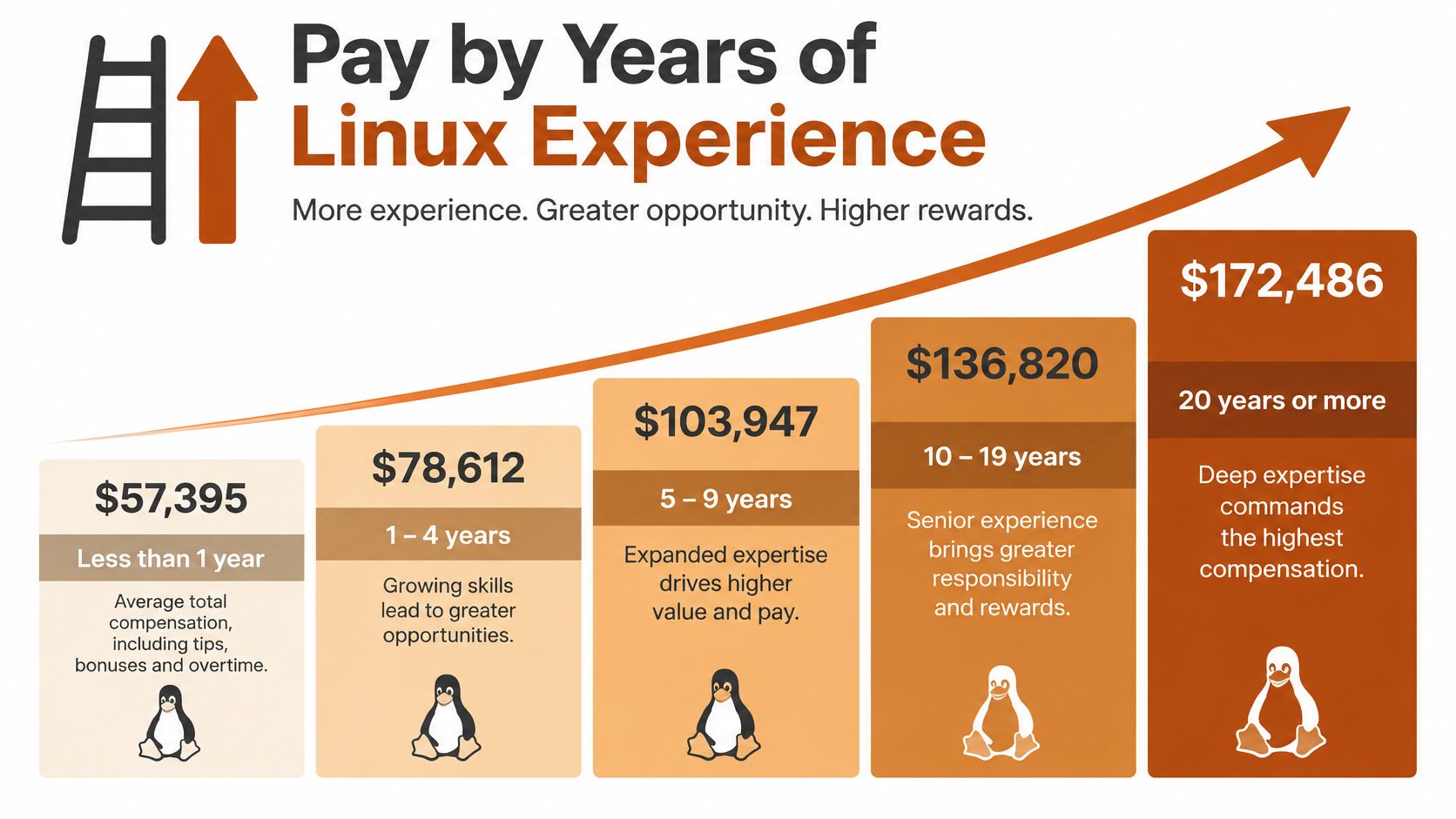
The climb inside the Linux title is steep in the first several years. The PayScale salary page for Linux System Administrator placed workers with less than one year of experience at $57,395 in average total compensation, including tips, bonuses and overtime, while workers with one to four years averaged $76,854 in total compensation. Both figures sit below PayScale's $92,353 average for the title overall, which is exactly what a reader should expect if longer-serving administrators pull the title average upward.
The gap between the first two bands is $19,459 by subtraction, and it reflects more than time served. Early production experience teaches an administrator how a change behaves under load, how to isolate a failing service and how to recover without creating a second outage. Employers pay for that judgment because the cost of a mistake rises with the importance of the systems involved.
The chart below shows the shape of that progression inside the title, with the earliest band as the starting step.
Sample size changes how firmly the bands can be used
PayScale cited 34 salaries for the entry-level estimate and 229 salaries for the one-to-four-year estimate. The early-career figure therefore rests on a broader set of reports, while the under-one-year figure should be treated as directional. Neither figure should be added to the BLS median, averaged with it or presented as an official floor.
| Experience | Average total pay | Sample | How to read it |
|---|---|---|---|
| Less than 1 year | $57,395 | 34 salaries | Entry reports; small sample |
| 1 to 4 years | $76,854 | 229 salaries | Early-career production work |
| All reported experience | $92,353 average; about $61,000 to $120,000 observed | Not stated as a percentile survey | Title average, not a BLS median |
A new graduate maintaining a small internal Linux estate, escalating unfamiliar faults and working under a senior administrator, maps most naturally to the under-one-year average. The work is real, but the employer still carries much of the risk. That reader shouldn't treat the title average as a first-year expectation.
An administrator with three years of on-call production work, patch ownership and troubleshooting across web, database and identity services maps closer to the one-to-four-year average. That person may still sit below the overall title average without being underpaid, because the title average includes administrators with much longer tenure and broader ownership. The important comparison is against the correct experience band, then against the duties attached to the vacancy.
The short video below gives a visual route into the experience discussion before the scope comparison that follows.
Years alone still don't settle pay. Two administrators can each report three years of experience while one resets accounts on a stable internal estate and the other owns automation, failover and incident response for customer-facing services. The second job carries more consequence, broader technical range and more unsocial hours. When the gap between two offers is driven by cloud, security or reliability duties rather than tenure, responsibility scope becomes the better explanation.
How Job Scope Changes the Advertised Range
A national median can't answer the practical question in most negotiations. Candidates need to know which extra duties appear beside higher advertised ranges, and which duties keep a role near the bottom of a posted band. The cleanest method is to classify the responsibility bundle before looking at the money.
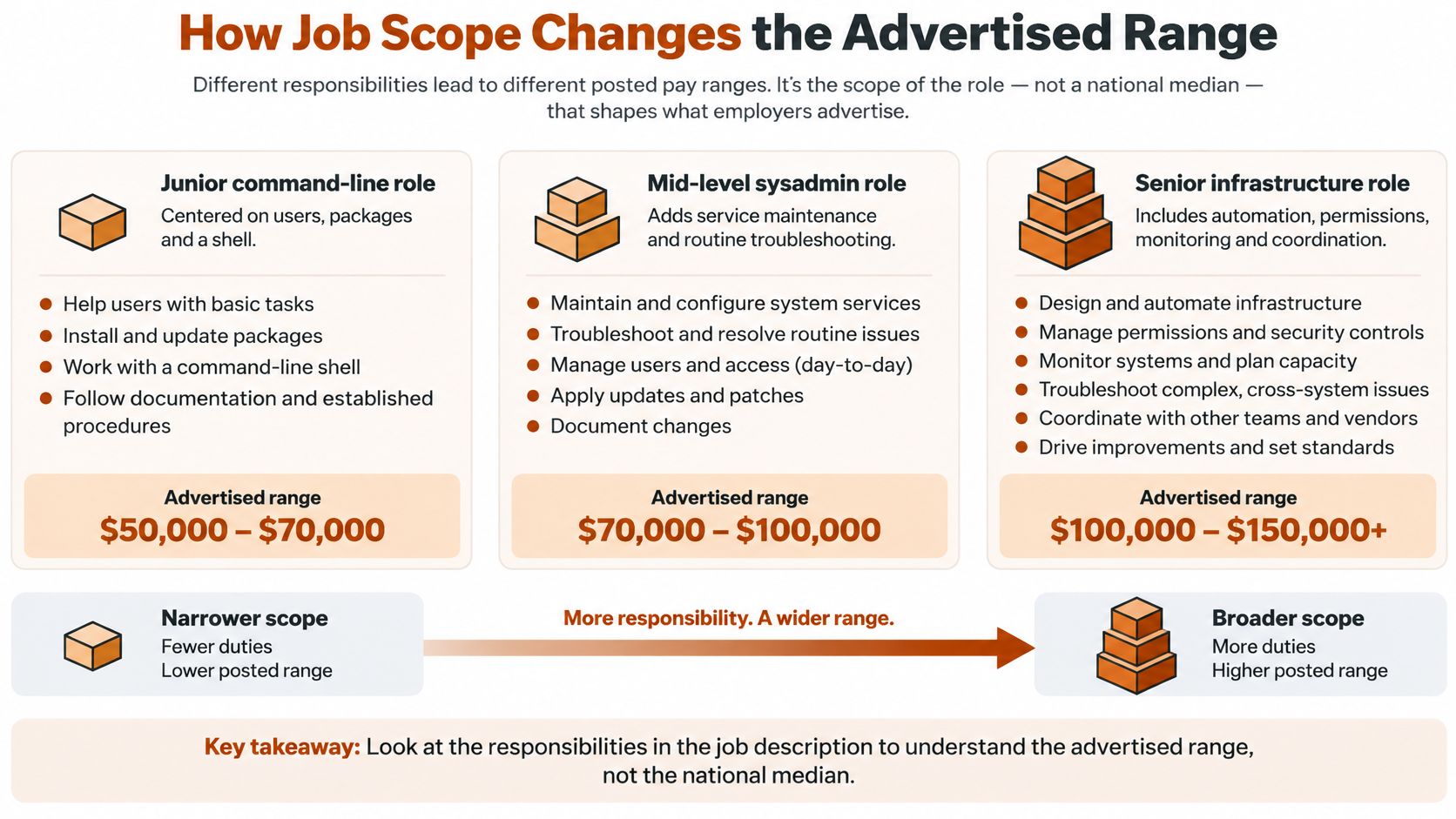
A supervised command-line role centers on users, groups, packages, patching and a small internal server estate. The administrator follows runbooks, escalates network or security faults and doesn't own service availability. That bundle sits toward the lower end of posted spans because the employer can train a junior worker into it and limit the blast radius of mistakes.
A standard operations role adds networking, name and address services, web and database support, scripting, monitoring and high availability. The administrator keeps services running rather than merely maintaining hosts. A regulated or mission-critical role adds security controls, compliance evidence, identity and access, failover design and incident ownership. That third bundle carries audit risk and business interruption risk, so it gives a candidate the strongest argument for the top of a band.
The diagram below stacks those responsibility levels so duties can be matched to a posting before a salary expectation is set.
Two posting examples, read as examples only
One U.S. posting on ClearanceJobs for a Linux system administrator listed $61,324 to $95,680 and requested Red Hat Linux, scripting, networking and information-security knowledge. Another advertised $52,000 to $94,000 while requiring infrastructure management, monitoring, failover, communications and availability responsibilities. Both ranges are wide because a single advert often has to cover more than one seniority outcome, and both name duties beyond distribution knowledge.
| Responsibility bundle | Duties named | Example posted range | What it is not |
|---|---|---|---|
| Supervised command line | Users, packages, patching, a small internal server estate | Lower portion of a posted span | Not a national median |
| Standard operations | Networking, DNS, web and database services, scripting, monitoring, high availability | $52,000 to $94,000 | One employer's posting, not a population estimate |
| Security-aware Red Hat operations | Red Hat Linux, scripting, networking, information security | $61,324 to $95,680 | One employer's posting, not a population estimate |
| Regulated or mission-critical ownership | Security controls, compliance, identity and access, failover, incident ownership | Upper portion of a posted span when those duties are named | Not a national median |
Single postings aren't population estimates and mustn't be averaged with BLS or PayScale figures. Their value lies in the pairing of money with duties. A reader can underline every accountability verb in an advert, such as own, design, lead, restore or evidence, and count how many services would degrade if the post stayed vacant.
Say two vacancies carry the same Linux administrator title. The first patches a lab fleet during office hours. The second owns production failover, access control, monitoring and incident command for a service customers use overnight. The second candidate can credibly argue for the top of the advertised band, while the first should expect a lower placement even with strong shell skills. If the difference is mainly years rather than duties, the experience bands are the better tool. If the duties differ, Linux sysadmin salary follows scope more closely than title.
United Kingdom Pay for Adjacent Network Roles
UK readers need a sterling figure from a UK source, not a dollar median run through an exchange rate. The National Careers Service profile for network manager lists approximately £30,000 for starters and up to £70,000 for experienced professionals per year. That adjacent category explicitly includes “network administrator” and IT manager, so it gives Linux administrators a government-published frame without pretending to be a Linux-only survey.
Placement inside that span should follow accountability. Supervised administration, routine patching, account work and escalation fit nearer the starter end. The upper end fits senior operational ownership, including designing resilient infrastructure, managing identity and access, implementing monitoring and backup controls, automating configuration or leading incident response. A Linux title by itself doesn't move a role to £70,000. Ownership of systems that must stay available and auditable does.
Keep the UK comparison in sterling
The pounds in this range shouldn't be converted into dollars and compared with the U.S. median. Taxation, benefits, labor-market conventions, and regional cost of living affect the actual value of compensation, and a currency conversion captures none of them. A relocating candidate should keep two columns, one for the United States and one for the United Kingdom, and negotiate inside the column where the job is based.
- Base salary: Compare the guaranteed annual amount first, in the currency of the payroll country.
- On-call and shift money: Separate premiums, overtime and shift allowances from base, because rota burden can differ sharply between similar titles.
- Bonus and pension: Record bonus terms, pension and other benefits beside base rather than folding them into a single headline.
- Accountability: Match resilient design, identity, backup, automation and incident leadership against the upper part of the range.
The same accountability test used for U.S. postings applies here, but the benchmark remains sterling. A UK administrator who owns a small office estate shouldn't borrow the top of the network manager span. A senior administrator who designs failover, controls privileged access and leads major incidents has a clearer case for it.
Readers comparing a move into broader network design can use the Mojolin network architect role page as a reminder that architecture is a different occupation from administration, with different entry expectations. That distinction protects a candidate from pricing an administrator vacancy as if it were an architect post. For UK offers, the practical question stays narrow. Which duties are owned, which payments sit outside base, and where does that bundle fall between £30,000 and £70,000?
Skills That Sit Beside Linux Pay
The two posted ranges in the scope comparison point to the same lesson. Employers rarely pay for a distribution name alone. They pay for accountable work beside Linux, and a candidate needs to describe that work with evidence a hiring manager can check.
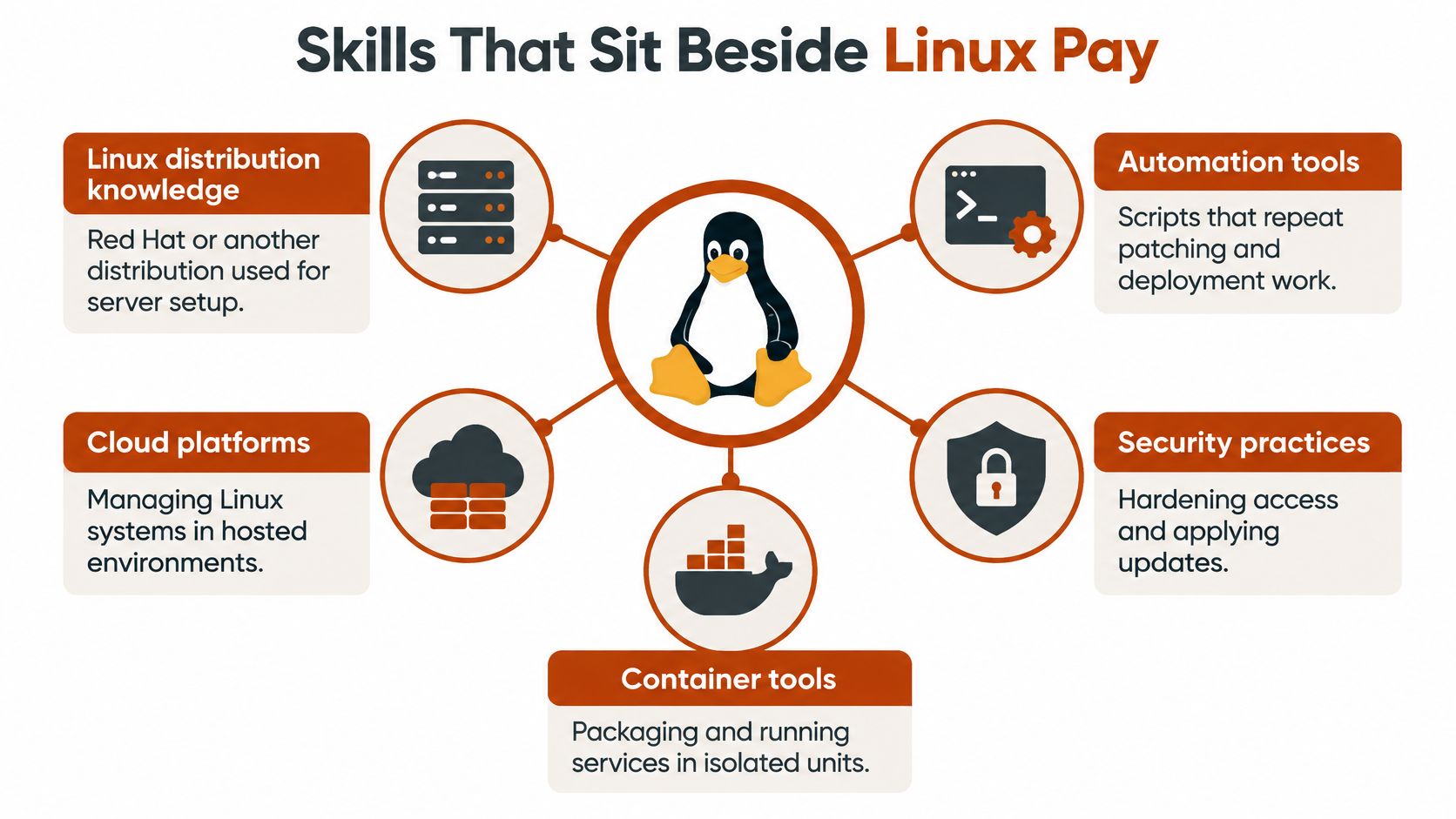
Linux distribution knowledge is the baseline. Red Hat Enterprise Linux, Ubuntu Server, Debian or another enterprise distribution covers installation, package management, users, permissions, storage, logs and service control. The verifiable artifact is a build standard or runbook that another administrator can follow. A strong sentence sounds like this. “This administrator maintains the Red Hat estate, keeps patching current across production hosts, and restores failed services from documented procedures.” That sentence names the estate, the duty and the consequence of absence.
The diagram below groups the main skill categories that sit beside the operating system.
Automation turns a task into ownership
Bash or Python automation moves an administrator from making a change by hand to owning that change repeatably. An Ansible playbook, a Terraform repository or a tested script that rotates logs, deploys configuration or rebuilds a host gives the hiring manager something concrete to inspect. The candidate sentence should name the tool, the number or type of systems touched and the failure prevented. “Manual patching became an Ansible workflow with rollback” carries more weight than a line listing Ansible beside ten other tools.
Containerization and cloud automation move the job toward platform work. Docker images, Kubernetes services, cloud networking, identity policies and infrastructure as code overlap with DevOps and site reliability roles. The artifact might be a repository, a pipeline or a documented recovery test. A candidate with under a year of production use should still map pay to the early experience band, because tool exposure in a lab isn't the same as carrying a live service.
Security, compliance and reliability carry visible consequence
Security and compliance work includes least-privilege access, privileged account control, patch evidence, hardening baselines and audit responses. A patch-compliance report or access review shows the work more clearly than the phrase security-minded. This category rises in value when a failure can trigger regulatory, contractual or customer harm.
On-call and reliability targets mean more than being reachable. A named service level, an on-call rotation, escalation authority and incident leadership define the burden. The artifact is a rota, an incident review or a runbook tied to a service target. A candidate sentence should state which service is protected, how often the phone rings in practical terms and who leads when recovery stalls.
Formal study can support that evidence, and the Mojolin RHCSA certification page is relevant where a posting names Red Hat system administration directly. A certificate still doesn't replace production ownership. Stacking tool names without systems, scale or consequences doesn't justify the top of a range.
Decision rule: Price the scope a candidate will be accountable for, not the length of the skills list.
The ranking follows consequence. Distribution knowledge opens the door. Automation proves repeatability. Cloud and container work widens the estate. Security, compliance, availability and incident ownership carry the clearest business risk, so a posting that names those duties should lead a candidate to open with that sentence rather than with the distribution name. UK candidates should describe the same ownership, then place it inside the sterling offer rather than translating the claim into dollars.
Offer Checklist Before You Compare Pay
A Linux sysadmin salary comparison fails when one offer is base pay and the other is a bundle of base, rota money and hoped-for bonus. The checklist below separates the parts that can be seen on a posting or offer letter, then matches the job to experience and scope. It doesn't create a new national median. It prevents a false one.
Separate the money before judging the title
- Base salary: Record the guaranteed amount and pay period first, with currency and country attached.
- Variable pay: Keep bonus, overtime, on-call premiums and shift allowances in separate lines, noting whether each is guaranteed, typical or merely possible.
- Retirement and benefits: Put pension or retirement match beside base, and name equity only if the offer names it.
- Location basis: Mark whether the comparison figure is U.S. national, a state row or a UK sterling range, and don't convert between countries.
- Required years: Place the candidate in the under-one-year band, the one-to-four-year band or the broader title population before arguing from an average.
Title needs the same care. A role called Linux administrator, systems administrator, DevOps engineer or platform engineer can involve the same servers, while two roles with identical titles can carry different risk. The duties decide the bundle. Supervised administration means runbooks and escalation. Standard operations means services, scripting, monitoring and availability. Security and availability ownership means access control, compliance evidence, failover and incident command.
Clearance requirements, night work and a named uptime target are scope, not decoration on a job advert.
Scope flags should be copied from the posting in plain words. A candidate should note whether the administrator can approve changes, restore production alone, speak for the service in an incident review or produce audit evidence. Each yes moves the comparison away from junior command-line work. Each no keeps the expectation nearer the supervised end, even when the advert lists fashionable tools.
One worked example
Say a U.S. offer shows $78,000 base, modest on-call pay and a requirement for three years of experience. The duties name Red Hat administration, monitoring and failover. That hypothetical base sits near the one-to-four-year total-pay reports once on-call money is counted, and inside the availability posting example, so the offer reads as ordinary rather than obviously low or high. The candidate's next question shouldn't be whether Linux deserves more in the abstract. It should be whether failover ownership, rota frequency and incident authority match the published duties.
A warning sign appears when several boxes show senior ownership and the base still sits near the entry figure for the title. Production accountability, security controls, a named uptime target and regular on-call work shouldn't be priced as supervised first-year administration. That's the point to negotiate, ask for the band in writing or keep looking. Conversely, a modest base for a narrow internal role may be fair once bonus, pension and limited rota burden are separated. The checklist makes that distinction visible before emotion attaches to a headline number.
Place Yourself in the Range and Set Your Anchor
A median means half of surveyed workers earned more and half earned less. It isn't an average pulled upward by a few very high earners, and it isn't a promise to every qualified applicant. The spread from the 10th to the 90th percentile is where early-career workers and lower-paying markets sit at one end and senior scope in higher-paying settings sits at the other.
Placement starts with the closest match, not the most flattering figure. A candidate with three years of production Linux, scripting and monitoring, but no people management and no regulated audit ownership, argues from the early-career band moving toward the overall title average. That profile doesn't support a staff-level outlier claim. It supports a solid production administrator claim, strengthened if the candidate can name the services owned and the incidents led.
Know what the national wage leaves out
BLS wages on Mojolin are national figures that exclude equity, signing bonuses and benefits, and they mix junior and senior people under one job title. A total offer can therefore sit above the median because bonus, overtime and on-call pay lift it, while base salary remains ordinary. The reverse also happens. A strong base with no rota payments may be better than a higher-looking package built from uncertain extras.
- Middle of the U.S. occupation: Use $99,130 when years, production responsibility and service scope match the broad middle.
- Under one year: Use $57,395 as the reported total-compensation reference, with the small sample kept in view.
- One to four years: Use $76,854 when the candidate carries early-career production work.
- Top of a posted band: Reserve that anchor for security, compliance or availability ownership named in the duties.
- United Kingdom: Place the role inside £30,000 to £70,000 by the same ownership test, kept in sterling with no invented city adjustment.
The employer's range should be requested before a candidate states a personal range, a point covered practically in the Mojolin tech salary negotiation guide. The candidate also has to decide whether the anchor is base salary or total compensation, because those are different conversations. A single written sentence prevents drift. It should name the source, the reference month or year, the figure and the scope reason, for example a May 2025 BLS median matched to production ownership rather than supervised support.
Each role page on Mojolin compares that role's median pay against the other 13 roles Mojolin tracks, which helps a candidate recheck whether a Linux vacancy has drifted toward network, platform or management work. Mojolin also publishes guides such as 'Entry-Level IT Jobs: Starting in Help Desk and Moving Up' and 'Are IT certifications worth it? When they help and when not' for readers deciding whether the next step is experience, certification or a title change. The anchor taken into the call should be one sentence, sourced and tied to accountable scope. A Linux sysadmin salary becomes negotiable when the number, the population behind it and the duties in the job all point to the same place.
Use Mojolin to compare the Linux sysadmin benchmark against the other technology roles Mojolin tracks, then recheck the source date, percentile and role scope before setting a salary expectation. Candidates and hiring teams can use its sourced pay pages, certification comparisons and negotiation guidance to turn a headline median into a defensible offer conversation.