The email lands on a Tuesday afternoon, or the recruiter calls while you're still at your desk. The role sounds right, the number looks fine, and the instinct is to say yes before anyone changes their mind. That rush is how people lock in a package they haven't read.
How to respond to a job offer is a short written process, not a yes on the phone. The salary line is only one term. Bonus rules, equity vesting, remote days, probation, and clawbacks decide whether the job is livable a year from now. The risk isn't asking for a change. It's accepting, or resigning, before those terms exist in a document you can check.
Table of Contents
- The Five-Step Response Sequence
- Acknowledge the Offer Without Committing
- Compare the Whole Package, Not Just Salary
- Choose Between Accepting, Negotiating and Declining
- How to Make One Counteroffer
- Accept or Decline in Writing and Take Your Next Step
The Five-Step Response Sequence
Treat the offer as a package with a deadline. Many candidates accept without negotiating, often because the first number feels safer than a short pause. The cost is rarely the ask itself. The cost is signing before bonus rules, vesting, benefits, location, probation and notice terms are written down clearly enough to check.
Use this default timeline unless the employer has already set a shorter clock.
| Step | Timing | What to Do |
|---|---|---|
| Acknowledge the offer | Within 24 hours | Thank the recruiter, confirm your interest, and ask for the written offer and a review period |
| Request the full package | Days 1 to 2 | Ask in writing for base pay, bonus, equity, benefits, start date, location, probation and notice terms |
| Benchmark and rank gaps | Days 2 to 4 | Compare the total package with market data and your alternatives, then rank gaps by value |
| Make one counterproposal | By day 5 | Send one request for the highest-value gap, with two or three reasons and a response date |
| Confirm the revised offer | Before resigning | Get every agreed change in a revised written offer, and sign only after it arrives |

Why the order matters
Acknowledgement buys the review. The written package shows the terms a verbal summary skips: how bonus is calculated, when equity vests, what benefits cost, where the job can be done, and which resignation date is realistic. Benchmarking then tells you which gap is worth the one ask, so the counterproposal lands as a business case rather than a wish list.
The final step is the control point. A promise made on a call is easy to misremember and hard to enforce; the revised offer is the only version to sign and the only version to resign against. If the deadline is shorter than five days, ask for more time in the first reply. Do not compress the analysis into an evening and then invent a number.
Do this today: Write down the employer's deadline, the start date you can actually meet, and the three terms you most want to see in writing.
If you are still mapping how offers fit a longer search, Mojolin's getting hired guide sits next to this sequence as a practical companion while you read the document in front of you.
Acknowledge the Offer Without Committing
The first reply is a holding move. It is not a decision, and it is not a negotiation. Four parts belong in it: thanks, genuine interest, a clear statement that you're reviewing the full package, and the date you will answer by.
A note like this is enough:
Thank you for the offer for the senior analyst role. I'm very interested. May I review the written terms, including base pay, bonus, equity, and benefits? I'll send a decision by Friday, March 20.
Hiring runs on weeks, not days, and employers plan around that. A few days to read a written package is a normal request inside that timeline. What they need from you is a date. Open-ended silence damages goodwill more than a firm answer ever does, and "I'll get back to you" with no deadline reads as low interest even when it isn't.
Ask what the process still includes
Candidates should be told the whole hiring process at the start, including stages, length, and expected timeline. If the recruiter never did that, ask now. Remaining steps often include background screening, references, work authorization, a probation clause, or a start-date constraint, and any of them can change what the offer means. Send one question: can they share the full written offer and list every contingency that still applies?
If the offer arrives by phone, don't discuss a figure yet. Ask for the written offer and say you'll reply once you've read it. Accepting on a call creates a commitment, and pulling terms back after that is far harder than asking for them up front. The written version is where base pay, bonus mechanics, equity, and benefits become real numbers instead of verbal summaries, so treat the document as the offer and the phone call as a preview.
If another offer is real
State a pending offer accurately and ask for a specific extension. Never invent a deadline or a competing number. Give the date you can keep, then keep it.
Recruiters do not always reply fast, and plenty of candidates wait days to hear anything at all. A same-day acknowledgment with a named decision date stands out for exactly that reason.
Compare the Whole Package, Not Just Salary
Read the offer as eight parts, not one number. Confirm each part in writing before you rank anything.
| Component | Confirm in Writing | Question to Ask |
|---|---|---|
| Base salary | Figure, pay frequency and next review date | When is the next pay review, and what criteria apply? |
| Bonus | Target percentage, payout rules and eligibility start date | Is the bonus pro-rated for a mid-year start? |
| Equity | Grant size, vesting schedule, cliff and exercise window | What is the vesting schedule, and how long do I have to exercise after leaving? |
| Benefits | Health premium share, retirement match and paid time off days | What will I pay per month for the plan I would actually use? |
| Start date and probation | Start date, probation length and notice period | Is there a probation period, and what does it cover? |
| Location and remote rules | Office days and remote policy | Is the remote arrangement written into the offer? |
| Title and promotion path | Title, level, promotion criteria and timing | What must happen for promotion, and by when? |
| Sign-on and relocation | Amount and repayment terms | Is there a clawback if I leave within the first year? |
How to price what isn't cash
Public pay data is a starting point, not a verdict. BLS wages on Mojolin are national figures that exclude equity, signing bonuses, and benefits, and they mix junior and senior people under one job title. A salary that looks strong against a national median can still be thin once premiums, a cliff, and a bonus that rarely pays in full are counted. Role pages such as Mojolin's tech salaries by role are useful for that base comparison, then you have to add the terms those wage figures leave out.
Price the package in four passes:
- Equity: Convert the grant with a conservative share-price estimate, then discount it for vesting risk and the chance you leave before the cliff.
- Benefits: Use the monthly premium you would pay, plus the retirement match you will receive, not the brochure maximum.
- Time: Treat extra vacation or remote days as hours you keep each year, and decide what those hours are worth to you.
- Bonus: Count a realistic payout, not 100% of target, unless the plan has paid at target for people in this role.
Say one offer pays a few thousand dollars more in base, but the bonus depends on company targets and the equity vests over four years with a one-year cliff. A plainer offer with faster vesting and a written three-day remote week can be worth more in the first two years, especially if you might move again. Rank the three largest gaps between the written package and your benchmark before you call the recruiter. That ranking is what the counterproposal is for.
Choose Between Accepting, Negotiating and Declining
The right reply is the one that matches the gap. Salary gets attention because it is easy to compare, but the safer test is whether the written package clears your floor and leaves room for the life you want.
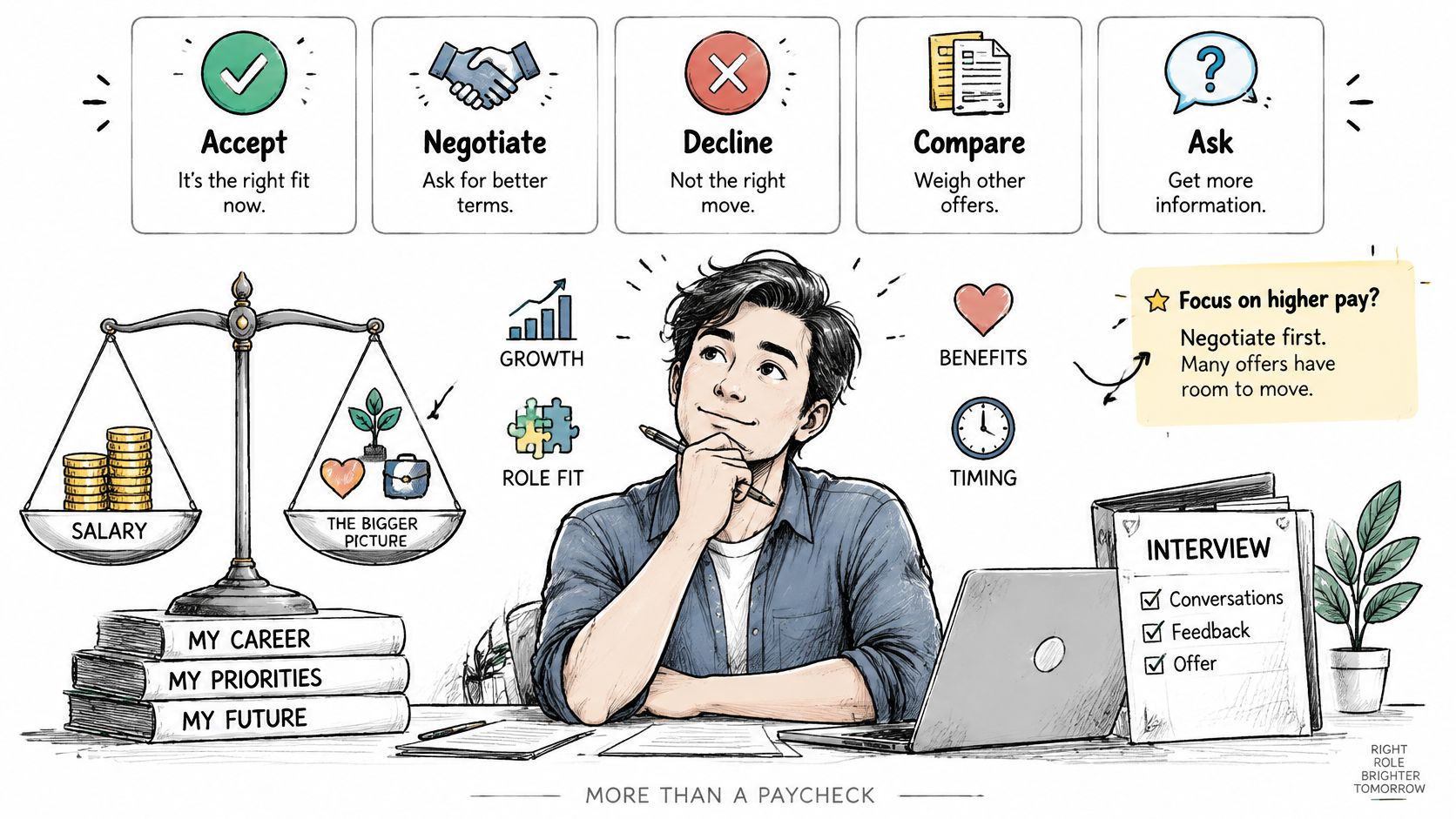
| Situation | Best Response | Next Step |
|---|---|---|
| Offer meets your minimum on every term | Accept after the revised written offer arrives | Sign and confirm your start date |
| Salary is fine but one term is weak | Negotiate that term rather than salary alone | Send one counterproposal with a response date |
| Salary band is fixed | Trade for flexibility, title, review timing or learning budget | Ask whether remote days or an earlier review can substitute |
| Another offer is pending | State it accurately and ask for a specific extension | Give a decision date and keep it |
| Still below your minimum after one counter | Decline courteously in writing | Send a short decline that thanks the employer and keeps the door open |
Gartner HR research from a 1Q25 survey found that 53% of candidates prioritized higher compensation when accepting an offer, while 47% considered career growth, 45% work-life balance, 39% better working conditions, and 39% opportunities to learn new skills. Pay leads, and the rest still decides whether the offer fits.
Build a minimum acceptable package
Split the decision into must-haves and trade-offs. Must-haves are few. A base floor you can live on, a start date you can meet, and a remote policy written into the offer are typical. Trade-offs are the rest: a smaller sign-on, a title one level lower, or a bonus that pays later. Put every must-have in writing before you decide. A spoken promise is the risk to manage, and the written offer is what you hold.
When the band is fixed, stop pushing base pay. Ask whether remote days, an earlier review, a title change, or a learning budget can stand in for cash. For some people, keeping time, autonomy, or health is worth more than a higher base. That is pricing the year you will live.
A short walk-through of how candidates frame that choice:
If one counterproposal still leaves the package under your floor, decline in a short note. Thank them, state the decision, and do not reopen the talks later. Then apply a plain test: would you still be glad to hold this role at this pay in two years? If the answer changes only because the offer is in hand, the gap was real.
How to Make One Counteroffer
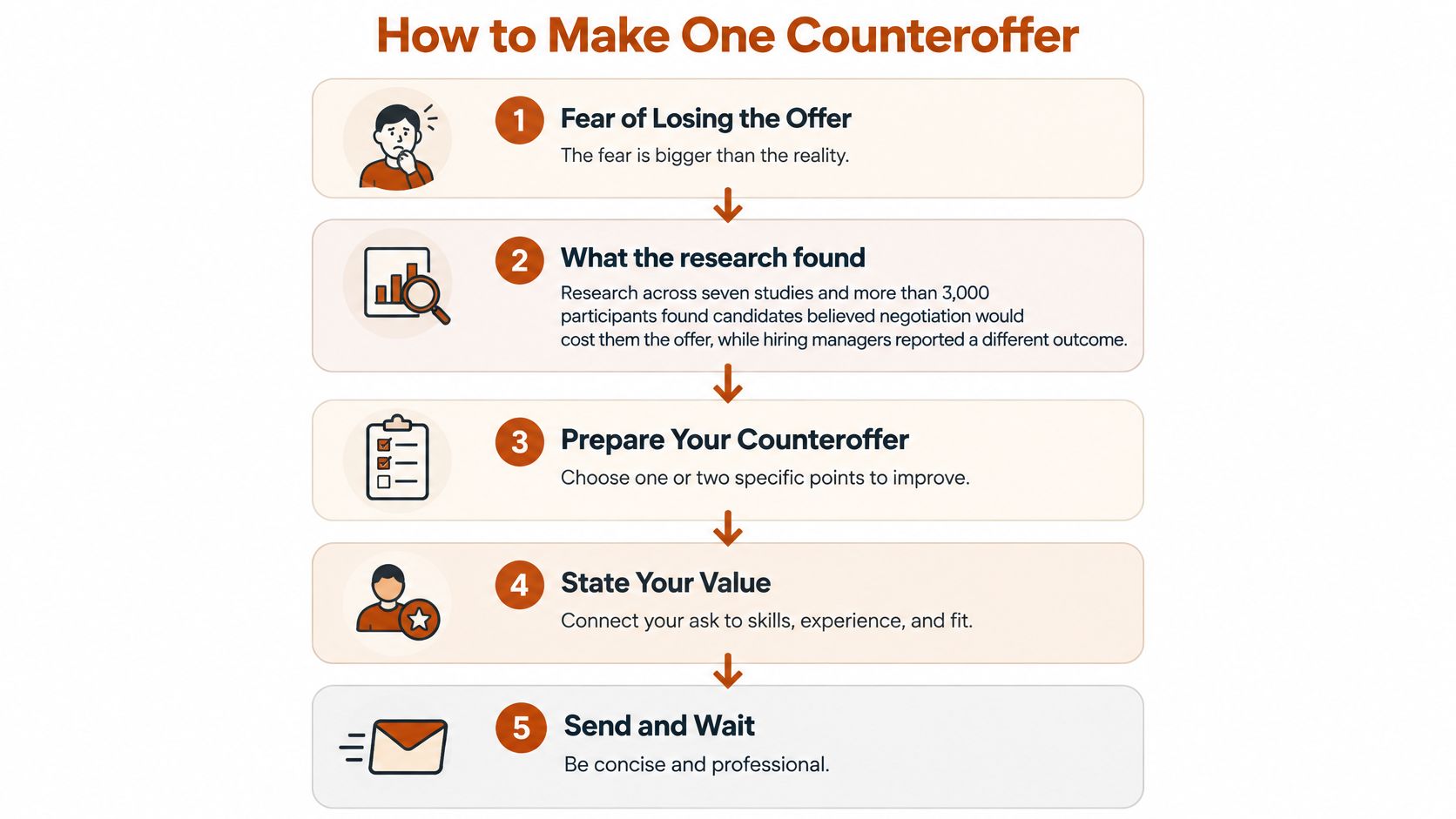
The fear of losing the offer is larger than the record. Research involving seven studies and more than 3,000 participants found candidates believed negotiation was likely to cost them the offer, while hiring managers reported withdrawing only 1.73 offers after negotiating out of an average of 26.9 offers extended during their careers, as covered by Phys.org. A related experiment with nearly 1,500 employers found approximately 6% of offers had been withdrawn overall. Professional negotiation is usually safer than people assume. Adversarial language, bluffing, and endless small asks are what create trouble.
The pay range should be shared early, on the first call with the candidate. If it wasn't, ask for it before you name a number, and use that band as the anchor.
One request, then stop
- Set a target and a walk-away point before the call, and don't invent either during the conversation.
- Open with appreciation and say you want the role.
- Ask for the single highest-value gap, often base pay, with two or three objective reasons: scope, scarce skills, or market evidence.
- Offer a trade, such as a sign-on bonus or an earlier review, if base pay can't move.
- Ask how the request will be evaluated, and agree a response date.
- Put every agreed change in the revised written offer. A verbal yes is not a term.
Harvard Kennedy School research in that same set of findings reports that women can face greater social penalties for initiating negotiation, with the negative hiring effect more than twice as large for women as for men in one set of experiments. Frame the ask around role scope and market value, ask how it will be judged, and document every change. Don't lean on personal expenses, and don't bluff a competing offer.
Mojolin's pay negotiation guide is the place to build the market reasons behind that single ask. Repeated incremental counters, unsupported demands, and assurances that never enter the contract are the failures to avoid. If the answer is no, compare the full offer with your walk-away point and decide once.
Accept or Decline in Writing and Take Your Next Step
Sign only after the revised written offer matches your notes. A verbal promise is not a guarantee, and resigning on one is the mistake that is hardest to undo.
Check these six points
- Match the deal: Base pay, bonus, equity, start date, and location should read exactly as agreed.
- Read the conditions: Background screening, references, work authorization, probation, and termination language all belong in that read.
- Flag the traps: Restrictive covenants and clawbacks need a slow read. Have an employment lawyer review unfamiliar clauses or equity documents before you sign. Mojolin's hiring guide is not legal advice.
- Accept in email: Quote the role title and the agreed start date so the record is specific.
- Decline cleanly: Thank the employer, state the decision in a sentence, and leave the relationship intact.
- Resign last: Tell your current employer only after the new offer is signed.
Mojolin publishes guides on getting hired, choosing a career path, negotiating pay, and running a fair hiring process. The next negotiation starts with a salary anchor built from pay percentiles and your own market evidence, not from the number you happened to accept this time.
Close your notes with one line you can stand behind: accepted, negotiated, or declined, and the reason. That line is the decision. The signature is just how you make it real.
Mojolin publishes practical references on technology pay, certifications, and hiring so you can compare a written offer with real occupational figures before you sign. Use those role pages and negotiation guides when you set a base floor, price equity and benefits, and decide which single term to ask for. Visit Mojolin and check the pay and hiring guides before your decision date.