Computer programmers have median annual pay of $100,390 versus $134,040 for software developers, but the practical distinction is scope: programmers concentrate on implementing code, while software engineers typically take responsibility for designing and operating the system around it. The titles overlap, so a computer programmer vs software engineer comparison is useful only when the duties match the occupational benchmark.
The important question isn't whether an employer uses the word engineer. It's whether the person receives a design to implement or has the authority and responsibility to decide what should be built, how it should behave, and what happens after release.
Table of Contents
- Computer Programmer vs Software Engineer Side by Side
- Classify Real Vacancies and Score Candidates
- Lifecycle Ownership from Requirements to Operations
- Real Teams and Which Role They Actually Need
- What Generative AI Changes About Both Roles
- Choose the Seat That Matches the Work
Computer Programmer vs Software Engineer Side by Side
The Bureau of Labor Statistics distinguishes occupations by work, not by the prestige of an employer's title. Computer programmers write, modify, and test code and scripts; software developers design computer applications or programs, according to the BLS computer and information technology occupational guide, which reports median annual wages of $100,390 and $134,040, respectively.
That's a $33,650 gap, approximately 33.5% relative to the programmer median, calculated from those BLS wages. It isn't a promotion schedule or a promised raise for changing a résumé heading.
For an employer's software-engineer position, software developer is the practical BLS benchmark when the duties include application or systems design. BLS doesn't present software engineer as a separate occupation in this comparison, so treating every engineering title as a distinct statistical category would create precision the classification doesn't support.
Programmer and software developer comparison
The employment counts below come from the BLS annual-average employment table for 2024: 334,000 computer programmers and 2.077 million software developers. Wage and education entries follow the occupational guide; the outlook row keeps the comparison on a single projection window.
| Criterion | Computer programmer | Software developer or engineer |
|---|---|---|
| Primary BLS work | Write, modify, and test code and scripts | Design computer applications or programs |
| 2024 employment | 334,000 | 2.077 million |
| Median annual wage | $100,390 | $134,040 |
| Gap versus programmer median | Baseline | $33,650 higher, about 33.5% |
| Projected employment change, 2025 to 2035 | Decline 7% | Growth 10% |
| Typical entry education | Bachelor's degree | Bachelor's degree |
Separate projection window: the BLS analysis of artificial intelligence, information technology, and employment projects 15.8% software-developer employment growth and 267,700 additional jobs for 2024–2034. That figure belongs to that period, not to the table's later projection window, and shouldn't be averaged with it.
What the comparison establishes
The defensible conclusion is narrower than the familiar claim that engineers earn more because they're better programmers. Software development is the larger, higher-paid occupational category, and its published outlook points in the opposite direction from programmer employment.
The software developer role profile is the relevant starting point for comparing a position that includes design responsibility. A posting centered on implementing supplied specifications deserves a closer comparison with programmer work, whatever appears in its title.
Pay interpretation: An occupation median describes a group of workers. It doesn't price a particular vacancy or measure an individual's ability.
Location, experience, specialization, and employer still affect individual compensation. A programmer maintaining a difficult business-critical system can earn more than a software engineer elsewhere, and the national medians don't contradict that possibility.
The employment counts also shouldn't be treated as interchangeable with a projection's baseline. They describe annual-average employment in a particular statistical table, while projections answer a different question about anticipated occupational change.
Classify Real Vacancies and Score Candidates
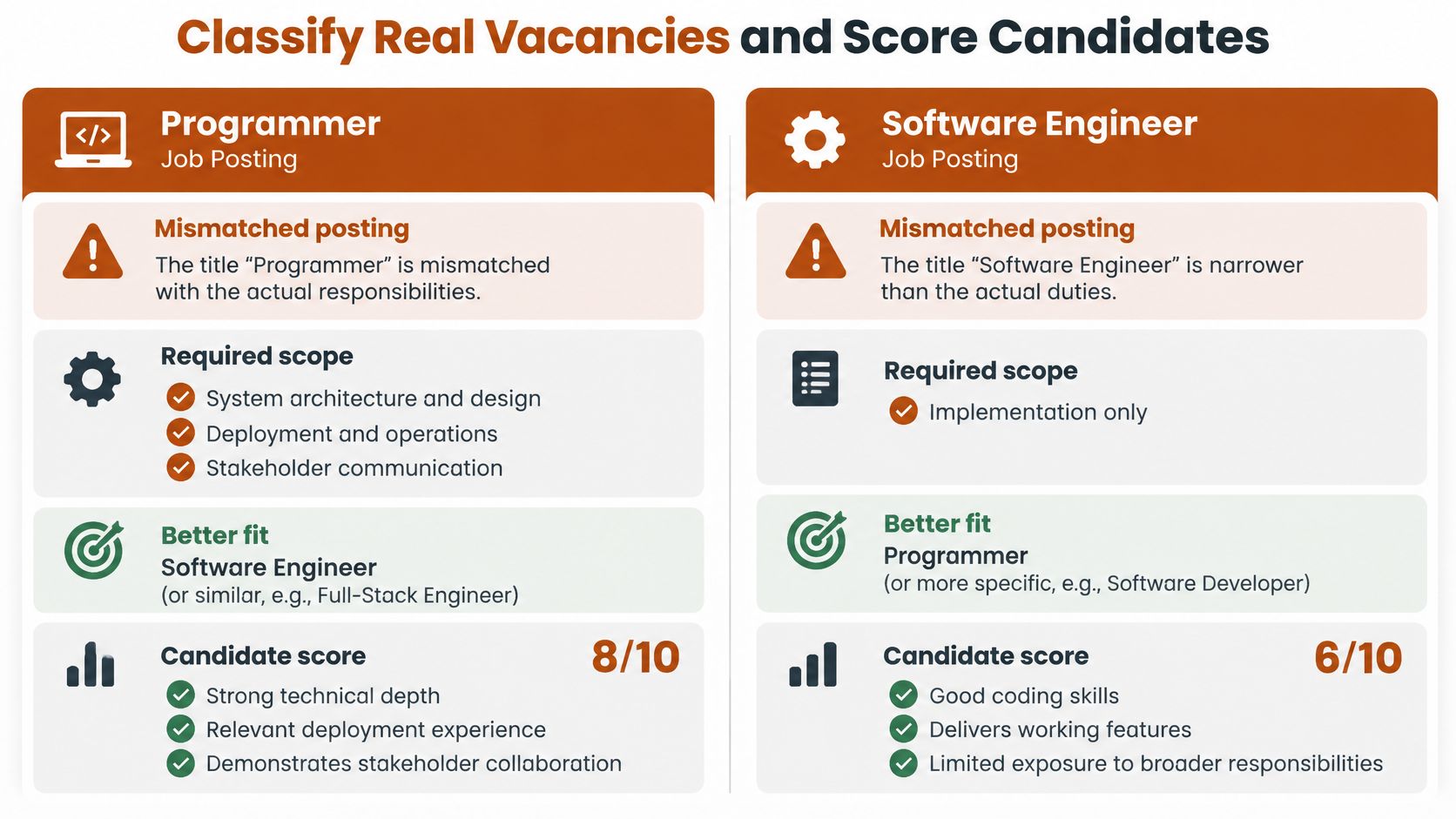
A programmer posting requires architecture decisions, deployment ownership, and meetings with business stakeholders. A software-engineer posting beside it lists duties that consist entirely of implementing approved tickets.
The first employer is requesting broader engineering responsibility under a programmer label. The second is offering a narrower implementation position under an engineering label. Neither title tells a candidate which comparison is appropriate.
This mismatch is easier to see when the title and required scope are placed alongside each other.
Classify the decision rights
A vacancy becomes clearer when the hiring manager answers these questions:
- Who writes requirements? Receiving acceptance criteria is different from interviewing stakeholders and resolving contradictory requests.
- Who can reject a design? A person accountable for reliability needs permission to challenge an unsafe or unmaintainable approach.
- Who remains accountable after release? Deployment, incident response, and subsequent maintenance reveal whether ownership extends beyond a merged change.
Engineer isn't a universally regulated job title across countries. Candidates should check local conventions and the employer's actual expectations rather than assuming the label guarantees a particular professional status.
The BLS software developers occupational description supplies the outlook comparison used here: software developers are projected to grow 10% from 2025 to 2035, while computer programmers are projected to decline 7% over the same window.
A shrinking occupation still produces vacancies when workers leave or retire. Projected contraction does not mean every current position disappears, and it says nothing about whether a specific employer is hiring.
Turn the vacancy into an assessment
Mojolin's hiring guidance puts capability definition before interview format: list the four to six capabilities that separate someone who will do well in the role from someone who will struggle. A guide to writing technical job descriptions can help keep the advertisement aligned with those capabilities rather than an inflated title.
For an implementation-focused seat, assess correctness, debugging, test quality, and the ability to finish a defined change. For broader ownership, add system decomposition, interface choices, failure analysis, and operating trade-offs. The capability list decides which interview stages are worth running at all.
A typical mid-level or senior engineering hiring loop starts with a 30-minute recruiter or manager screen. That conversation should establish scope fit before a candidate invests in a technical exercise.
The exercise then needs explicit scoring criteria. A candidate who identifies an ambiguous requirement should receive credit when clarification is part of the job, rather than a penalty for failing to rush into code.
A scorecard records why the candidate fits the work. An unwritten impression cannot be checked later.
Keep scorecards as the record of why each hiring decision was made. Reject the word engineer, a computer-science degree alone, and raw lines of code as substitutes for demonstrated capability: none answers whether the candidate can make the decisions this vacancy requires.
Lifecycle Ownership from Requirements to Operations
The most useful technical distinction is scope, not the number of programming languages someone knows. A programmer can have exceptional implementation expertise without being responsible for selecting the system's architecture or accepting its operating risks.
The BLS computer programmers description places writing, modifying, testing, and correcting code at the center of programmer work, while also noting that programmers may perform design work in some organizations. That caveat prevents a rigid separation between people who think and people who type.
Who owns each stage of the work
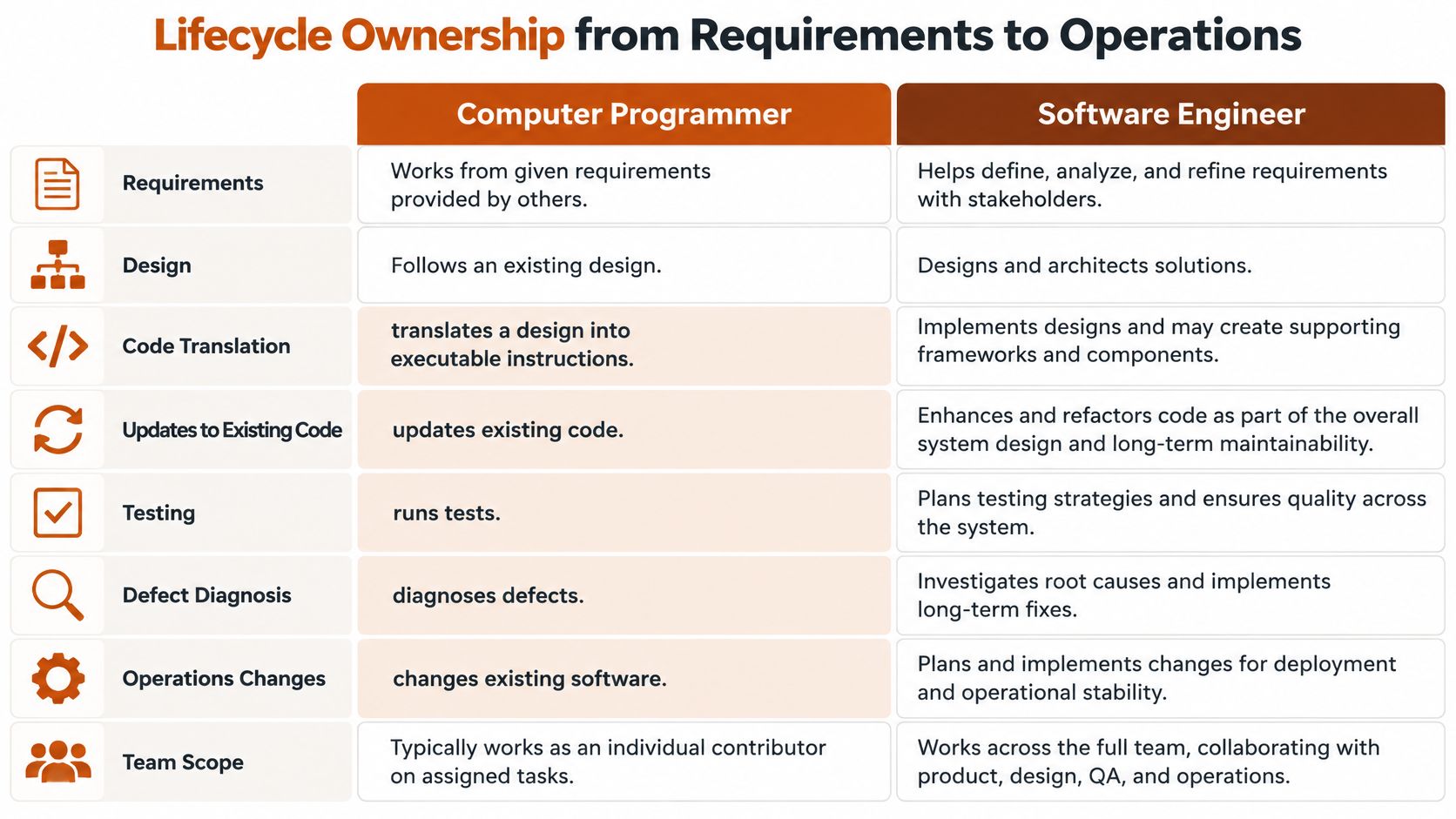
Software engineering applies engineering, scientific, and mathematical methods across the product lifecycle. The table describes a useful allocation of responsibility, not a rule that every employer follows.
| Stage | Computer programmer | Software engineer |
|---|---|---|
| Requirements | Usually receives a specification | Elicits requirements and writes the specification |
| Architecture | Follows a design and may design locally | Decomposes the system and sets interfaces |
| Construction | Primary work is writing, updating, and fixing code | Builds and reviews while keeping the design buildable |
| Verification | Runs tests and diagnoses defects | Defines validation and acceptable failure behavior |
| Release and operations | Often hands off after the change merges | Owns deployment, monitoring, and later change |
The distinction doesn't imply that engineers stop coding. It means their implementation choices must remain consistent with requirements, dependencies, and operating constraints that extend beyond the component being edited.
A refund change exposes the boundary
Say a payments application needs a revised refund rule. The programmer's assignment could be to implement eligibility logic, update the relevant endpoint, and fix failing regression tests against an approved specification.
The engineering assignment starts with questions the specification may not answer. What happens if the customer retries after a timeout? Can a refund succeed at the payment provider while the application records a failure?
Idempotency prevents a repeated request from causing an unintended duplicate action. The engineering owner must decide how a request is identified, how its result is stored, and how retries behave when an external service returns an uncertain result.
Audit logging and rollout also belong in the decision. A release plan should identify what gets recorded, which signals reveal incorrect behavior, and how the team can disable the change without losing the ability to reconcile transactions.
Those are concrete work products, not evidence of a more impressive title. The programmer may contribute to all of them, but the employer needs to identify who has final responsibility.
For assessment, request a component plus an explanation of its complexity, interfaces, tests, failure behavior, and operating plan. Judge implementation quality separately from the candidate's ability to connect those artifacts into a maintainable system.
That standard travels across countries more reliably than job titles. It describes what someone produces and owns, without assuming a national naming convention.
Real Teams and Which Role They Actually Need
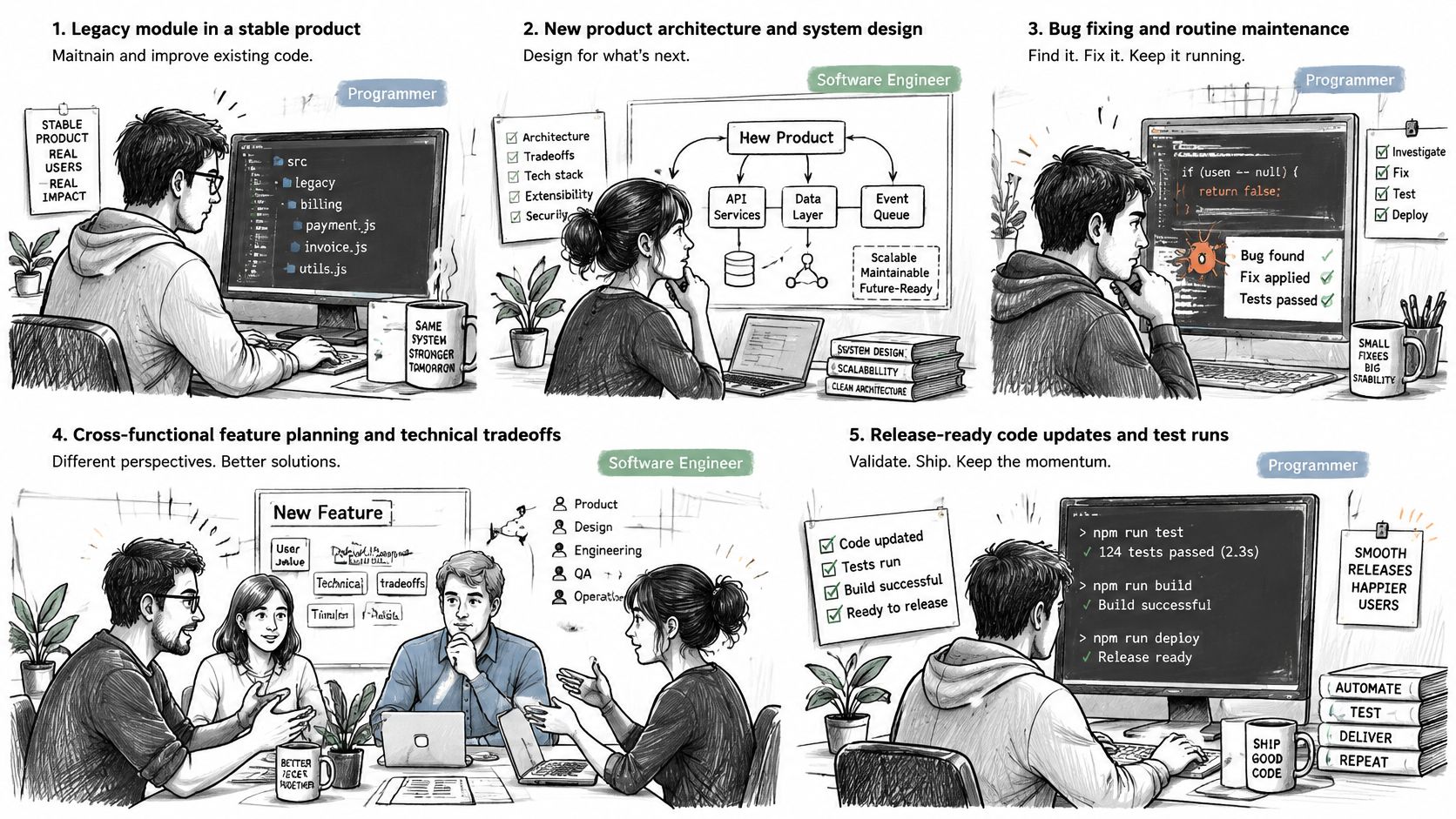
A legacy module inside a stable product is a sensible place for a programmer brief. If the architecture, interfaces, acceptance criteria, and release process already exist, the immediate need may be accurate changes, defect diagnosis, and regression tests rather than another person redefining the system.
The illustration separates daily implementation tasks from broader professional responsibilities.
Stable work and unresolved work
A new product surface with unclear users needs an engineering brief. Someone must turn competing requests into requirements, choose boundaries, and decide which operating risks the team will accept. Hiring only for implementation leaves those decisions unassigned.
For a small startup where the same person performs both kinds of work, the title contributes little to workload planning. The useful document separates committed ticket work from unresolved system decisions, so delivery deadlines don't crowd out design and release preparation.
Internal tools at a non-software company can support a programmer-focused position when another team owns hosting, access control, backups, and the chosen stack. If those responsibilities have no owner, describing the vacancy as simple scripting understates the job.
The difference can be checked through concrete conditions:
- Legacy maintenance: An approved specification and established release owner support an implementation-focused hire.
- Startup delivery: Unresolved product decisions require protected time and authority, even if the same person also writes every change.
- Internal tooling: A named infrastructure owner makes the boundary credible; an assumed owner doesn't.
Platforms and high-consequence changes
Platform and developer-experience work calls for engineering ownership when other teams depend on the resulting system. A deployment service or shared authentication component needs explicit compatibility rules, recovery behavior, and a support model, not just a completed implementation.
For another perspective on how these roles are described, the embedded video provides a supplementary comparison.
In payments or health-software scenarios, a hiring manager should give particular weight to failure analysis, traceability, and monitoring. That's a recommendation about assigning responsibility, not a claim that a particular title automatically satisfies regulatory requirements.
A fast implementation doesn't settle what happens when a dependency fails or an operator must investigate a disputed result. The role definition should name the person authorized to delay release when those questions remain unanswered.
The practical checks are straightforward: Does a usable specification already exist? Is there a named on-call or operating owner? Can the person refuse a design that fails the agreed constraints? The answers reveal the team's missing responsibility more clearly than its preferred title.
What Generative AI Changes About Both Roles
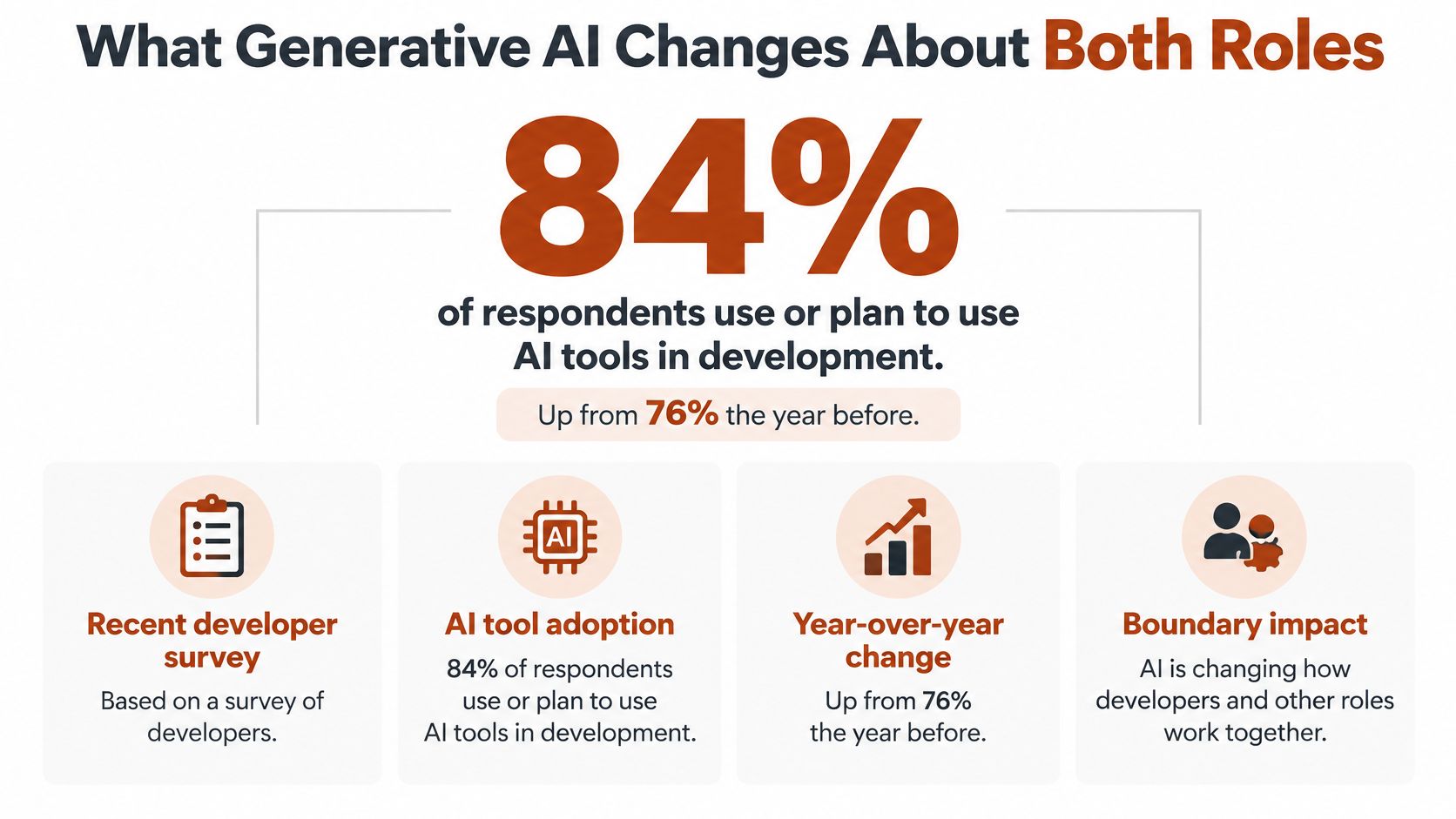
In the 2025 Stack Overflow Developer Survey, 84% of respondents used or planned to use AI tools in development, while 46% distrusted the accuracy of AI output. Those findings describe adoption alongside skepticism, not adoption as proof of trust.
The adoption figure captures interest in using assistance. The accuracy finding matters when someone must accept responsibility for the resulting software.
Assistance isn't delegated accountability
The survey also describes reluctance to delegate high-responsibility activities such as deployment, monitoring, and project planning. That makes a simple claim that AI erases programmer jobs an inadequate reading of the evidence.
A tool-use survey doesn't establish how many jobs employers will create or remove. Its respondents describe development practices and attitudes, whereas the labor projections concern U.S. occupational employment.
The useful implication is about the work surrounding generated code. If a tool can draft an implementation, the remaining questions include whether it implements the right requirement, respects authorization boundaries, handles failure, and can be operated safely.
Those questions aren't new. AI assistance makes it easier to produce code before they've been answered, which gives reviewers a practical reason to insist on explicit acceptance criteria and verification.
Career implication: Producing a plausible implementation and accepting responsibility for that implementation are different capabilities.
AI may reduce the effort required for some routine coding tasks. The evidence doesn't establish that it eliminates the need for people who understand those tasks, and distrust of output makes independent verification especially relevant.
Build evidence of the work a tool isn't trusted to own
A programmer seeking broader responsibility should assemble work products that demonstrate judgment beyond prompting:
- Testing AI-generated code: Write tests from the requirement rather than copying the generated implementation's assumptions. Include boundary conditions, invalid inputs, and permission failures.
- System design: Document component boundaries, data ownership, and the reasons for rejecting an alternative.
- Observability: Choose logs, metrics, and alerts that help an operator distinguish a user error from a broken dependency.
- Deployment: Prepare a reversible rollout and describe what evidence would justify stopping it.
- Threat modeling: Identify assets, trust boundaries, and abuse paths before accepting generated code into the application.
- Trade-off communication: Explain the cost, reliability, and maintenance consequences of a technical choice in language a stakeholder can evaluate.
These activities shouldn't become a list of fashionable terms on a résumé. A design note, a regression test exposing a generated defect, or a documented rollback decision gives a hiring manager something concrete to assess.
The responsibilities that remain difficult to delegate are the ones requiring interpretation and accountability: resolving conflicting needs, choosing acceptable failure behavior, authorizing release, and explaining the consequences. The career opportunity is to demonstrate those responsibilities, not merely adopt a different label.
Choose the Seat That Matches the Work
Choose a programmer emphasis when deep implementation work is the attraction, the design is supplied, and responsibility is deliberately bounded. The published contraction in that occupational category deserves attention, but replacement vacancies still make it a career decision rather than an automatic rejection.
Choose a software-engineering emphasis when the desired work includes resolving requirements, designing boundaries, and accepting operational accountability. Software developers provide the relevant occupational benchmark, not an imagined category in which every engineer has identical duties or compensation.
Make the next move observable
For someone who already codes, a practical next-year plan is to seek ownership of a change from design through release. Useful evidence includes a written design decision, independent verification of AI-written code, deployment preparation, and a clear explanation of trade-offs.
The résumé should describe those outcomes accurately rather than replacing programmer with engineer. The guide to becoming a software developer provides a relevant career-path reference for that transition.
- For candidates: Select an emphasis, implementation execution or system ownership, and compare vacancies against it.
- For hiring managers: Match the title to the capability list before posting, then assess candidates against the same list.
Mojolin profiles 14 technology roles with pay, job counts, and a ten-year outlook drawn from BLS data. The next useful check is whether the chosen role's duties and projection period match the comparison being used, rather than whether its title sounds more senior.
Mojolin offers occupational profiles and practical career and hiring guides grounded in official labor statistics. Candidates and hiring teams can visit to compare programmer and software-developer benchmarks, check the outlook period, and match a career choice or vacancy to the work it requires.