
Yes, the US$300 CCNA is worth it for people entering network support, junior administration, or early security who will add labs and automation within its three-year validity window. It's a weak bet as a standalone credential for experienced engineers or candidates pursuing cloud-first and software-first careers without networking responsibilities.
The popular advice gets the decision backward: earn the certificate, then expect a better job. A more defensible approach starts with the job and asks whether certification supplies evidence the candidate currently lacks. A certificate isn't a raise, and studying device commands without learning how to validate and automate changes can leave a candidate prepared for only a narrow slice of infrastructure work.
Table of Contents
- Who Should Treat the CCNA as Worth It
- What the Exam Costs Over Three Years
- What the CCNA Proves You Can Troubleshoot
- Why Automation Changes the CCNA Answer
- Career Ladder and the Administrator Outlook
- CCNA Against Other Routes
- Book the Exam or Spend the Months Elsewhere
Who Should Treat the CCNA as Worth It
CCNA makes the strongest investment when a candidate needs to establish networking competence that employment history doesn't yet demonstrate. That could mean a help-desk technician moving toward network support, or a security beginner who needs to understand how traffic crosses segmented infrastructure.
Cisco's CCNA certification overview sets no formal prerequisites and describes the credential as intended for entry-to-mid-level professionals specializing in networking, security, or automation. That makes entry accessible, but it doesn't make every beginner job-ready. Eligibility to take an exam and readiness to operate an employer's network are different thresholds.
Is CCNA worth it by career situation
The following editorial scorecard uses a four-point scale: strong no, lean no, lean yes, and strong yes. The condition matters more than the label.
| Situation | Verdict | What has to be true |
|---|---|---|
| Help desk or non-network IT, targeting network support | Strong yes | The candidate needs recognized proof of fundamentals and will build labs while studying |
| No IT background, aiming at junior network administration | Lean yes | The candidate accepts a support or junior administration stop before an engineer title |
| Early cybersecurity, needing to explain segmentation and traffic | Lean yes | Networking is paired with security fundamentals, not used as a security substitute |
| Long path toward network architect | Lean yes | CCNA is an early milestone, followed by engineering experience and cloud networking |
| Already configuring enterprise networks at work | Lean no | Employment history already proves the skill the exam would certify |
| Cloud or software role with no infrastructure duty | Strong no | Target postings don't ask for Cisco networking or CCNA |
An experienced technician has a different calculation from a career switcher. Someone who already configures VLANs, interprets routing tables, and documents production changes may gain little additional evidence from an associate-level badge. An employer requirement, promotion policy, or explicit certification filter could still justify it.
For a newcomer, the missing evidence is larger. A structured curriculum can organize learning, while the credential gives an employer a recognizable reference point. The candidate still needs to explain how that knowledge translates into fault isolation and safe changes.
Decision rule: The strongest reason to pursue CCNA is a specific hiring requirement or demonstrable skills gap, not the general belief that another certificate improves every résumé.
Before committing to preparation, a candidate should select the closest row and inspect actual vacancies for that role. Repeated requests for Cisco configuration, routing, switching, or CCNA strengthen the case. Listings centered on application development or cloud services without network ownership suggest a different investment.
What the Exam Costs Over Three Years
The headline fee is only the beginning of the purchase. Break-even depends on the full preparation cost and the career outcome that certification changes, not merely on whether an eventual salary exceeds the exam price.
Cisco's CCNA exam information lists the current 200-301 exam at US$300, lasting 120 minutes, with English and Japanese delivery; certification remains valid for three years, with renewal through a qualifying exam or continuing-education credits. Cisco also cites the 2025 Pearson VUE Value of Certification Report, in which 32% of respondents received a salary increase after certification, 41% hoped to receive one, and 31% of raises received were above 20%.
CCNA cost and break-even inputs
| Item | Figure | What it does to the decision |
|---|---|---|
| Exam fee, 200-301 | US$300 | A paid promotion or modest raise could recover the fee alone |
| Exam length | 120 minutes | A single sitting rather than a multi-exam entry requirement |
| Languages | English and Japanese | Preparation must include confidence in an available exam language |
| Validity | 3 years | Experience or progression should follow before renewal becomes due |
| Renewal | Qualifying exam or continuing-education credits | Maintaining certification creates another commitment of time or money |
| Preparation | Can extend across several months | Study time may cost more than registration |
| Retake | Another registration at the current exam price | A failed attempt belongs in the contingency budget |
| Reported raise after certification | 32% received one; 41% hoped to; 31% of raises were above 20% | Certification survey results, not evidence that CCNA caused a raise |
The survey doesn't establish a CCNA salary premium. Respondents could have changed employers, gained experience, taken on responsibilities, or earned other credentials. Hoping for a raise also isn't the same outcome as receiving one.
Count the hours that could go elsewhere
A useful personal calculation is:
Total investment = registration + preparation materials + lab expenses + retake allowance + the value of study time + renewal planning.
Study time deserves particular attention. Evening preparation can displace paid work, applications, interview practice, or a project that would demonstrate a more relevant skill. For someone with limited spare time, the most expensive course may be the one that delays entry into the right role.
An interview alone doesn't repay registration. It has value only if it improves the likelihood of a paid opportunity, promotion, or other worthwhile outcome. Candidates comparing potential destinations can use technology salaries by role to separate occupational compensation from assumptions about a certification premium.
A credential breaks even when it changes a paid outcome enough to justify the entire investment, not when a salary website displays an attractive number beside its name.
Outside the United States, candidates should assess the applicable purchase price against local wages and employer recognition rather than mechanically converting an American salary claim. If target employers don't request the credential or its underlying skills, there's no sound reason to assume registration will pay for itself.
What the CCNA Proves You Can Troubleshoot
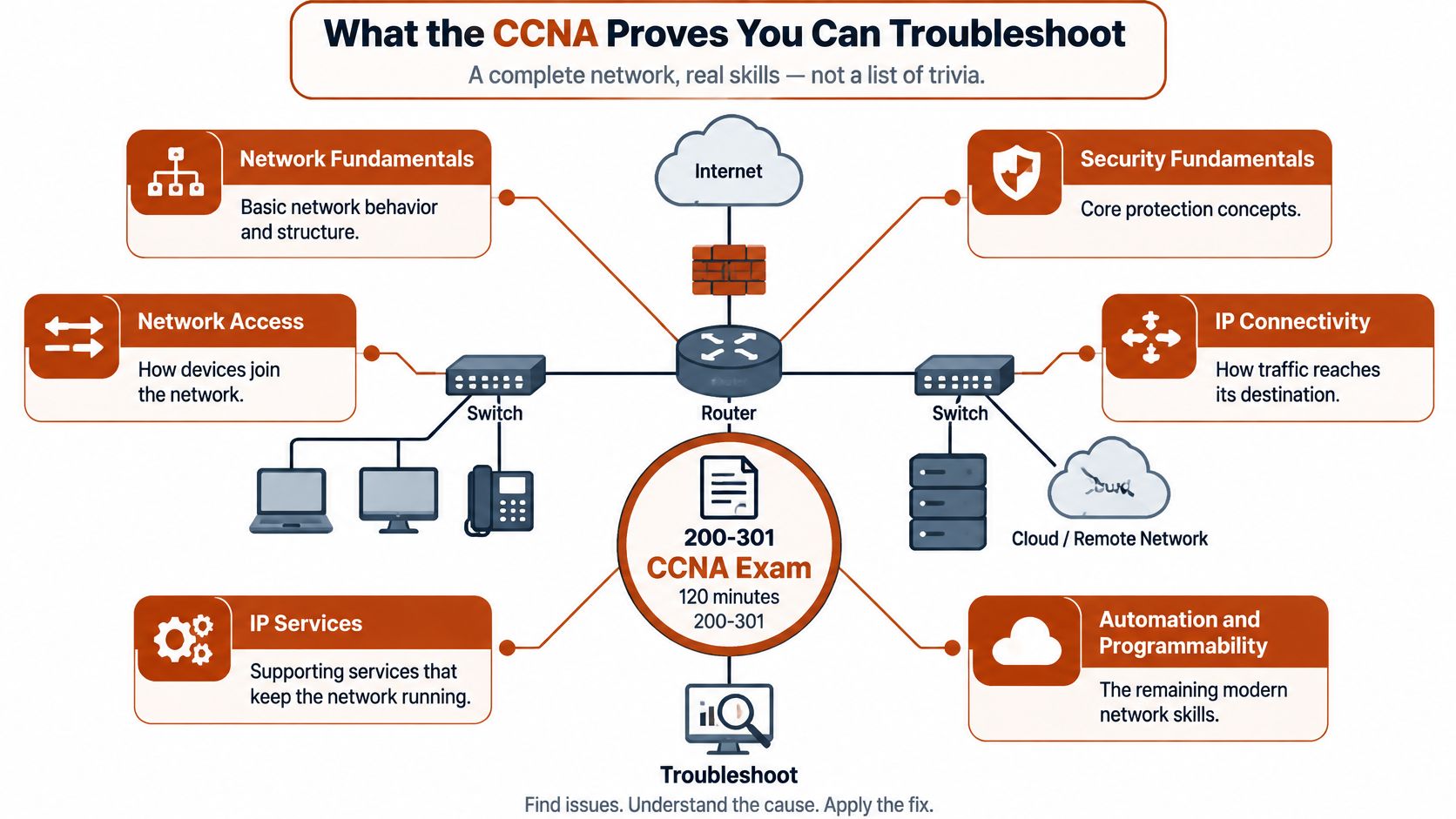
The exam is best understood as a map of a working network, not a collection of isolated commands. A service failure can begin with a device connection, cross a switching boundary, encounter a routing problem, or fail because a supporting service isn't responding.
Cisco's CCNA exam topics span network fundamentals, network access, IP connectivity, IP services, security fundamentals, and automation and programmability. The practical value comes from connecting those subjects rather than memorizing each independently.
The curriculum diagram shows how those areas fit around the same network.
Follow the failure through the building
Think of the domains as floors in a building. A user's ticket arrives at the reception desk, but the cause may sit anywhere upstairs. The technician's job is to locate the fault before changing anything.
Suppose a workstation can reach neighboring devices but can't access a service beyond its local network. Replacing a cable without checking addressing and routing would be guesswork. A structured investigation separates local connectivity from the path to the destination.
- Addressing and subnetting: Check whether the host's addressing and gateway configuration fit the intended network.
- Switching and VLANs: Establish whether ports and links place traffic in the correct segment.
- Routing: Read the routing table and determine whether an appropriate destination path exists.
- Management access: Distinguish reachability from SSH or HTTPS access and authentication through TACACS+ or RADIUS.
- Supporting services: Investigate whether the network path works but a service such as DNS is causing the apparent outage.
That reasoning is useful in network support, administration, and junior engineering because it narrows escalation. Instead of reporting that the network is broken, a technician can describe which boundary failed and what evidence supports that conclusion.
Turn knowledge into operational evidence
A passing result doesn't show how a candidate handles an uncertain fault, records a change, or confirms that a repair hasn't disrupted another service. A lab portfolio can make those behaviors visible.
A compact portfolio should contain a network diagram, routed VLAN configurations, ping and traceroute results, relevant routing-table observations, and a change log. Each exercise should include a deliberately introduced fault and a short explanation of the diagnosis.
The accompanying video can support study, but watching an explanation shouldn't replace reproducing the behavior in a lab.
The most persuasive interview artifact isn't a screenshot of a successful ping. It's a clear account of the expected behavior, the failure, the evidence collected, and the verification after repair. The certificate identifies the knowledge base; the portfolio demonstrates its use.
Why Automation Changes the CCNA Answer
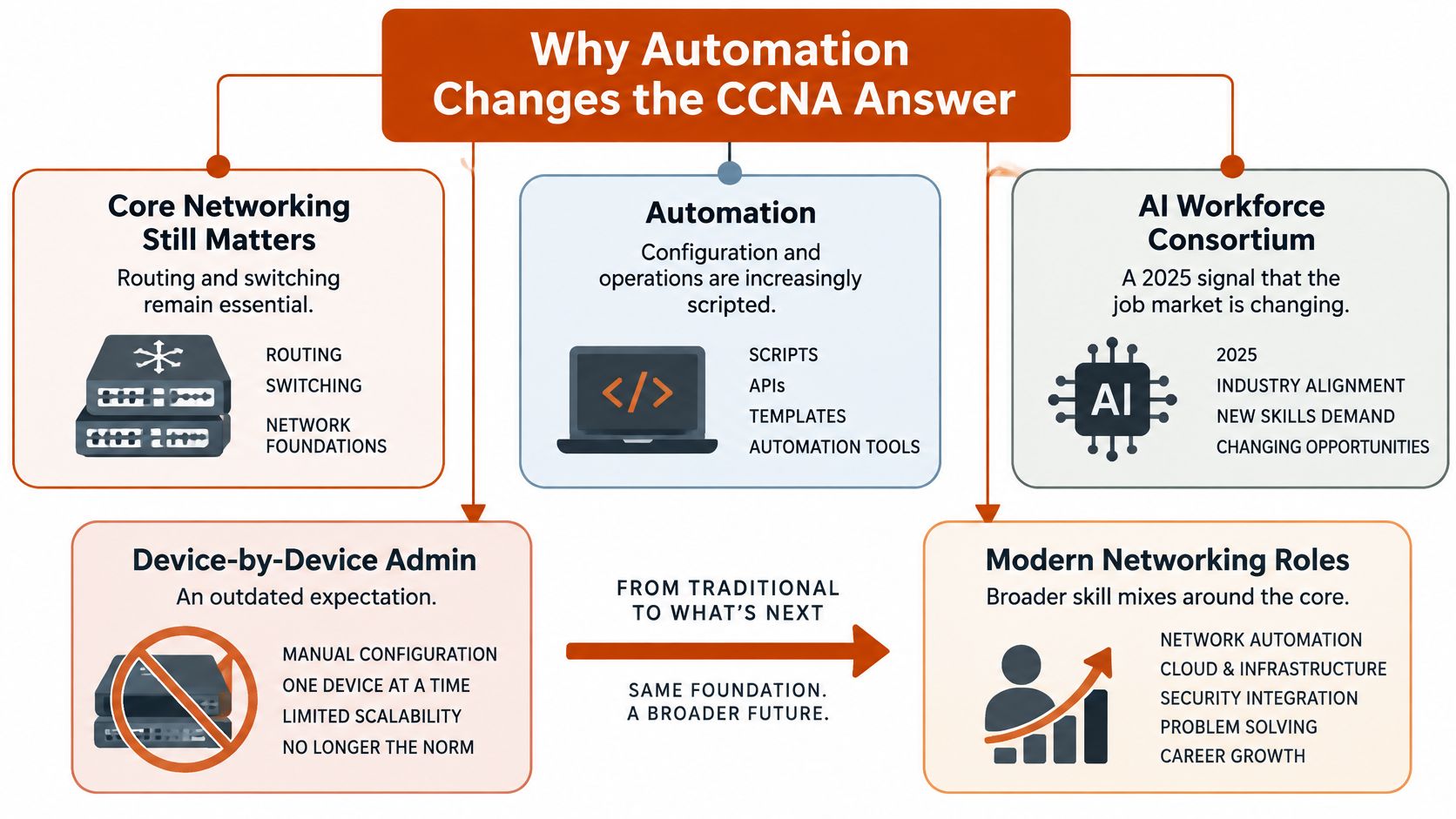
CCNA shouldn't be treated as a ticket to a career spent entering commands into individual devices. Manual configuration remains useful for understanding behavior and investigating exceptions, but it's a poor stopping point for professional development.
The 2025 AI Workforce Consortium report lists network automation, routing and switching, VPN/security, software-defined networking, troubleshooting, firewalls, and network protocols among in-demand skills; emerging skills include AI network optimization, predictive network analytics, and automated threat detection. The accompanying network-automation survey finding reports that 91.94% of surveyed network engineers across 58 countries had automation skills.
That survey describes its respondents, not every network engineer. Nevertheless, the combination is important: demand for foundational networking and demand for automation coexist. The choice isn't between learning networks and learning code.
The diagram captures that change in career expectations.
Learn to validate what gets automated
An automation tool can apply the wrong configuration consistently. A script that completes without an error doesn't establish that traffic follows the intended path or that segmentation still protects the right systems.
The durable skill is therefore understanding intended behavior and testing actual behavior. Networking knowledge helps a practitioner recognize an incorrect route, an overly broad access rule, or a service dependency that a generated configuration overlooked.
Automation reduces the value of repeated typing more readily than it reduces the value of understanding why a change is safe.
A useful extension to a CCNA lab is to retrieve device information through an API, save the results, and compare them with the expected state. The exercise connects configuration knowledge to repeatable verification rather than treating scripting as an unrelated résumé keyword.
Pair the foundation with a destination
The strongest additions depend on the work being pursued:
- Network automation: Python, APIs, and Git support repeatable changes, reviewable scripts, and version history.
- Infrastructure operations: Linux and monitoring help connect network symptoms to hosts, services, and operational evidence.
- Cloud operations: Cloud networking provides practice with route tables, private networks, access controls, and hybrid connectivity.
- Security: Firewall policy, segmentation, and traffic analysis connect packet movement with protection requirements.
Candidates don't need to master every adjacent discipline before applying. They need a coherent combination that fits a role.
At that point, the value of a manual-only CCNA strategy can collapse. The holder has paid for a foundation but stopped before developing the capabilities that make that foundation adaptable. A candidate who can explain a configuration, automate a limited task, and verify its outcome offers a substantially clearer professional proposition.
Career Ladder and the Administrator Outlook
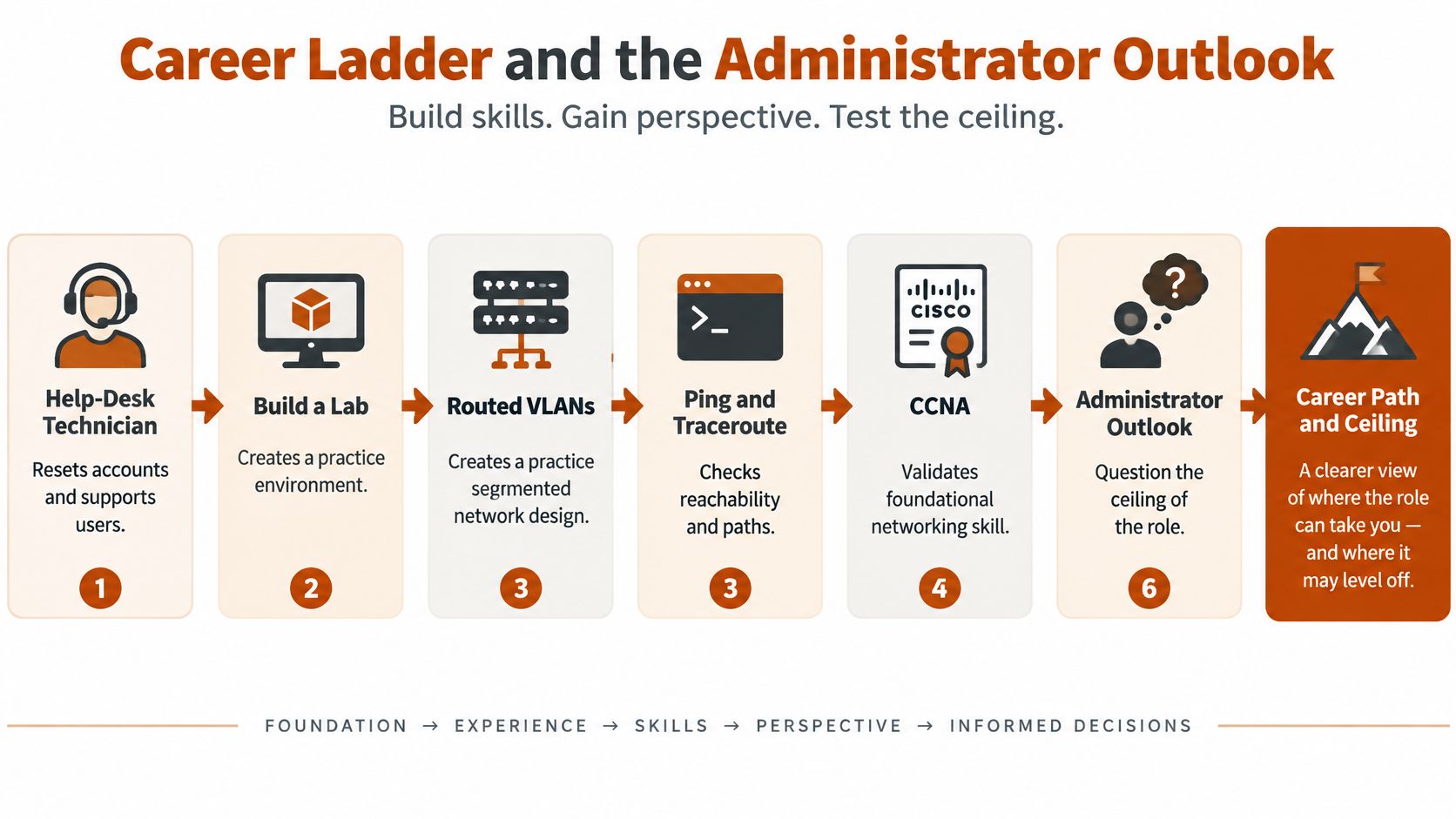
Consider a help-desk technician who handles account resets and user connectivity complaints. In a practice environment, the technician builds routed VLANs, records ping and traceroute checks, and writes change notes that another person could follow.
With CCNA added, that candidate can present a credible case for network support: existing ticket-handling experience plus evidence of deeper troubleshooting. It's a plausible move, not a guaranteed promotion, and it doesn't yet establish readiness to design an enterprise network.
The career diagram separates the entry step from the eventual destination.
Progress through responsibility, not badges
The usual path toward architecture runs from help desk or network support to administrator or engineer, then senior engineer, then architect. Almost nobody enters directly at the architect level because architecture requires judgment about systems that must keep working under constraints.
Each transition should add responsibility, not merely another exam result. A support technician isolates incidents; an administrator owns recurring operations and controlled changes; an engineer handles more complex implementation and diagnosis. Senior work adds design decisions, migration planning, and accountability for trade-offs.
Candidates comparing networking with broader infrastructure ownership can examine the systems administrator career profile. The useful distinction is the actual remit: maintaining devices, managing services, coordinating access, or owning a wider operating environment.
Certification requirements don't guarantee occupational growth
The U.S. Bureau of Labor Statistics administrator profile says employers may require certifications in the products they use and that certification validates relevant knowledge and best practices; it also projects network and computer systems administrator employment to decline 4% from 2025 to 2035.
Both facts belong in the decision. An employer can value certification while the traditional occupation contracts. A product credential helps establish suitability for particular work; it doesn't insure its holder against changes in how employers organize that work.
The projection applies to the named U.S. occupation, not every networking, cloud, or security job. It's a warning against targeting a title without examining its duties, rather than proof that networking knowledge has become unnecessary.
- For infrastructure support: Add monitoring and scripting so diagnosis extends beyond device configuration.
- For security-adjacent work: Connect identity controls, firewalls, DNS, segmentation, and traffic flow.
- For eventual architecture: Develop engineering judgment and cloud networking across the platforms relevant to prospective employers.
The practical ceiling isn't CCNA itself. It's the point at which a holder stops adding responsibility and transferable capability. The credential is most useful when it supports movement through that ceiling rather than becoming the entire career plan.
CCNA Against Other Routes
The right alternative isn't necessarily a more prestigious certificate. It's the route that closes the gap between the candidate's current evidence and the work an employer needs performed.
CCNA is a direct fit when a posting names Cisco networking and expects hands-on routing or switching knowledge. When the advertised outcomes are different, candidates should compare the relevant curriculum rather than assume that networking depth always deserves priority.
Choose by the work described
| Route | Best reason to consider it | Decision boundary |
|---|---|---|
| CompTIA Network+ | An introductory, vendor-neutral networking foundation | Useful when conceptual grounding is the immediate gap rather than Cisco configuration |
| CCNA | Enterprise networking fundamentals with Cisco relevance | Strongest when the posting names Cisco or related hands-on duties |
| CCNP | Deeper professional networking study after foundational competence | A later development step, not a shortcut around practical fundamentals |
| Cloud associate certification | A role organized around a named cloud platform | Prioritize the platform and services actually used in the target job |
| Security certification | Defensive responsibilities and security-specific knowledge | Networking supports the work but doesn't replace security preparation |
A cloud candidate evaluating AWS Certified Solutions Architect – Associate should compare the role's design and platform requirements with the candidate's existing experience. The relevant question isn't whether AWS outranks Cisco. It's whether the employer needs cloud architecture knowledge, enterprise network administration, or both.
Similarly, a security candidate may need to understand packet flow without spending the next preparation cycle focused on device administration. Firewall investigation, identity controls, and incident analysis can require a different balance of study.
Avoid buying the same evidence twice
Existing competence changes the comparison. A candidate with strong networking experience may gain more from a cloud project than another foundational credential. A beginner who can't explain subnetting may need structured fundamentals before attempting either advanced networking or cloud design.
Selection test: A proposed credential should answer a requirement in a target posting or address a weakness exposed by a practical task.
Certificate stacking without that test can produce an expensive but unfocused profile. Course completion, renewal obligations, and exam preparation all consume resources. The strongest route produces evidence of the intended work, whether that evidence comes from a certification, a project, employment, or a deliberate combination.
Book the Exam or Spend the Months Elsewhere
The decision should produce a concrete next action, not another open-ended study list. Candidates can use the following paths in order, choosing the first that matches their situation.
Choose the commitment that fits the evidence gap
Existing enterprise-network practitioners should defer the exam unless a specific requirement justifies it. When employment already demonstrates configuration and troubleshooting competence, preparation time can go toward automation, cloud networking, or security. A documented improvement to an operational workflow may supply stronger new evidence than an overlapping credential.
Candidates without that experience should pursue CCNA when target postings explicitly request it or hands-on Cisco networking. Preparation should include a lab that the candidate can explain without scripted answers. Booking makes sense after practical exercises reveal reliable understanding, not merely after finishing a video course.
Everyone else should hold the purchase and clarify the destination. For an eventual architect, CCNA can be an early milestone only if the next realistic role requires its skills. Otherwise, the immediate investment should match the next attainable position, with engineering experience and relevant cloud networking planned beyond it.
Put a use-by plan beside the study plan
Certification should trigger applications, increasingly demanding projects, and opportunities to perform the work. A holder who stops at the badge postpones the very activities that could justify earning it.
Before paying for a course, the candidate should compare the exam commitment with the intended job transition. Mojolin's certification comparisons consolidate exam prices, lengths, and renewal rules, with those details checked against issuing vendors' official pages. The comparison is useful only when paired with current job descriptions and an honest inventory of existing skills.
CCNA is worth it when it changes the candidate's next credible step. When it doesn't, spending the preparation months elsewhere is a deliberate career decision, not a failure to invest in development.
Mojolin offers technology career profiles, compensation comparisons, and certification guides that help distinguish a useful credential from an unnecessary purchase. Candidates weighing CCNA can visit the publication to compare certification commitments and career requirements before choosing a course or booking an exam.